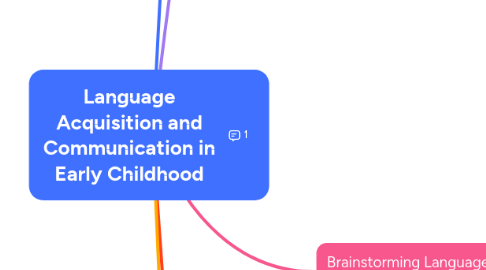
Language Acquisition and Communication in Early Childhoodсоздатель Mustard Wrintings
1. Brainstorming First and Second Language Acquisition
1.1. Babies acquire language through exposure to spoken language from caregivers and their environment
1.2. They begin by recognizing and imitating sounds, then progress to forming words and sentences
1.3. Language acquisition is influenced by cognitive development and social interactions
1.4. Language is not only a means of communication but also a social tool for connecting with others
1.5. It facilitates social interactions, understanding cultural norms, and expressing emotions and thoughts
1.6. Language acquisition involves learning the social and cultural aspects of language use
1.7. Theories such as behaviorism, nativism, and interactionism explain different aspects of language acquisition
1.8. Behaviorism emphasizes environmental stimuli and reinforcement in shaping language skills
1.9. Nativism proposes that language acquisition is innate and guided by universal grammar
1.10. Interactionism highlights the importance of both biological factors and social interactions in language development
2. The Arts as Communication
2.1. The arts encompass various creative expressions, such as visual arts, music, dance, and drama
2.2. In early childhood, arts serve as a powerful medium for communication, self-expression, and storytelling
2.3. Artistic activities allow children to communicate their thoughts, emotions, and experiences in non-verbal ways
2.4. Visual arts, such as drawing and painting, help children develop fine motor skills and express their ideas visually
2.5. Music promotes language development through rhythm, melody, and song lyrics
2.6. Dance and movement activities enhance body awareness and facilitate the expression of emotions and narratives
2.7. Engaging in artistic activities encourages language acquisition by promoting vocabulary development, narrative skills, and imaginative thinking
2.8. The arts provide opportunities for children to collaborate, negotiate, and express their ideas within a social context
2.9. Through arts-based communication, children learn to interpret and respond to visual, auditory, and sensory stimuli, enhancing their overall communication skills
3. Brainstorming Language Diversity and Multilingualism
3.1. Language diversity refers to the existence of multiple languages within a community or society
3.2. Exposure to diverse languages in early childhood enriches cultural understanding and promotes cognitive development
3.3. They highlight the cultural, historical, and social context of language use within Indigenous communities
3.4. Australia is home to a wide range of languages, including Aboriginal languages with rich cultural significance
3.5. Understanding the languages of Australia, including Aboriginal languages, promotes inclusivity and cultural appreciation
3.6. It recognizes the linguistic diversity within the country and supports the preservation of Indigenous languages
3.7. Inclusion of First Nations perspectives fosters respect, cultural competence, and a holistic understanding of language acquisition
3.8. First Nations perspectives bring unique insights into language acquisition and communication in early childhood
3.9. Children benefit from exposure to different linguistic structures and communication styles
3.10. Multilingualism refers to the ability to speak multiple languages
3.11. Research suggests that multilingualism enhances cognitive skills, such as problem-solving and creativity
3.12. Multilingual individuals have broader cultural perspectives and can engage in effective communication across different communities
4. Communication Through Various Modes
4.1. Signed languages, such as American Sign Language (ASL), are visual-gestural systems used by deaf communities
4.2. The concept of the "100 languages of children" refers to the various ways children express themselves, including through art, play, movement, and storytelling
4.3. Visual communication promotes creativity, imagination, and memory retention in early childhood The concept of the "100 languages of children" refers to the various ways children express themselves, including through art, play, movement, and storytelling
4.4. Recognizing and valuing these diverse modes of expression fosters holistic development and language acquisition
4.5. Supporting and encouraging children to express themselves in their preferred languages promotes their individuality and self-esteem
4.6. Signed languages play a crucial role in facilitating communication and language acquisition for individuals who are deaf or hard of hearing
4.7. Understanding signed languages broadens the scope of inclusive communication in early childhood settings
4.8. Non-verbal communication includes facial expressions, body language, gestures, and eye contact
4.9. Non-verbal cues enhance communication by conveying emotions, intentions, and emphasis
4.10. In early childhood, non-verbal communication supports language development and helps children understand social cues
4.11. Visual communication involves the use of images, pictures, and visual aids to convey information Visual stimuli engage children's visual senses and support language learning and comprehension
5. Introduction
5.1. Create a mind map to communicate ideas about language acquisition and communication in early childhood Include consideration of First Nations Perspectives and references to academic sources from the unit and research
5.2. Early childhood is a critical period for language acquisition and communication development
5.3. Understanding this process can inform teaching practices and support effective communication with children from diverse backgrounds.