


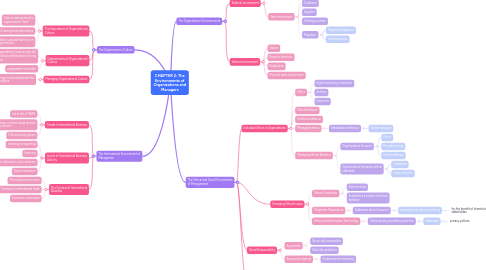
1. The Organization’s Environments
1.1. External environment
1.1.1. General environment
1.1.1.1. Economic dimension
1.1.1.2. Technological dimension
1.1.1.3. Political-legal dimension
1.1.2. Task environment
1.1.2.1. Competitor
1.1.2.2. Customer
1.1.2.3. Supplier
1.1.2.4. Strategic partner
1.1.2.5. Regulator
1.1.2.5.1. Regulatory agencies
1.1.2.5.2. Interest groups
1.2. Internal environment
1.2.1. Owner
1.2.2. Board of directors
1.2.3. Employees
1.2.4. Physical work environment
2. The Ethical and Social Environment of Management
2.1. Managing Social Responsibility
2.1.1. Organizational Dimensions
2.1.1.1. Formal
2.1.1.1.1. Legal compliance
2.1.1.1.2. Ethical ompliance
2.1.1.2. Informal
2.1.1.2.1. Whistle-blowing
2.2. Individual Ethics in Organizations
2.2.1. Ethics
2.2.1.1. Right and wrong in behavior
2.2.1.2. Actions
2.2.1.3. Decisions
2.2.2. Ethical behavior
2.2.3. Unethical behavior
2.2.4. Managerial ethics
2.2.4.1. Standards of behavior
2.2.4.1.1. Guide managers
2.2.5. Managing Ethical Behavior
2.2.5.1. Organizations focus on
2.2.5.1.1. Ethics
2.2.5.1.2. Provide training
2.2.5.1.3. Face challenges
2.2.5.2. Organizations formalize ethical standards
2.2.5.2.1. Guidelines
2.2.5.2.2. codes of ethics
2.3. Social Responsibility
2.3.1. Arguments
2.3.1.1. Be socially responsible
2.3.1.2. Solve the problems
2.3.2. Arguments Against
2.3.2.1. Undermine the economy
2.4. Emerging Ethical Issues
2.4.1. Ethical Leadership
2.4.1.1. Sets the tone
2.4.1.2. Establishes a culture of ethical behavior
2.4.2. Corporate Governance
2.4.2.1. Addresses ethical issues in
2.4.2.1.1. managing and decision-making
2.4.3. Ethics and Information Technology
2.4.3.1. Online privacy and data protection
2.4.3.1.1. addressed
3. The International Environment of Managemen
3.1. Trends in International Business
3.1.1. set at the of WWII
3.1.2. Warrning countries must recover their economi
3.1.3. USA economy grown
3.2. Levels of International Business Activity
3.2.1. inporting or exporting
3.2.2. licensing
3.2.3. strategic alliances or joint ventures
3.2.4. Direct invesment
3.3. The Context of International Business
3.3.1. The cultural enviroment
3.3.2. Controls on international trade
3.3.3. Economic comunities
4. The Organization’s Culture
4.1. The Importance of Organizational Culture
4.1.1. Culture determines the organization’s “feel.”
4.1.2. A strong and clear culture
4.1.3. Culture is a powerful force in organizations
4.2. Determinants of Organizational Culture
4.2.1. organization’s culture typically develops and blossoms in long time
4.2.2. organization’s founder.
4.3. Managing Organizational Culture
4.3.1. The manager must understand the current culture