


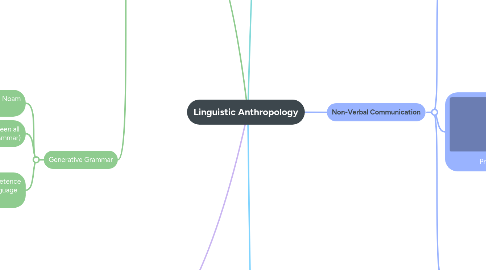
1. Non-Verbal Communication
1.1. Kinesics
1.1.1. Study of body motions used in communication
1.1.2. Body Language
1.1.2.1. Shrugging
1.1.2.2. Winking
1.1.2.3. Pointing
1.1.3. Kineme
1.1.3.1. Smallest unity of body movement
1.1.3.1.1. Facial expressions
1.1.3.1.2. Eye contact
1.1.3.1.3. Body posture
1.1.3.1.4. Hand gestures
1.2. Proxemics
1.2.1. Developed by Edward T. Hall
1.2.2. 1960's
1.2.3. "Personal space bubble"
1.2.4. Haptic behavior
1.2.4.1. Sense of touch
1.2.4.2. Differs by culture
1.2.5. Study or cultural pattern in how individuals manage personal space during interactions
1.3. Sign Language
1.3.1. system of hand gestures used as an alternative to speech.
1.3.2. Primary Sign Language
1.3.2.1. Used to the exclusion of spoken language (born deaf)
1.3.3. Alternative Sign Language
1.3.3.1. Used by speaker-hearers as a substitute for speech occasionally
1.3.4. Thomas Gallaudet
1.3.4.1. School for Deaf in 1830's
1.3.4.2. French teacher taugh sign
1.3.4.2.1. Later developed into ASL
1.3.4.2.2. Spread to other Deaf schools
1.3.5. William C. Stakoe
1.3.5.1. Linguist who Studied Sign in 1950's and 1960's
1.3.5.2. 1st scholar to call ASL a legitimate Language
2. Three Trends
2.1. Americanist Anthropological Linguistics
2.1.1. 1900-1960
2.1.2. Initially proposed by Franz Boas
2.1.3. Sapir-Whorf hypothesis
2.1.3.1. "Languages provide their native speakers with a set of hard-to-question dispositions that have an impact on their interpretation of reality, and consequently, on their behavior” (Duranti 2003:326)
2.2. Linguistic Anthropology and Sociolinguistics
2.2.1. 1960s and 1970s
2.2.2. Alternative to Chomsky’s
2.2.3. Language became a way to express social phenomena and social relationships.
2.2.4. Language is studied within a social context and beyond study of grammar
2.2.5. Examine and describe the patterns of the spoken “speech activity” in the “speech community.”
2.3. Social Constructivism
2.3.1. Guides current research
2.3.2. More focused on role language plays in constituting social encounters.
2.3.3. Micro-macro connection
2.3.3.1. "Connection between larger institutional structures and processes and the ‘textual’ details of everyday encounters" (Duranti 2003)
3. Part of the Four-Field Approach
3.1. Definition: the use of four interrelated disciplines to study humanity
3.2. Physical Anthropology
3.2.1. Definition: The study of human biological evolution, primates, and human bio cultural variation, both past and current.
3.2.2. Human Genetic Variation
3.2.3. Paleoanthropology
3.2.4. Primatology
3.3. Archeology
3.3.1. Definition: The investigation of the human past by means of excavating and analyzing artifacts.
3.3.2. Prehistoric archeology
3.3.3. Historic archeology
3.3.4. Garbology
3.4. Cultural Anthropology
4. Definition: Study of language in its biological and sociocultural contexts
4.1. Language is an integral part of daily life
4.2. Language conveys
4.2.1. Thoughts
4.2.2. Feelings
4.2.3. Intentions
4.2.4. Desires
4.3. Critical questions when studying language
4.3.1. How can language and culture be adequately described?
4.3.2. How are languages acquired?
4.3.3. What is the relationship between language and thought? Etc.
4.4. Sociocultural
4.4.1. interconnection between society and culture
4.4.2. Ex. cave-wall paintings of the Upper Paleolithic Cro- Magnons
5. Linguistics
5.1. Definition: Scientific Study of language
5.2. Structuralist Paradigm
5.2.1. Dominated the first half of the twentieth century until the 1960s.
5.2.2. Interested in scientifically and objectively analyzing and describing the world’s languages.
5.2.3. Found rules and patterns that governed language.
5.2.3.1. Phonology
5.2.3.1.1. Language’s sound system
5.2.3.1.2. Phones
5.2.3.1.3. Phonemes
5.2.3.1.4. Allophone
5.2.3.2. Morphology
5.2.3.2.1. The Study of word structure
5.2.3.2.2. Morphemes
5.2.3.3. Syntax
5.2.3.3.1. Grammar
5.2.3.4. Lexicon
5.2.3.4.1. Vocabulary
5.2.3.5. Semantic
5.2.3.5.1. Structure of meaning
5.3. Generative Grammar
5.3.1. Developed 1950s by Noam Chomsky
5.3.2. Finding similarities between all languages (Universal grammar)
5.3.3. Every speaker has competence in all aspects of how language works
5.3.3.1. I-Language – internalized knowledge
5.3.3.2. E-language – speech produced by speakers under external conditions
5.3.3.3. Plato’s problem – we seem to know more than we are explicitly taught