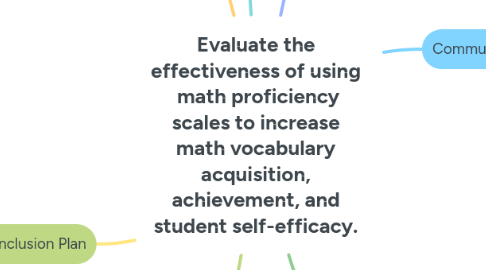
Evaluate the effectiveness of using math proficiency scales to increase math vocabulary acquisition, achievement, and student self-efficacy.создатель Olivia Cushing
1. Communication Plan
1.1. Teachers: Teachers will particiapte in vertical planning meetings to share and evaluate proficiency scales.
1.2. Students: Teachers will have student-led conferences using the student-friendly proficiency scales.
1.3. Families: Parents receive "Parent Letters" that go along with each topic in math. The student-friendly proficiency scales will be included in this parent letter.
1.4. Community Members: Student-friendly proficiency scales will be posted on the school website, along with at-home resources that align with the standards-based proficiency scales.
2. Feeder Schools Inclusion Plan
2.1. Curriculum: Teachers will continue to use Envisions math to provide math instruction. Teachers will receive grade-level student-friendly proficiency scales.
2.2. Instruction: Teachers will continue to use the Envisions curriculum for core math instruction. Teachers will use student-friendly proficiency scales to provide data for tier 2 instruction.
2.3. Assessment: Teachers will use pre-assessments and post-assessments to collect data on student growth throughout each math topic and acquisition of math vocabulary.
3. Data & Stakeholders
3.1. Exact Path: Teachers will monitor student growth through Exact Path.
3.2. Teachers will assess students' growth through pre-tasks and end-of-topic tasks.
3.3. Teachers will monitor student self-efficacy through pre-assessments and post-assessments.
4. Professional Development
4.1. AMSTI Training: Proficiency Scales
4.2. Meeting with building-based math coaches and the district math coach in PLCs.
4.3. Vertical planning to connect foundational skills/pre-requisite skills in prior grade levels to standards in grades 3-5.
5. Communication Plan
5.1. STEAM Math and Reading Night: Families who attend will receive training on how to use the proficiency scales. Students will receive math vocabulary resources to use at home.
5.2. Toolkits: All students will receive a math and reading toolkit with resources aligned to state standards.
5.3. Student-led Parent/Teacher Conferences
6. Budget Needs
6.1. Cost of AMSTI training: $0
6.2. Cost of sub per teacher: $175.13 or stipend pay for summer trainings
6.3. Cost of materials: "A Handbook for Developing & Using Proficiency Scales in the Classroom"- $30.92
7. Collaboration Plan
7.1. Vertical planning meetings between grades K/1 and 2/3.
7.2. Vertical planning meetings with grades 3-5
7.3. All grade-levels will receive AMSTI proficiency scales and student-friendly proficiency scales aligned to the grade-level standards.
7.4. Faculty meetings and grade-level meetings
7.5. Instructional Rounds: Teachers will participate in instructional rounds to observe teachers using student-friendly proficiency scales.