


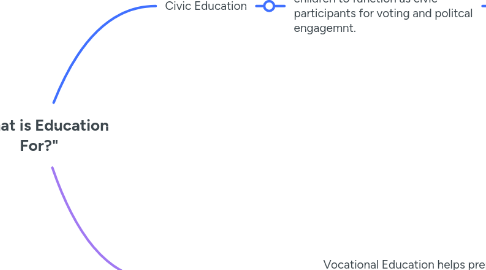
1. Civic Education
1.1. Civic Education helps prepare children to function as civic participants for voting and politcal engagemnt.
1.1.1. Studies show that more of humanities majors have participated in poltical engagment more than STEM majors.
1.1.1.1. Civic education helps support everyone not just you.
1.1.1.1.1. Civic education will be helpful for the world and inequalities that are faced.
1.1.2. "Data from the Department of Education reveal that, among 2008 college graduates, 92.8 percent of humanities majors have voted at least once since finishing school. Among STEM majors, that number is 83.5 percent. And, within ten years of graduation, 44.1 percent of 1993 humanities graduates had written to public officials,compared to 30.1 percent of STEM majors" (Allen 13).
1.1.2.1. " What is more, defending the right to civic education, and the kind of curriculum that delivers it, would benefit not only individual students but also society as a whole, advancing both political equality and distributive justice" (Allen 13).
1.1.2.1.1. "An education that prepares every student for civic and political engagement not only supports political equality but may also lead to increased economic fairness"(Allen 11).
2. Vocational Education
2.1. Vocational Education helps prepare children to grow economically with well stable careers.
2.1.1. Although civic education is very important,vocational education has really helped families and low-income households.
2.1.1.1. STEM education was increased.
2.1.1.1.1. Vocational education helps children live a successful life.
2.1.2. "It is not that civic education is incompatible with professional training, but policymakers, education specialists, and many parents—including low-income parents, whose children are most likely to see their civic education shortchanged—have narrowed their focus exclusively to the economic field"(Allen 10).
2.1.2.1. "The result has been massively increased investment in science, technology, engineering, and mathematics education—STEM—and correspondingly reduced outlays for the humanities"(Allen 9)
2.1.2.1.1. "The dominant policy paradigm attends almost exclusively to education’s vocational purpose: the goal is to ensure that young people, and society generally, can compete in a global economy"(Allen 9).