


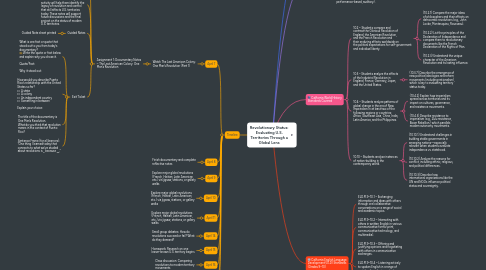
1. Timeline
1.1. April 7
1.1.1. Watch The Last American Colony: One Man’s Revolution (Part 1)
1.1.1.1. Assignment 1: Documentary Notes – The Last American Colony: One Man’s Revolution
1.1.1.1.1. Due: April 10
1.1.1.1.2. Objective: Students will analyze key themes of colonialism, resistance, and national identity by engaging with the documentary "The Last American Colony." This activity will help them identify the legacy of revolution and control that still affects U.S. territories today. These notes will support future discussions and the final project on the status of modern U.S. territories.
1.1.1.1.3. Guided Notes
1.1.1.1.4. Exit Ticket
1.2. April 8
1.2.1. Finish documentary and complete reflective notes
1.3. April 9
1.3.1. Explore major global revolutions (French, Haitian, Latin American, etc.) via jigsaw, stations, or gallery walks
1.4. April 10
1.4.1. Explore major global revolutions (French, Haitian, Latin American, etc.) via jigsaw, stations, or gallery walks
1.5. April 11
1.5.1. Explore major global revolutions (French, Haitian, Latin American, etc.) via jigsaw, stations, or gallery walks
1.6. April 14
1.6.1. Small group debates: How do revolutions succeed or fail? What do they demand?
1.7. April 15
1.7.1. Homework: Research on one lesser-known U.S. territory begins
1.8. April 16
1.8.1. Class discussion: Comparing revolutions to modern territory movements
1.9. April 17
1.9.1. Project Workshop Day: Planning + conference with teacher
1.10. April 18
1.10.1. Final Project Due + Presentations Begin
2. Essential Question: Should this territory remain as-is, fight for independence, or become a U.S. state?
3. Students will:
3.1. Connect revolution movements from world history to modern-day U.S. territories.
3.2. Use research and evidence to form arguments.
3.3. Choose a presentation format from an assessment menu that fits their learning style (visual, written, performance-based, auditory).
4. 📘 California World History Standards Covered
4.1. 10.2 – Students compare and contrast the Glorious Revolution of England, the American Revolution, and the French Revolution and their enduring effects worldwide on the political expectations for self-government and individual liberty.
4.1.1. (10.2.1) Compare the major ideas of philosophers and their effects on democratic revolutions (e.g., John Locke, Montesquieu, Rousseau).
4.1.2. (10.2.2) List the principles of the Declaration of Independence and compare them to revolutionary documents like the French Declaration of the Rights of Man.
4.1.3. (10.2.3) Understand the unique character of the American Revolution and its lasting influence.
4.2. 10.3 – Students analyze the effects of the Industrial Revolution in England, France, Germany, Japan, and the United States.
4.2.1. (10.3.7) Describe the emergence of new political ideologies and reform movements (including nationalism), which is key to evaluating territory status today.
4.3. 10.4 – Students analyze patterns of global change in the era of New Imperialism in at least two of the following regions or countries: Africa, Southeast Asia, China, India, Latin America, and the Philippines.
4.3.1. (10.4.2) Explain how imperialism spread across territories and its impact on cultures, governance, and resistance movements.
4.3.2. (10.4.3) Describe resistance to imperialism (e.g., Zulu resistance, Boxer Rebellion), which parallels modern autonomy movements.
4.4. 10.10 – Students analyze instances of nation-building in the contemporary world.
4.4.1. (10.10.1) Understand challenges in building stable governments in emerging nations—especially relevant when students evaluate independence vs. statehood.
4.4.2. (10.10.2) Analyze the reasons for conflict, including ethnic, religious, and political differences.
4.4.3. (10.10.3) Describe how international organizations like the UN and NGOs influence political status and sovereignty.