


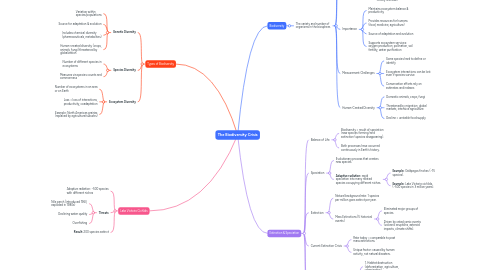
1. Biodiversity
1.1. The variety and number of organisms in the biosphere.
1.1.1. **Levels of Measurement**
1.1.1.1. Species diversity (number and commonness of species)
1.1.1.2. Genetic diversity (variation within and among species)
1.1.1.3. Ecosystem diversity (variety of ecosystems)
1.1.2. Current Estimates
1.1.2.1. 8.7 million eukaryotic species on Earth
1.1.2.2. Only 1.5 million named and studied
1.1.2.3. Prokaryotes: numbers far greater, mostly unknown
1.1.3. Importance
1.1.3.1. Maintains ecosystem balance & productivity
1.1.3.2. Provides resources for humans (food, medicine, agriculture)
1.1.3.3. Source of adaptation and evolution
1.1.3.4. Supports ecosystem services: oxygen production, pollination, soil fertility, water purification
1.1.4. Measurement Challenges
1.1.4.1. Some species hard to define or identify
1.1.4.2. Ecosystem interactions can be lost even if species survive
1.1.4.3. Conservation efforts rely on estimates and indexes
1.1.5. Human-Created Diversity
1.1.5.1. Domestic animals, crops, fungi
1.1.5.2. Threatened by migration, global markets, intensive agriculture
1.1.5.3. Decline = unstable food supply
2. Extinction & Speciation
2.1. Balance of Life
2.1.1. Biodiversity = result of speciation (new species forming) and extinction (species disappearing).
2.1.2. Both processes have occurred continuously in Earth’s history.
2.2. Speciation
2.2.1. Evolutionary process that creates new species.
2.2.2. **Adaptive radiation:** rapid speciation into many related species occupying different niches.
2.2.2.1. **Example:** Galápagos finches (~15 species).
2.2.2.2. **Example:** Lake Victoria cichlids (~500 species in 3 million years).
2.3. Extinction
2.3.1. Natural background rate: 1 species per million goes extinct per year.
2.3.2. Mass Extinctions (5 historical events)
2.3.2.1. Eliminated major groups of species.
2.3.2.2. Driven by cataclysmic events (volcanic eruptions, asteroid impacts, climate shifts).
2.4. Current Extinction Crisis
2.4.1. Rate today = comparable to past mass extinctions.
2.4.2. Unique factor: caused by human activity, not natural disasters.
2.5. Main Human Drivers of Extinction
2.5.1. 1. Habitat destruction (deforestation, agriculture, urbanization).
2.5.2. 2. Introduction of exotic species (competition, predation, diseases).
2.5.3. 3. Overharvesting (overfishing, poaching, unsustainable hunting/collection).
2.6. Predictions for the Future
2.6.1. Within the next century, 10–50% of species may go extinct.
2.6.2. Scale of extinction only seen 5 times in Earth’s history.
2.6.3. Losses could change the course of life on Earth.
3. Types of Biodiversity
3.1. **Genetic Diversity**
3.1.1. Variation within species/populations
3.1.2. Source for adaptation & evolution
3.1.3. Includes chemical diversity (pharmaceuticals, metabolites)
3.1.4. Human-created diversity (crops, animals, fungi) threatened by globalization
3.2. **Species Diversity**
3.2.1. Number of different species in ecosystems
3.2.2. Measures via species counts and commonness
3.3. **Ecosystem Diversity**
3.3.1. Number of ecosystems in an area or on Earth
3.3.2. Loss = loss of interactions, productivity, coadaptation
3.3.3. Example: North American prairies (replaced by agriculture/suburbs)
4. Lake Victoria Cichlids
4.1. Adaptive radiation: ~500 species with different niches
4.2. **Threats**
4.2.1. Nile perch (introduced 1963, exploded in 1980s)
4.2.2. Declining water quality
4.2.3. Overfishing