

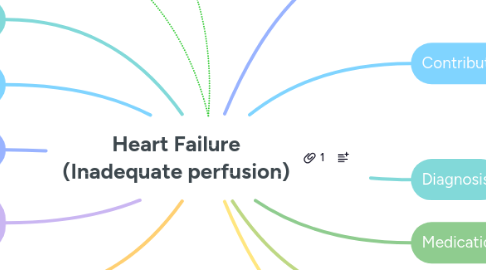
1. Pathophysiologic mechanisms
1.1. Compensatory mechanism decreased Cardiac Output
1.1.1. Decreased cardiac output (CO)
1.1.1.1. Compensation to CO
1.1.1.1.1. Activation of sympathetic NS
1.1.1.1.2. Activation of Renin-anginotensin-aldosterone system
1.1.1.1.3. Increased Antidiuretic horomone release
1.1.1.1.4. Increase Atrial natriuretic peptide/brain natriuretic peptide (BNP) release
1.1.2. Decreased perfusion
1.1.3. Decreased stroke volume (SV)
1.1.3.1. Compensation to increase SV
1.1.3.1.1. Increase cardiac output
1.1.3.1.2. Increase Afterload and Preload
1.1.3.1.3. Prevent the development of symptoms
1.1.3.1.4. Cardiac remodeling (Hypertrophy)
1.1.4. Increases pulmonary vessel pressures
1.2. Neurohormonal mechanisms
1.2.1. Increase Heart rate
1.2.2. Arterial and venous (vasoconstriction) maintain BP
1.2.3. Increase Blood volume; Increase ventricular filling
1.3. Frank-Starling mechanism
1.3.1. Increased venous return
1.3.2. Greater ventricular filling
1.3.3. Increased stroke volume
2. Classification of Heart Failure
2.1. Stage A= At risk for heart failure w/o any symptoms or structural heart disease
2.2. Stage B= Patients have structural heart disease but do not exhibit symptoms of heart failure
2.3. Stage C= Patients with structural heart disease who currently experience or have previously experienced symptoms of heart failure
2.4. Stage D= Patients with advanced heart failure who exhibit severe symptoms and are often hospitalized despite optimal medical therapy.
2.5. New York Heart Association Functional
2.5.1. Class I= No limitation of physical activity
2.5.2. Class II= Slight limitation of physical activity
2.5.3. Class III= Marked limitation of physical activity
2.5.4. Class IV= Severe limitation
2.6. Ejection fraction
2.6.1. Preseved Ejection Fraction (HFpEF)
2.6.1.1. Inadequate relaxtion and filling
2.6.1.2. normal myocyte contractility
2.6.1.3. Perseved EF despite low SV
2.6.1.4. LVEF> or equal to 50%
2.6.2. Midrange Ejection Fraction (HFmrEF)
2.6.2.1. Known in Europe as HF with mildly reduced EF
2.6.2.2. LVEF between 41% and 49%
2.6.3. Reduced Ejection Fraction (HFrEF)
2.6.3.1. Ischemic heart disease
2.6.3.2. dilated cardiomyopathy
2.6.3.3. Mitral insufficiency
2.6.3.4. EF is dimminished
2.6.4. HF with improved EF (HFiEF)
2.6.4.1. LVEF was previously < equal to 40%, but on follow up assessment is betteEF (>40 %)
2.7. Areas affected
2.7.1. Left sided HF anormalities
2.7.1.1. Left ventricle
2.7.1.2. aortic valve
2.7.1.3. mitral valve
2.7.2. Right sided HF abnormalities
2.7.2.1. Right ventricle
2.7.2.2. tricuspid valve
2.7.2.3. pulmonic valve
2.7.3. Left and Right occuring at the same time
2.7.3.1. Biventricular
3. Risk factors (objective)
3.1. Metabolic Syndrome
3.2. Obesity
3.3. Sedentary lifestyle
3.4. Hereditary risk for HF
3.4.1. Family History of cardiomyopathy
3.5. Coronary artery disease
3.6. Diabetes mellitus
3.7. Hypertension
4. Diagnostic tests
4.1. Echocardiography
4.2. Electrocardiography (ECG)
4.2.1. Evaluates for evidence of current ischemia
4.2.2. Detects abnormalities in cardiac rhythm and conduction
4.2.3. Show evidence of cardiomyopathy or prior MI
4.2.3.1. Increased QRS voltage in leads 1 and aVL
4.2.3.2. Q waves
4.2.3.3. St- and T-wave abnormalities
4.3. Transthoracic echocardiography (TTE) with Doppler imaging
4.3.1. Measures ejection fraction and assesses cardiac anatomy
4.3.2. Detects abnormalities in valves, myocardium, and pericardium
4.4. Cardiac magnetic resonance imaging (CMR)
4.4.1. Detects damaged myocardium
4.4.2. Fibrosis
4.4.3. Detects Myocardium infarction (acute and chronic)
4.4.4. Detects infiltrated and inflammatory disease
4.5. Multigated acquistion scan (radionuclide ventriculography)
4.5.1. Most accurate way to assess ejection fraction
4.5.2. Obtain baseline assessment of ventricular function
4.5.3. Monitor cardiotoxicity of anthracyclines (chemotherapy)
4.6. Cardiopulmonary exercise testing (CPET)
4.6.1. Detect ischemic heart disease
4.6.2. Assess appropriatness of advanced treatment such as transplantation
4.6.3. Assess maximal oxygen uptake (VO2) to estimate the severity of myocardial dysfunction
4.7. Chest X-ray
4.7.1. ABCDE finidings on CXR
4.7.1.1. A: alveolar edema (batwing)
4.7.1.2. B: Kerley B lines
4.7.1.3. C: Cardiomegaly
4.7.1.4. D: dilated upper lobe vessels
4.7.1.5. E: pleural effusion
4.7.2. Pulmonary edema
4.7.3. Pulmonary vascular congestion
4.7.4. Cephalization of vessels
4.8. Cardiac catheterization
4.9. Laboratory test evaluation
4.9.1. Cardiac markers
4.9.1.1. BNP/N- terminal pro BNP (NT-proBNP) levels
4.9.1.1.1. BNP >400 pg/mL
4.9.1.1.2. Pro-BNP
4.9.1.1.3. Variation in subpopulation
4.9.1.1.4. Noncardiac elevated levels
4.9.1.2. Troponin
4.9.1.2.1. Determined presence of acute coronary syndrome
4.9.1.2.2. Obtained in the emergency setting of acute decompensated heart failure
4.9.2. Additional lab studies
4.9.2.1. CBC
4.9.2.1.1. Anemia casuses high-output (Cardiac Failure)
4.9.2.1.2. Hemoglobin <8mg/dl impaired delivery of oxygen
4.9.2.2. BUN and creatinine
4.9.2.2.1. >20 prerenal failure worse prognosis
4.9.2.2.2. Increased BUN increased mortality
4.9.2.2.3. Increase of >0.3 mg/dL in creatinine increased mortality
4.9.2.3. Electrolytes
4.9.2.3.1. Hyponatremian worse prognosis
4.9.2.3.2. Sodium <137 mEq/l decrease survival
4.9.2.4. Bilirubin
4.9.2.4.1. Elevated total bilirubin worse prognosis (congestive hepatopathy)
4.9.2.5. Albumin
4.9.2.5.1. Hypoalbuminemia worse prognosis
4.9.2.6. Lipid panel
4.9.2.6.1. Increase Lipids
4.9.2.6.2. Increase risk for atherosclerotic cardiovascular disease.
4.9.2.7. Serum aminotransferase levels
4.9.2.7.1. reflects liver function
4.9.2.8. Thyroid function test
4.9.2.8.1. Hyperthyroidism
4.9.2.8.2. Hypotheroidism
4.9.2.8.3. these can lead to or contirbute to severe heart failure
4.9.2.9. Fasting glucose and hemoglobin A1c
4.9.2.9.1. Diabetes mellitus is a common comorbidity
5. Development of signs and symptoms
5.1. Increases left ventricular end-diastolic pressures (LVEDP) and atrial pressure
5.1.1. Increase pulmonary capillary pressure
5.1.2. Transduation of fluid
5.1.3. pulmonary edema
5.1.4. Dyspnea
5.2. Right ventricular dysfuction dysfuction increased venous congestion
5.2.1. Jugular venous distention
5.2.2. Increased hydrostatic pressure
5.2.2.1. transduation of fluid from capillaries
5.2.2.2. Peripheral edema
5.2.3. Hepatic congestion
5.2.3.1. Liver injury (congestive hepatopathy)
5.2.3.2. Cirrhosis
5.3. Acute kidney injury
5.3.1. Inadequate blood pressure
5.3.2. decrease renal perfusion
5.3.3. progressive chronic disease (cardiorenal syndrome)
5.4. Inability to supply blood to other areas
5.4.1. Confusion
5.4.2. Fatigue
5.4.3. Diaphoresis
6. Contributing factors
6.1. Underlying causes
6.1.1. Renal Failure
6.1.1.1. Electrolyte abnormalities
6.1.1.1.1. Hyperkalemia: potassium binders can be given to those with hyperkalemia while on renin-angiotensin inhibitor.
6.1.1.1.2. Severe hyponatremia (sodium ≤ 120 meq/L):
6.1.2. Valvular heart disease
6.1.3. Myocarditis
6.1.4. Pericardial disease
6.1.5. Myocardial infarction
6.1.6. Left ventricular hypertrophy
6.1.7. Hemochromatosis
6.1.8. Amyloidosis
6.1.8.1. Amyloidosis: Tafamidis, a transthyretin stabilizer, is an option for amyloid cardiomyopathy with class I–II symptoms
6.1.9. Chemotherapy or cardiotoxic drugs
6.1.9.1. Cancer-related cardiomyopathy: ARB/ACEi and β-blockers given in EF < 50% to reduce progression
6.1.10. Arrhythmias
6.1.10.1. Bradyarrhythmia
6.1.10.2. Tachyarrhythmias
6.1.10.2.1. Atrial fibrillation (AF) with HF symptoms: Consider AV nodal ablation or cardiac resynchronization therapy if with rapid ventricular rates despite optimized medical therapy.
6.2. Compliance with medical therapy
6.3. Presence of comorbidities
6.3.1. Hypertension
6.3.1.1. Optimize guideline-directed medical therapy up to maximally tolerated dose.
6.3.1.2. The following drug classes are generally avoided or used with caution
6.3.1.2.1. Direct-acting vasodilators
6.3.1.2.2. Calcium channel blockers
6.3.1.2.3. Alpha-blockers
6.3.1.2.4. Centrally acting alpha-agonists
6.3.2. Obstructive SA
6.3.2.1. Perform sleep study in those in whom sleep disorder is suspected.
6.3.2.2. Continuous positive airway pressure (CPAP) recommended in those confirmed with OSA
6.3.3. Type 2 diabetes mellitus
6.3.3.1. SGLT2i is recommended.
6.3.3.2. Avoid thiazolidinediones.
6.3.3.3. Optimize glycemic control.
6.3.4. Plumonary HTN
6.3.4.1. Manage the underlying cause.
6.3.4.2. Pulmonary vasodilators may be of benefit.
6.3.5. Iron deficiency
6.3.5.1. IV iron therapy is indicated in HFrEF.
6.3.5.2. Erythropoietin-stimulating agents are not recommended.
7. Diagnosis
7.1. Clinical Evaluation
7.1.1. Signs and symptoms of Congestion
7.1.1.1. Left sided symptoms
7.1.1.1.1. Fatique
7.1.1.1.2. Dyspena
7.1.1.1.3. Exercise intolerance
7.1.1.1.4. Cough
7.1.1.1.5. Pulsus alternans (alternating strong and weak pulses)
7.1.1.2. Right sided symptoms
7.1.1.2.1. Dyspena
7.1.1.2.2. Fatique
7.1.1.2.3. Nausea
7.1.1.2.4. Abdominal Distention
7.1.2. Fluid retention and/or hypoperfusion
7.1.3. Impairment functional capacity
7.1.4. Percipitating factors casue exacerbation to increase cardiac workload
7.1.5. Family history of cardiac disease
7.2. Evidence of cardiac dysfunction
7.2.1. Echocardiography evidence of cardiac dysfunction
7.2.2. Cardiac catheterization
7.3. Laboratory test/imaging studies
8. Right-sided Heart Failure
8.1. Cor Pulmonale
8.1.1. (COPD) Chronic Obstructive Pulmonary Disease
8.1.2. Obstructive Sleep Apnea
8.1.3. Pulmonary Hypertension
8.1.4. Pulmonary Embolization
8.2. Decompensated HF
8.2.1. Hypertrophy
8.2.1.1. Decrease lumen size
8.2.1.2. fails to increase contractility
8.2.2. Exacerbation of HR
8.2.2.1. Increase oxygen demand
8.2.2.2. Decrease contractility
9. Medications/Treatments
9.1. Etiology testing
9.1.1. Cardiac stress tset can assess functional impairment due to coronary heart diseae
9.1.1.1. Exercise ECG testing completed with treadmill exercise
9.1.1.2. Radionuclide myocardial perfusion imaging (rMPI) completed with exercise or pharmacologic stress
9.1.1.3. Stress echocardiograghy completed with exercise or pharmacologic w/o radiation exposure
9.1.2. Coronary angiography Gold standar for diagnosing coronary artery stenosis
9.1.2.1. Measures CO, the dgree of left ventricular dysfunction, LV end diastolic pressure
9.1.2.2. Invasive procedure that carries risk of arrhytmias, storke, and atheroemboli
9.1.2.3. Diagnostic as well as therapeutic procedure (revascularization can be done)
9.1.3. Endomyocardial biopsy
9.1.3.1. Invasive procedure with risk
9.1.3.1.1. Cardiac tamponade
9.1.3.1.2. Perforation
9.1.3.1.3. Thrombus formation
9.1.3.2. Performed to influence the management and the information provided outweighs the risk
9.1.4. Right heart (pulmonary artery) catheterization
9.1.4.1. Measures intracardiac pressures
9.1.4.2. Directs eligility for advanced therapies
9.1.4.3. Consider if HF is due to
9.1.4.3.1. Constrictive percarditis
9.1.4.3.2. Restrictive cardiomyopathy
9.1.4.3.3. Congenital heart disease
9.1.4.3.4. High-output state
9.1.4.4. Advanced HF
9.1.4.4.1. Left- and right-sided filling pressures are persistently high
9.1.4.4.2. Decreased cardiac index (< or equal to 2.2 l/min/m2)
9.2. Consultation Cardiologist
9.2.1. Advanced therapies w Cardiologist
9.2.1.1. ICD (implantable cardiverter defibrillator)
9.2.1.2. Cardiac resynchronization therapy (CRT)
9.2.1.3. Coronary revascularization
9.2.1.3.1. Percutaneous transluminal coronary angioplasty
9.2.1.3.2. Coronary artery bypass surgery
9.2.1.4. Mechanical circulatory support
9.2.1.4.1. Inotropic therapy
9.2.1.4.2. Short term MCS
9.2.1.4.3. Durable MCS long trem therapy
9.2.1.5. Cardiac transplantation
9.3. Medication
9.3.1. Loop Diuretics
9.3.1.1. Furosemide 20‒40 mg 1–2 times daily
9.3.1.2. Bumetanide 0.5‒1 mg 1–2 times daily
9.3.1.3. Torsemide 10–20 mg daily
9.3.2. Thiazides
9.3.2.1. Chlorothiazide 250‒500 mg 1–2 times daily
9.3.2.2. Chlorthalidone 12.5‒25 mg daily
9.3.2.3. Hydrochlorothiazide 25 mg 1–2 times daily
9.3.2.4. Indapamide 2.5 mg daily
9.3.2.5. Metolazone 2.5 mg daily
9.3.3. ARNIs
9.3.3.1. Sacubitril-valsartan (24mg/26mg, 49mg/51mg twice daily)
9.3.4. ACEi
9.3.4.1. Lisinopril (2.5-5mg) daily
9.3.4.2. Ramipril 1.25‒2.5 mg daily
9.3.4.3. Enalapril 2.5 mg daily
9.3.5. ARBs
9.3.5.1. Losartan 25‒50 mg daily
9.3.5.2. Valsartan 20‒40 mg twice daily
9.3.5.3. Candesartan 4‒8 mg daily
9.3.6. MRA
9.3.6.1. Spironolactone 12.5‒25 mg daily
9.3.6.2. Eplerenone 25 mg daily
9.3.7. SGLT2 inhibitors
9.3.7.1. Dapagliflozin 10 mg daily
9.3.7.2. Empagliflozin 10 mg daily
9.3.8. Beta-1 adrenergic blocker
9.3.8.1. Metoprolol XL12.5‒25 mg daily
9.3.8.2. Carvedilol 3.125 mg twice daily
9.3.8.3. Bisoprolol 1.25 mg daily
9.3.9. Mineralocorticoid receptor antagonists
9.4. Management of acute or exacerbation HF
9.4.1. Lasix/Loop diuretic
9.4.2. Morphine (for ACS)
9.4.3. Nitroglycerin
9.4.4. Oxygen
9.4.5. Position or Prop up the patient
10. Restrictive Cardiomyopathy
10.1. Cardiac muscle becomes stiff
10.1.1. Infiltration with abnormal cell/substances
10.1.2. Excessive deposition of metabolic by-products
10.1.3. Direct fibrosing injury
10.2. During Diastole (cannot relax properly) inadequate filling of the heart with blood
10.2.1. Atria becomes dilated/enlarged
10.2.2. Increased pulmonary and sysemic congestion
10.2.3. Increases HR, Heart is unable to adequately increase CO
10.3. Systolic function normal
10.4. slight ventricular dilation or thickening
11. Assessment and Exam findings
11.1. Left sided HF
11.1.1. S3 heart sound (low-pitched sound in early diastole)
11.1.2. Cyanosis (poor perfusion)
11.1.3. Crackles or Rales lungs sounds
11.2. Right sided HF
11.2.1. Jugular venous distention
11.2.2. Hepatojugular reflux
11.2.3. Hepatosplenomegaly
11.2.4. Ascites
11.2.5. Symmetric and /or pitting lower-extremity edema
11.2.5.1. Volume overload
11.2.5.2. Skin induration
11.2.6. S4 Heart sounds
12. Patient education
12.1. Lifestyle modifications
12.1.1. Weight loss
12.1.1.1. weight monitoring if >5 lb weight gain, consult a physician
12.1.1.2. Exercise contraindicated if decompensating )
12.1.2. Restriction of sodium to 3g/day
12.1.3. Restriction of fluids to 1.5-2 liters per day in volume overload/edema
12.1.4. Cessation of smoking and alcohol consumption
12.1.5. Avoid illicit drug use
12.2. Avoid drug that trigger exacerbation
12.2.1. NSAIDs
12.2.2. Thiazolidinediones
12.2.3. Antidepressants (tricyclic)
12.2.4. Trimethoprim-sulfamethoxazole (increase patassium when taken with drugs for HF)
12.2.5. Nondihydropyridine calcium channel blockers
12.2.6. Phosphodiesterase-3
12.2.7. Cardiotoxic chemotherapy
12.2.8. Antiarrhythmics (class 1C and dronedarone) negative inotropic effect
12.2.9. Dipeptidyl peptidase-4 inhibitors (alogliptin, saxagliptin)
12.2.10. Tumor necrosis factor-alpha inhibitors
12.3. Keep immunizations current
12.3.1. Pneumococcal polysaccharide vaccine
12.3.2. Annual influenza vaccine