

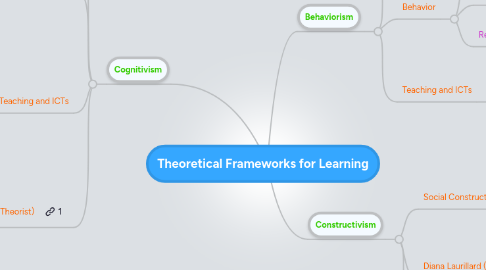
1. Cognitivism
1.1. Jean Piaget (Psychologist)
1.2. Memory
1.2.1. Atkinson-Shiffrin Model
1.2.1.1. Sensory Memory
1.2.1.2. Short-Term Memory
1.2.1.3. Long-Term Memory
1.3. Teaching and ICTs
1.3.1. Ask Questions
1.3.2. Use Multimedia Content
1.3.3. Highlight Important Points
1.3.4. Relate to Existing Knowledge
1.3.5. Practice Exercises
1.3.5.1. Rehearsal
1.3.5.2. Feedback
1.4. Robert Gagne (Learning Theorist)
1.4.1. 5 Conditions for Learning
1.4.1.1. Verbal Information
1.4.1.2. Intellectual Skills
1.4.1.3. Cognitive Strategies
1.4.1.4. Motor Skills
1.4.1.5. Attitude
1.4.2. 9 Instructional Events
1.4.2.1. Gain Attention
1.4.2.2. Inform Learners of Objectives
1.4.2.3. Stimulate Recall of Prior Learning
1.4.2.4. Presenting the Content
1.4.2.5. Providing Learning Guidance
1.4.2.6. Elicit Performance
1.4.2.7. Providing Feedback
1.4.2.8. Assess Performance
1.4.2.9. Enhancing Retention and Transfer
2. Behaviorism
2.1. B.F. Skinner (Behavioral Scientist)
2.1.1. Skinner Box
2.2. Behavior
2.2.1. Learning
2.2.2. Environment
2.2.3. Reinforcement
2.2.3.1. Reward
2.2.3.2. Punishment
2.3. Teaching and ICTs
2.3.1. Management of Class Behavior
2.3.2. Programmed Instruction
3. Constructivism
3.1. Social Constructivism
3.1.1. Teaching and ICTs
3.1.1.1. Collaborative Learning Activities
3.1.1.2. Testing integrated with Task
3.1.2. Negotiation of Meaning
3.1.3. Salmon Model
3.1.3.1. Access and Motivation
3.1.3.2. Online Socialisation
3.1.3.3. Information Exchange
3.1.3.4. Knowledge Construction
3.1.3.5. Development
3.1.4. Active Learning
3.2. Diana Laurillard (Professor)
3.2.1. Conversational framework
3.3. Jean Piaget (Psychologist)
3.3.1. Active Learner