Unlock the full potential of your projects.
Try MeisterTask for free.
还没有账户?
免费注册
浏览
精选思维导图
分类
项目管理
业务与目标
人力资源
头脑风暴与分析
营销与内容
教育与笔记
娱乐
生活
科技
设计
概要
其他
语言
English
Deutsch
Français
Español
Português
Nederlands
Dansk
Русский
日本語
Italiano
简体中文
한국어
其他
显示完整思维导图
复制和编辑思维导图
复制
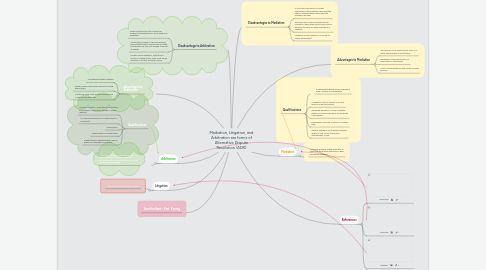
Mediation, Litigation, and Arbitration are forms of Alternative Dispute Resolution (ADR)

其他
Sarabeth Hurlbert
关注
Mediation, Litigation, and Arbitration are forms of Alternative Dispute Resolution (ADR)
马上开始.
它是免费的哦
使用Google 注册
或
注册
使用您的电邮地址
类似的思维导图
思维导图概述
Mediation, Litigation, and Arbitration are forms of Alternative Dispute Resolution (ADR)
作者:
Sarabeth Hurlbert
1. Advantages to Arbitration
1.1. Less expensive than litigation
1.2. Private, unless both parties agree to it being undisclosed
1.3. Parties are under oath and the final decision is ruled by the arbitrator
2. Arbitration
2.1. A process similar to a trial that include opening statements and evidence is presented. The final award/decision is either binding or non-binding
3. Litigation
3.1. An in court process to settle a dispute
4. Qualifications
4.1. General Education, unless the state requires a law degree. A bachelors degree is usually required.
4.2. 5-10 years experience in a related field (i.e. professor)
4.3. Certification
4.4. Employment in a related field
4.5. A dedication to upholding the Code of Ethics for Arbitration in disputes.
5. Disadvantage to Arbitration
5.1. Evidence that would not normally be allowed in a litigation/trial can be used in an arbitration
5.2. If both parties agree to the final decision being binding before the process is stated, both parties are then not allowed to file for an appeal
5.3. Length; unlike mediation, arbitration is known for taking longer. With some issues, litigation is actually the wiser choice.
6. Sara Hurlbert - Prof. Koenig
7. Mediation
7.1. A process in which a third party who is neutral to the dispute attempts to help resolve the situation
8. References
8.1. Arbitration
8.2. Mediation
8.3. Litigation
9. Qualifications
9.1. A certification which usually requires at least 20 hours of course work.
9.2. A mediator must be placed on a court roster in order to practice.
9.3. Advanced education, usually a masters degree, but some even go as far as having a law degree.
9.4. Experience of at least 10 years in a related field.
9.5. General education of at least a bachelors degree in law, conflict resolution management, or law.
10. Disadvantages to Mediation
10.1. If one party chooses to no longer participate in the mediation they have the right to withdraw which then ends the mediation process
10.2. The issue may not be resolved through mediation, which then means more money will need to spent on either arbitration or litigation
10.3. Mediation is not suitable for all issues (i.e. sexual harassment)
11. Advantages to Mediation
11.1. The process is not controlled by a jury or a judge which makes it less stressful
11.2. Mediation is a private process, all information is confidential
11.3. Cost is much less and is also usually a faster process
马上开始吧。是免费的!
与Google服务连接
或
注册