

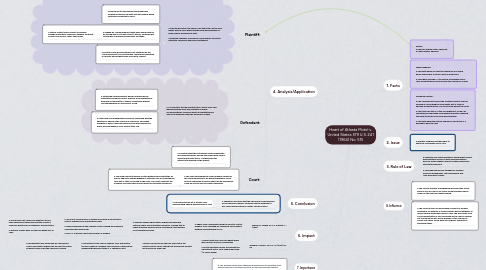
1. 4. Analysis/Application
1.1. Plaintiff:
1.1.1. o Moreton Rolleston, the owner, says that Title II of the Civil Rights Acts of 1964, which forbids racial discrimination in public places, exceeded its limit. o Said that Congress' Commerce Clause powers to control interstate commerce had been overstepped.
1.1.1.1. o Argued his 5th amendment rights had been violated because he couldn't pick and choose which customers he wanted to serve.
1.1.1.2. o Argued his 13th amendment rights were being violated, by forcing him to rent out rooms to blacks; Congress was forcing him to engage in involuntary servitude.
1.1.1.2.1. o Stated, a hotel/motel doesn't necessarily engage in interstate commerce because the profit comes from persons rather than goods.
1.1.1.3. o Asserted racial discrimination is not forbidden by the 14th Amendment/ the Constitution. Argued discrimination is a private wrong that people are free to commit.
1.2. Defendant:
1.2.1. o U.S maintains that by enacting Title II of the 1964 CRA, which abolished racial discrimination in public accommodations, Congress didn't unconstitutionally extend its authority under the Commerce Clause.
1.2.1.1. o Stated the 5th Amendment would not preclude fair interstate commerce control, and that such unintentional harm did not amount to a "taking" of property without just compensation or due process of law.
1.2.1.2. o Stated the 13th Amendment is primarily concerned with the abolition of slavery & the removal of commonly associated disabilities- doesn't exclude issues of racial discrimination in public accommodations from federal/state law.
1.2.2. o Countered that the restrictions requiring adequate accommodations for African Americans were closely linked to interstate travel- Congress had the authority to legislate on the subject.
1.3. Court:
1.3.1. o The court considered the claims made in support of the 13th Amendment to be without substance, and it found it impossible to believe that such an amendment could be used to limit civil rights legislation.
1.3.1.1. o The motel was strategically located between two interstates, as well as two main Georgia highways. Attracted 75% of its customers from out of state, according to the court. The court ruled that the company's activities had a direct effect on interstate commerce.
2. 5. Conclusion
2.1. o Supreme Court ruled that the CRA was a proper exercise of the commerce power; Congress had the authority to ban racial discrimination by motels serving visitors.
2.1.1. o This prevented Heart of Atlanta from discriminating against people based on race.
3. 6. Impact
3.1. Gibbons v. Ogden, 22 U.S. 9 Wheat. 1 1 (1824)
3.1.1. o Ogden filed a complaint asking the court to restrict Gibbons from operating his steamboat on the waters between Elizabethtown & NYC.
3.1.1.1. o Gibbons’ lawyer argued that Congress had exclusive national power over interstate commerce- claimed that to argue otherwise would result in confusing & contradictory local regulatory policies
3.1.1.1.1. o The Court found in favor of Ogden and issued an injunction to restrict Gibbons from operating his boats. o Gibbons appealed to the Supreme Court; arguing the monopoly conflicted with federal law. o The U.S. Supreme Court ruled in favor of Gibbons
3.2. Wickard v. Filburn, 317 U.S. 111 (1942) No. 59
3.2.1. o Filburn planted 23 acres of wheat which was used for personal consumption o Due to regulations under the Agricultural Adjustment Act of 1938, Filburn was fined $0.49 per bushel
3.2.1.1. o Filburn refused to pay the fine. Filed suit in the Federal District Court, stating that the penalty violated his due process under law.
3.2.1.1.1. o The District Court ruled in Filburn’s favor and limited the fine. However, Wickard, the Secretary of Agriculture, appealed this decision to the U.S. Supreme Court