Eye Graphic Organizer
作者:. .
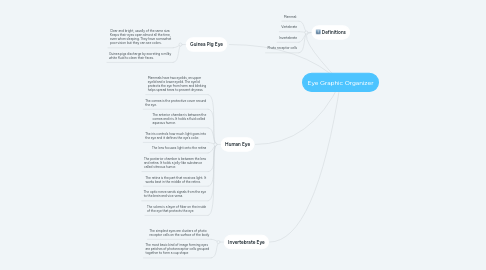
1. Human Eye
1.1. Mammals have two eyelids, an upper eyelid and a lower eyelid. The eyelid protects the eye from harm and blinking helps spread tears to prevent dryness.
1.2. The cornea is the protective cover around the eye.
1.3. The anterior chamber is between the cornea and iris. It holds a fluid called aqueous humor.
1.4. The iris controls how much light goes into the eye and it defines the eye’s color.
1.5. The lens focuses light onto the retina
1.6. The posterior chamber is between the lens and retina. It holds a jelly-like substance called vitreous humor.
1.7. The retina is the part that receives light. It works best in the middle of the retina.
1.8. The optic nerve sends signals from the eye to the brain and vice versa.
1.9. The sclera is a layer of fiber on the inside of the eye that protects the eye
2. Guinea Pig Eye
2.1. Clear and bright, usually of the same size. Keeps their eyes open almost all the time, even when sleeping. They have somewhat poor vision but they can see colors.
2.2. Guinea pigs discharge by excreting a milky white fluid to clean their faces.
3. Invertebrate Eye
3.1. The simplest eyes are clusters of photo receptor cells on the surface of the body
3.2. The most basic kind of image forming eyes are patches of photoreceptor cells grouped together to form a cup shape
4. Definitions
4.1. Mammal:
4.2. Vertebrate
4.3. Invertebrate
4.4. Photo receptor cells


