

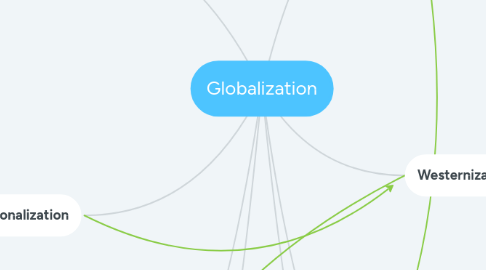
1. Effective advising for international students
1.1. Finances- Financing study abroad programs goes back to working closely with academic advisors, study abroad centers, and the financial aid offices.
1.2. Faculty and advisor support- While working closely with your advisors we can formulate pre departure plans, course evaluations, graduation maps, and career planning. This will give students an idea of how and where they're credits apply. In doing so, this puts ease on student as well as parental concerns.
1.3. Friends and Family- This is a big concern for many international students and where working with your advisor can benefit. Advisors work to build a safety network of connections between students on campus to ensure they are adjusting to their new environment.
2. Internationalization
2.1. At the National/sector/institutional levels is defined as, "The process of integrating International, intercultural, or global dimension into the purpose, functions or delivery of post-secondary education" (Knight, 2004, p.11).
2.2. The term "process" is used to convey that Internationalization is an ongoing effort.
2.3. The notion "integration" is used to denote the process of embedding the international and intercultural dimension in policies and programs.
2.4. Campus based internationalization- With increased international student mobility comes an increase in campus and curriculum based efforts so students can feel more interconnected.
2.4.1. The strategies used are curriculum and programs, teaching/learning process, research and scholarly activity, co-curricular activities, extracurricular activities, and liaison with local community.
2.5. Cross border education
2.5.1. Cross border education refers to the movement of people, programs, providers, policies, knowledge, ideas, projects, and services across national boundaries.
3. CAS Important tenets
3.1. International student advisors must receive training and stay updated on government regulations and policies in order to communicate effectively with students.
3.2. Advisors need to be able to maintain relationships on and off campus, be competent in crisis management and also be able to interact with a variety of cultures.
3.3. Essentially advisors serve as the bridge between international students and those they come in contact with on campus.
4. Neocolonialism
4.1. In terms of higher education this subconsciously imposes western views and culture
4.2. A hierarchy is created through items that are designed in the US but manufactured somewhere else. This discredits other countries and gives the idea that the US is the inovator
5. Neoliberalism
5.1. definition
5.1.1. a theory of political economic practices that proposes that human well-being can best be advanced by liberating individual entrepreneurial freedoms and skills within an institutional framework characterized by strong private property rights, free markets, and free trade” (Harvey, 2005, p. 2).
5.2. Neoliberalism believe in competitive markets, choice and voice, and increasing funding. All of which are great for the super power countries but as for other smaller countries or underrepresented populations that's not the case. Critiques will argue neoliberalism focuses on profits rather than the education of students.
6. Westernization
6.1. definition
6.1.1. "A process of social change where societies convert to the customs and practices of Western civilization. As a concept it has a long pedigree and it is closely linked with colonialism, modernization, and lately globalization"(Bozkurt, 2012).
6.1.2. Westernization encompasses the Western way of life and also ties into Americanization and Eurocentrism.
6.2. Americanization
6.2.1. Cambell (2012) defines Americanization as the "transmission of American ideas, customs, values, images, social patterns, language, industry, and capital around the world.” The example of Mcdonalds relates well because it is an American made food chain that has spread through the entire world.
6.3. Eurocentrism
6.3.1. Krossa (2012) Defines Eurocentrism as the perception of Europe being the center of world. Meaning that Europe is the general baseline to which all things are measured.