


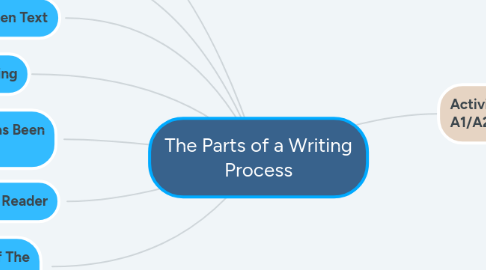
1. Considering the Goals of The Writer
1.1. Purposes
1.2. Examples of activities
1.2.1. Immediate Feedback
1.2.1.1. the writer receives immediate feedback as he or she writes something
1.2.2. Writing to your students
1.2.2.1. Every student receives a letter with different info from the teacher and they react to that information.
1.2.3. Letter Writing
1.2.3.1. Learners are given a situation and they pretend to write emails or answers to questions depending on their contexts.
1.2.4. Situational composition
1.2.4.1. Learners must create a report, a newspaper ad, or a letter depending on a situational activity.
2. Having a Model of the Reader
2.1. Students ask themselves 3 questions: Is the writing piece consistnt in regards to formality? Is the amount of details appropriate considering the amount of knowledge of the readers? does the level of formality match the kind of question that the writing is trying to answer?
3. Gathering Ideas
3.1. Examples of activities
3.1.1. Group brainstorming
3.1.1.1. The whole group suggests ideas
3.1.2. List making
3.1.2.1. Individually, students list possible ideas about their topic.
3.1.3. Looping
3.1.3.1. In 5 minutes, students write as much as they can . Then, they read and rewrite in 1 or 2 sentences all that was written before.
3.1.4. Cubing
3.1.4.1. 1. Describe 2. Compare 3. Associate 4. Analyze 5. Apply 6. Argue for and against
3.1.5. Topic-type grids
3.1.5.1. checkilst before writing
3.1.6. Reading like a writer
3.1.6.1. Students read an article that follows the same pattern of the one they want to write and then do something similar.
3.1.7. Add details
3.1.7.1. The teacher gives main ideas that students will develop with details.
3.1.8. Quickwriting
3.1.8.1. Students concentrate on content, mistakes are not relevant, and they write non-stop.
3.1.9. Expanding writing
3.1.9.1. Students write in every other line and when they finish, they see what details they could add.
3.2. Three groups
3.2.1. Systematic searching procedures like questiong or filling a diagram.
3.2.2. Open-ended activities like Brainstorming and quick writing
3.2.3. Gather and organize ideas with diagrams or maps.
4. Organizing Ideas
4.1. This can add uniqueness to the piece of writing.
4.1.1. Activities in class
4.1.1.1. Projection into dialogue: students look at a model letter and list the questions that the writer seems to be answering
5. Turning Ideas into Written Text
5.1. Students may have issues with putting their ideas into words. This may be due to the differences in writing between L1 and L2.
6. Reviewing what Has Been Written
6.1. Activities in class
6.1.1. Providing students with checklist of goals
6.1.2. Peer feedback.
7. Editing
7.1. Making changes to organization, style, grammatical, and lexical correctness and appropriateness.
7.1.1. Activities in class
7.1.1.1. Marking sheet: Comment sheet divided into categories like content, transitions, etc
7.1.1.2. Marking using a graph: Use a graph as a mathematical way to measure success.
7.1.1.3. Use a system: Using letters to indicate feedback for common mistakes.