


Classical India
作者:Wai Kay Sarah (Sarah) Tsang
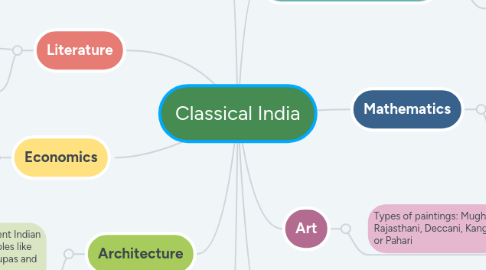
1. Literature
1.1. characteristics: religion, deeds, human values, obedience...
1.2. Major pieces: Mahabharata, Ramayana, Bhagavata-Purana
2. Astronomy & Science
2.1. Vedic astronomy and post Vedic astronomy. Astronomy in ancient times was the science of time determination. It centred round the Sun and Moon and its aim was to study the natural divisions of time caused by the motion of the Sun and Moon
3. Economics
3.1. The Indus valley people practised agriculture, domesticated animals, made tools and weapons from copper, bronze, and tin and even traded with some Middle Eastern countries.
4. Architecture
4.1. Several examples of ancient Indian architecture include temples like Chaityas, Viharas, and Stupas and other religious structures
4.1.1. Chaityas and Stupas are believed to be sacred in the Buddhists community because of the monks
5. Society
5.1. The Aryan caste system consisted of four castes, including Brahmins, Kshatriyas, Vaishyas, and Shudras.
5.1.1. Brahmins are the highest caste as they are believed to be the intellectual comes that came from Brahma's head, the god of creation
5.2. Women played important roles in society. They engaged in professions for increasing health and well-being, as well as teaching professions.
6. Medical Advancements
6.1. India had a leading reputation in the field of medicine
6.1.1. Charaka Samhita was the first physician to posit the concepts of digestion, metabolism, and immunity.
6.1.2. Susruta was a great surgeon who is credited for the book Susruta Samhita where he described over 300 surgical procedures and 120 surgical instruments (his own inventions)
7. Mathematics
7.1. Not only did India give us the concept of zero, but they also made seminal contributions to trigonometry, algebra, arithmetic, and negative numbers.
8. Art
8.1. Types of paintings: Mughal, Rajasthani, Deccani, Kangra or Pahari
8.1.1. Mughal paintings were influenced by Persian art, naturalism theme
8.1.2. Rajput depicted religious Hindu epics, royal activities, political scenarios, and social values.