

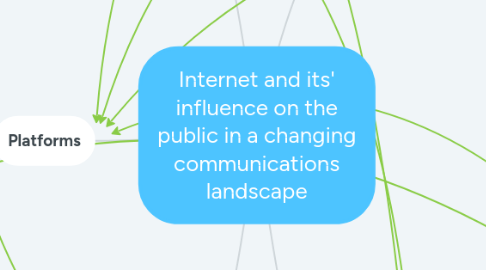
1. Technology based
1.1. can rapidly change
1.1.1. is overwhelming
1.1.2. is time consuming
1.2. can unite
1.2.1. communties
1.2.2. platforms
1.3. requires skills and tools
1.3.1. can divide
1.3.1.1. by age
1.3.1.1.1. access
1.3.1.1.2. understanding
1.3.1.2. by groups with limited or no access
1.3.1.2.1. religions
1.3.1.2.2. socities
1.3.1.2.3. cultures
1.3.1.3. by social class
2. Platforms
2.1. Social networks
2.1.1. Facebook
2.1.2. LinkedIn
2.1.3. Twitter
2.1.3.1. microbloggers
2.2. Social news
2.2.1. credible
2.2.1.1. who are we learning from
2.2.2. ethical
2.3. Media sharing
2.3.1. Instagram
2.3.2. YouTube
2.3.3. SnapChat
2.3.4. Pinterest
2.4. Community blogs and reviews
2.4.1. influencers
2.4.1.1. support
2.4.1.2. boycott
2.4.1.3. incite
2.5. Digital storytelling
3. News
3.1. Who gets it?
3.2. How is it disseminated?
3.3. What is news?
3.3.1. who decides
3.3.1.1. profit driven
3.3.1.2. datafication
3.3.2. who makes it
3.4. Types
3.4.1. real
3.4.1.1. credible
3.4.1.2. unbiased
3.4.2. false
3.4.2.1. agenda driven
3.4.2.2. misinforming
3.4.2.3. slanted view
4. As a tool
4.1. To connect
4.1.1. friends
4.1.2. professionals
4.1.3. family
4.1.4. strangers
4.1.5. influencers
4.2. Datafication
4.2.1. personalize ads
4.2.2. social listening
4.2.3. surveillance
4.2.3.1. monitor real time trends
4.2.3.2. ID leaders, respond to #s
4.2.3.3. sentiments
4.2.3.4. competition
4.2.4. computers tracking
4.3. By businesses
4.3.1. drive ethics
4.3.1.1. social listening
4.3.2. To advertise
4.3.2.1. products reaching untouched markets
4.3.2.2. target certain markets
4.3.3. To manage a crisis
4.3.3.1. get behind story immediately
4.3.3.2. audience reach
4.3.3.3. Easier to managa chaotic events
4.3.4. To drive change
4.3.4.1. strategic planning
4.4. To engage in real time
4.5. To share information
4.6. To entertain
4.7. To coerce
4.7.1. Horkeimer's Theory - passive audience being manipulated by strongest economic power
5. Constraints
5.1. Monitored
5.1.1. information gathering
5.1.1.1. loss of freedom
5.1.2. can be censored
5.1.2.1. who gets it
5.1.2.2. who doesn't
5.1.3. can create discourse
5.2. Unmonitored
5.2.1. bullying
5.2.2. false information
5.3. Transparency
5.3.1. Reality vs. Altered reality