


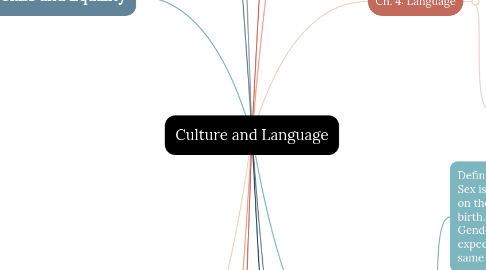
1. Ch. 5: Human Origins
1.1. Evidence and proofs of origins; back to prehistoric time, and years of studies by many experts. From fossils, DNA analysis to artifacts collection, etc.
1.2. Standpoint terminologies: - Deep time: the time range used by scientist in regard of the Earth and universe span -
1.3. The diversity of life on Earth, the key to past, present and future
1.3.1. Theory of Evolution (Darwin's theory of adaptation in any living creatures that follows to its changing environment over time)
1.3.1.1. Mutation Natural Selection Gene Migration Genetic Drift
1.3.2. Creationism (religious belief on God's creating everything in the universe)
1.3.3. Intelligent design: that "life is too complex to be random" (Guest, pg. 164), that there are something beyond everything, something supernatural, and just can't be explained.
1.4. Modern Humans survival skills: -Genetic adaptation -Development Adaptation -Cultural Adaptation -Acclimatization -and continuity skills of keep evolving and adapting
2. Global Economy
2.1. Definition: Economy is part of humans culture and the efficiency of life to cultivate what's available to fulfill their needs in order to survive.
2.2. Standpoint terminologies: - Colonialism: connects to low wage, cheap labor, easy to get raw materials, by one nation. How this connect to current economic system was its easy spread from Europe, and affecting to all colonized countries.
2.2.1. "beginning in the 1500s, European colonialism played a pivotal role in establishing the the framework for today's global economic system" (Guest 455)
2.3. - commodity chain: the process in economy where goods or services are transported between consumers or users and makers (producers).
2.4. The ups and downs of global economy in the recent years: + it has been positively increased + life expectancy has rose with less infant death (illness, etc.) - because of population grow, we create huge "ecological foot print" - as a result; climate change - increase consumption of necessary resources (from earth) as well as waste (to earth).
2.4.1. "studies suggest that as early as 1980 humans began to use more resources that the planet could generate" (Guest 481). Thus, the high demands caused by more humans in the planet. "Ecological overshoot, where human demands on nature exceed the planet's ability to provide" (Guest 484) Do we really need the second "Earth" to accommodate humans and its greed?
3. Class and Equality
3.1. Definition: Class - is a power from a group or collection of people categorized mostly by economic background and status.
3.2. Class and Equality constructed in the U.S. defined by mainly economic status: 1. Income - the jobs or occupations one holds, how much money they made defined their class (low income, median or high income) 2. Wealth - without counting on debts or what someone's owes, the whole amount of valuable things someone's have. 3. the U.S. social construct itself
3.2.1. "access to wealth, power, prestige, and the resources of U.S. society were stratified not only by race and gender but also by class." (Guest 411).
3.3. The inequality case in the U.S: - Mass Media; for the profit-maker individual or groups, creating a "good" living standard which sometimes can't be as good as in reality. - consumer culture; everything that get the goods or service upfront and pay later creates debts habit.
3.3.1. "The role of class is rarely discussed but present everywhere in U.S. society, as is the attempt to "consume" class." (Guest 429).
3.4. Life chances: the chance for one individual to make change in their life to going forward (better life). The resources to achieve a better life chance could be an outreach for resources based on Maslow hierarchy (Food, shelter, education, clothing, etc.)
4. Religion
4.1. What is it exactly? it is either a system, or interest by certain groups of people to believe and have faith on unique power or any supernatural.
4.2. - Emile Durkheim: holy vs. not-holy; a term of "sacred and the profane".
4.2.1. "religion as a unified system of beliefs and practices relative to sacred things, that is to say, things set apart and forbidden - beliefs and practices which unite into one single moral community..." (Guest 582.
4.3. - Karl Marx: "opiate of the masses" rather uses religion to act as the medium to gather people and "take away" their hardships.
5. Race and Racism
5.1. Definition: Race: dividing or categorizing system, by judging its physical appearance of one individual or group. Racism: the thoughts, perspective and actions by an individual or a group that are different from others as to create unfairness.
5.1.1. "Race is NOT scientifically real, race is culturally real and a powerful framework." (Power Point Lecture Chapter 5, slide 16, Plascencia).
5.2. The construction of Race around the world and in the U.S., thanks to the colonialism era. Since many centuries ago, the classification based on physical appearance (as much as the eye can see). In the U.S., there are more part in social construct of race and racism, such as political lines, physical appearance, language, global economy, countries, etc.
5.2.1. "Locally, racism and systems of racial classification are complex frameworks built out of the encounter of colonialism with local cultural patterns, global migration, and specific movements of resistance." (Guest 203).
5.2.2. "the meaning of race is defined and contested throughout society, in both collective action and personal practice" (Omi, Michael, pg. 23)
5.3. Institutional Racism: the perspective of how race is constructed based on cultural institutions, systems, and regulations or policies. Individual Racism: an individual perspective and prejudice against other race. Racial ideology:
6. Ethnicity and Nationalism
6.1. Ethnicity: often times are confused and mixed up with the meaning of "race". The differences are the way each group or individual background and connection to its cultural sense. Ethnicity is more like a shared cultures such as language, ancestry, cultural practices and beliefs.
6.1.1. "Anthropologists see ethnicity as a cultural construction, not as a natural formation based on biology or inherent human nature." (Guest 241).
6.2. Ethnicity meaning to anthropologist: ethnicity can be found on any applications form in the U.S., the US Census, and public places (markets, food, place of interest).
6.2.1. "Anthropologist view ethnicity as a cultural construction" (Guest 241). People or certain groups create or construct such formation about which culture is similar or difference (categorization).
6.3. What ethnicity really are: the shared values or beliefs that stand out equally within the group or regions. From my personal background experience, Indonesia is one country, which consists of many ethnic people. They are differs in languages, religions, culture, beliefs, family values, society norms, etc. E.g: in one Java island, we have at least 10 ethnic groups of Javanese, Sundanese, Bantenese, Madurese, and more, and all of each group have their own language or dialect that some of them wouldn't understand each other. Unless the speakers are using the nation language which is Bahasa.
7. Ch. 1: Anthropology in a Global Age
7.1. Definition: Anthropology is a study of humans and their background that focus specifically on the variation of culture, or race, in addition to their evolutions.
7.1.1. Cultural anthropologist really learns and observes about one culture by adopting ethnographic work, by living in that culture "to understand their lives by walking in their shoes." (Guest, pg. 10)
7.2. Standpoint terminologies: -Holism: anthropologist stand points of overlooking human life as a whole (culture, physical, background and language) -Globalization: the development of increased use of money and goods across the world. -Ethnocentrism
7.3. Anthropology branches: 1.Physical Anthropology 2. Archeology 3. Linguistic Anthropology 4. Cultural Anthropology
8. Ch. 2: Culture
8.1. Definition: Culture is the beliefs, the way of how certain group of people live in, that the concept (values, beliefs, tradition, etc.) has been passed down and shared.
8.2. Standpoint terminologies: - Enculturation: the way culture is learned - Cultural relativism: the ability of other people of not the same culture to be able of acceptance of others' culture - Hegemony: the dominance of authority, power or group that influence one's culture or beliefs
8.2.1. Example of Cultural Relativism: more Chinese foods are accepted and adopted in Western (American) culture
8.3. "Culture beliefs and practices are not timeless; they change and can be changed" (Guest, pg. 54)
8.3.1. homogenizing and consumerism both connected well to a 'changed' culture. In Indonesia, we never celebrated Thanksgiving day before (because it was American old Pilgrims' celebration), due to the many Western culture came to Indonesia with the products and other foreign influences, now Indonesian has Thanksgiving day.
9. Ch. 4: Language
9.1. Definition: Language is both system and form of exchanging information.
9.2. Standpoint terminologies: - Descriptive linguistic: the branch of anthropology to learn the in depth of language - lexicon: the vocabulary or wording in a language - Focal vocabulary: set of words or vocabularies that stand out for that particular group of that language use.
9.2.1. "Languages are not abstract concepts with ideal forms perfectly displayed in a dictionary or a textbook. Language is dynamic and live." (Guest, pg. 114)
9.3. Language makes a person how to think, act, behave and is part of one's culture.
9.3.1. Some languages for instance Korean, formed based on the class level (like class stratification) with honorific language and non-formal language.
10. Gender
10.1. Definition: Sex vs. Gender: Sex is either male or female based on the physical and biological after birth. Gender is the thoughts or expectation of those sex (either same or different sex adaptation)
10.2. Standpoint terminologies: - Cultural construction of gender: how sex and gender is understood and viewed by society rather than that individual - gender stratification: gender is viewed as bias for the uneven spread of power or any access to resources (based on gender).
10.3. The studies of gender, cannot be just based on itself and stand alone, there are many more aspects that inter-related with this sensitive matter. "contemporary anthropological research acknowledges that gender cannot be viewed on its own but must be examined as it intersects with dynamics of race, class, and sexuality." (Guest, 292).
11. Ch. 9: Sexuality
11.1. Definition: sexuality is divided into two perspectives and definition. 1) the acts and desires that could elaborate to some physical contact. 2) what is appropriate or natural for those behavior that brought into a debate.
11.2. Standpoint terminologies:
12. Politics and Power
12.1. Origins of Human political history: Bands, Tribes, Chiefdom, States. All regions are divided and each has power to control its own region, lands, people, things, etc.
12.1.1. "beginning in the late 1800s, as nations-states emerged to dominate political activity on a global scale the anthropological gaze shifted significantly to encompass more complex, state-oriented societies and the process by which local settings are politically incorporated into a larger context." (Guest 534).
12.2. Hegemony: the system of using no force or power to affect the population decision making. It becomes as normalization or generalization over power and authority.
12.2.1. "The hegemonic aspect of power can make group members discipline their own behavior, believing and acting in certain "normal" ways, even without threat of punishment for misbehavior." (Guest 545).