


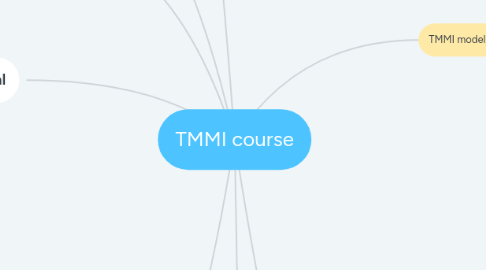
1. TMMI assesment (4)
1.1. INformal assesesment
1.2. Formal assessment (last 3 years)
1.2.1. Planning
1.2.1.1. purpose, scope, constrains
1.2.1.2. Timeline, cost, activities, reporting
1.2.2. Preparation
1.2.2.1. schedule kick-off, interview, progress report, feedback session, presentation and report
1.2.2.2. document study artefacts, finding documented in initial
1.2.2.3. practical things: room booking, back procedures, agree roles
1.2.3. Interview
1.2.3.1. Collect information, conduct interviews
1.2.3.2. Perform preliminary analysis
1.2.4. Reporting
1.2.4.1. Feedback to the assessed organization: validate and finalize findings, perform analysis, formulate recomendations, results and recommendations
1.2.4.2. report assesments results to TMMI
1.3. Assessment process
1.3.1. Rating 1 - each goal
1.3.1.1. Not achieved
1.3.1.2. Partially achieved
1.3.1.3. Largely achieved
1.3.1.4. Fully achieved
2. Introduction to TMMI models (4)
2.1. TMMI framework published 2010
2.2. Independant model
2.3. LEading model for according to IEEE
3. TMMI maturity levels (3)
4. TMMI in agile context (4)
5. Implementing TMMI (4)
5.1. I.D.E.A.L model
5.1.1. 1. Initiating
5.1.1.1. Identify stimulos for improvement
5.1.1.2. Set context and establish sponsorship
5.1.1.3. Chatert the infraestructure
5.1.2. 2. Diagnosing
5.1.2.1. Run an assesment to understand where you re now
5.1.3. 3. Establishing
5.1.3.1. Set priorities
5.1.3.1.1. most visible
5.1.3.1.2. low cost
5.1.3.1.3. easy action first
5.1.3.1.4. degree of acceptance
5.1.3.1.5. Reduce highest risks
5.1.3.1.6. Long term and short term
5.1.3.2. Develop approach
5.1.3.2.1. HOw to get from the current situation to the new one?
5.1.3.2.2. REsourceS?
5.1.3.2.3. Any technical considerations?
5.1.3.2.4. Top down - botton down?
5.1.3.3. PLan actions
5.1.4. 4. Acting
5.1.4.1. Create solution
5.1.4.2. Test / Pilto solution
5.1.4.3. Refine solution
5.1.4.4. Implement solution
5.1.5. 5. Learning
5.1.5.1. Analyse and validate
5.1.5.2. Propose future solution
6. Exam TMMI professional
6.1. 40 questions
6.2. 65% pass rate (26 points)
6.3. 60 mins
6.4. High level 11 pages
6.4.1. Be able to recognise and remember concepts
6.4.2. Be able to select the reasons or explanations for statements
7. Context of test improvement (3)
8. TMMI model (14)
8.1. 1. Initial
8.2. TMMI level 2 Managed
8.2.1. 2.1 Tes policy
8.2.2. 2.2 Test planning
8.2.3. 2.3 Test monitoring and control
8.3. TMMI level 3 - Defined
8.3.1. 3.1Test organization
8.3.1.1. Establish a test organisation
8.3.1.2. Establish test function for test specialist
8.3.1.3. Establish Test career paths
8.3.1.4. Determine, plan and implement test process improvement
8.3.1.5. Deploy organisational test process
8.3.2. 3.2Test training program
8.3.2.1. Establish an organisational Test training capability
8.3.2.2. Provide necessary test training
8.3.3. 3.3 Test lifecycle
8.3.3.1. Establish organizational test process
8.3.3.1.1. how to... / guides
8.3.3.2. Integrate test lifecycle models with development models
8.3.3.3. Establish a master test plan
8.3.4. 3.4 Non functional testing
8.3.4.1. Perform nont functional product risk assesment
8.3.4.2. Establish a non functional test approach
8.3.4.2.1. DOD should include Non functional exit criteria
8.3.4.3. Non functional test analysis and design
8.3.5. 3.5 Peer reviews
8.3.5.1. Establish peer review approach
8.3.5.2. Perform Peer reviews
8.3.5.2.1. walkthrought
8.3.5.2.2. Technical review
8.3.5.2.3. Inspection
8.4. TMMI level 4- MEasured
8.4.1. 4.1 Test measurement
8.4.1.1. Establish test measurement
8.4.1.2. Specify test measures
8.4.1.3. Specify data collection
8.4.1.4. Specify analysis procedures
8.4.2. 4.2 Product Quality evaluation
8.4.2.1. Quality attributes ISO 9126
8.4.2.2. Identify product quality needs
8.4.3. 4.4 Advance reviews
8.5. TMMI level 5 - Optimised
8.5.1. 5.1 Defect prevention
8.5.1.1. Determine common causes of defects
8.5.1.2. Prioritize and define actions to systematically eliminate common causes of defects
8.5.2. 5.2 Quality control
8.5.2.1. Establish a statistically controlled test process
8.5.2.1.1. Establish test process performance objectives
8.5.2.1.2. PErformance measures
8.5.2.1.3. Performance baselines
8.5.2.2. Testing is performed using statistical methods
8.5.3. 5.3 Test process optimisation
8.5.3.1. Select test process improvements
8.5.3.2. NEw testing tech are evaluated to determine their impact on testing process