Study Revision
作者:Pamella Mpungose
1. Personality development •Lesson 1 Freud: Psycho-sexual development •Lesson 2 Jung: Neo-analytic theory of personality development •Lesson 3 Trait theories of personality development •Lesson 4 Social learning, personality and culture
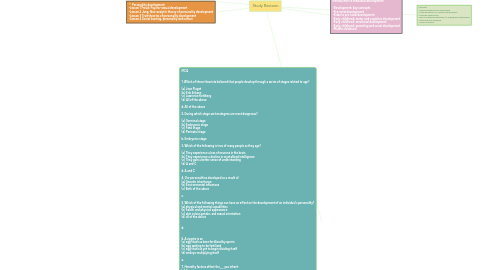
2. MCQ 1. Which of these theorists believed that people develop through a series of stages related to age? (a) Jean Piaget (b) Erik Erikson (c) Lawrence Kohlberg (d) All of the above d. All of the above 2. During which stage are teratogens are most dangerous? (a) Germinal stage (b) Embryonic stage (c) Fetal stage (d) Perinatal stage b. Embryonic stage 3. Which of the following is true of many people as they age? (a) They experience a loss of neurons in the brain (b) They experience a decline in crystallized intelligence (c) They gain a better sense of understanding (d) A and C d. A and C 4. Our personalities developed as a result of (a) Genetic inheritance (b) Environmental influences (c) Both of the above c. 5. Which of the following things can have an effect on the development of an individual's personality? (a) physical and mental capabilities (b) health and physical appearance (c) skin colour,gender, and sexual orientation (d) all of the above d. 6. A zygote is an (a) egg that has been fertilized by sperm (b) egg waiting to be fertilized (c) egg that has yet to begin dividing itself (d) embryo multiplying itself a. 7. Heredity factors affect the___ you inherit (a) Genes (b) Physical traits (c) Lifespan (d) Parents b. 8. The idea that no two people are the same is: (a) Unique (b) Friends (c) Enemies a. 9. Your personality stops developing at this stage: (a) 09 (b) Never (c) 15 (d) 22 b. 10. Creative, funny,moody are all examples of: (a) Healthy (b) Free (c) Personality traits (d) Character traits c.
3. Personality Assessment •Lesson 1: Personality assessment and interviews •Lesson 2: Objective personality assessment •Lesson 3: Projective personality assessment •Lesson 4: Reliability in personality assessment •Lesson 5: Types of reliability in personality assessment •Lesson 6: Validity in personality assessment
4. Theories of individual development •Socio-emotional development: Early to middle childhood •Socio-emotional development: Adolescence to adulthood •Piaget: Cognitive development •Vygotsky: Cognitive & socio-cultural development •Social learning theory •Development of moral reasoning •Ecological systems of development
5. -Unconscious determinants of behavioral -Sexual and aggressive instinctual drives -Enduring effects of early childhood experiences on later personality development -ID,Ego, Superego
6. Theories of personality •Biological theories •Behavioral theories •Humanist theories •Psychodynamic theories Personality characteristics •Personality of a person is organised and consistent •Personality is largely, stable, but it is affected by the surrounding environment and factors •We react because we have a personality.Thus personality is always reactive
7. 4 Stages of personality development •Infancy •Preschool •Middle childhood •Adolescence
8. Introduction to individual development •Development: key concepts •Pre-natal development •Risks to pre-natal development •Early childhood: motor and cognitive development •Early childhood: emotional development •Early childhood: parenting and social development •Middle childhood
9. Concepts •Examine research into adolescence •Evaluate theories of cognitive development •Describe adolescence •Role of childhood attachment in subsequent relationships •Attachment in childhood •Define resilience

