

Momentum
作者:kinda alfassed
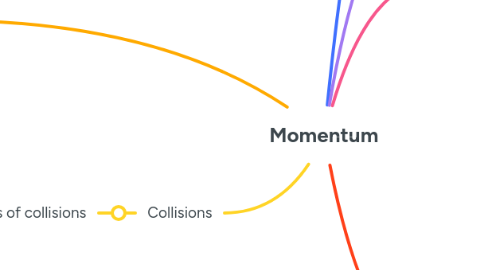
1. Collisions
1.1. 2 types of collisions
1.1.1. Elastic (Elastic Collision formula of momentum is given by: m1v1fi + m2v2i = m1v1f + m2v2f)
1.1.1.1. A collision in which the system would not face a net loss of kinetic energy as a result of the collision. In elastic collisions, momentum and kinetic energy are both conserved.
1.1.2. Inelastic (Inelastic Collision formula of momentum is given by: m1v1i+m2v2i=(m1+m2)vf)
1.1.2.1. In the collision, portion of the kinetic energy is converted into another type of energy.
2. According to the law of conservation of momentum, The overall momentum of two or more bodies acting on one another in an isolated system stays constant unless an external force is introduced. As a result, momentum cannot be gained or lost.
3. Definition
3.1. "Quantity of motion"
3.2. A characteristic of a moving body that it possesses due to its mass and motion and is, in general, equal to the product of the body's mass and velocity
3.3. If the object is not moving then there is 0 momentum. (since v=0)
4. Formula
4.1. F=m*a
4.1.1. F=m(vf-vi)/t
4.1.1.1. F=p/t