


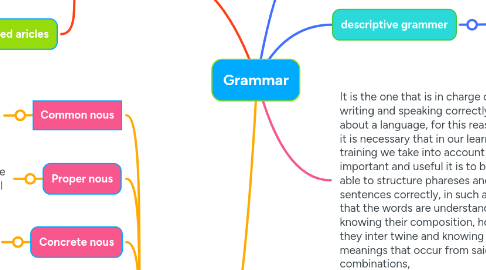
1. prescriptive grammer
1.1. studies the grammar that is related to the established correct or incorrect norms of language use, having a specific set of grammatical rules
1.1.1. Example: The internal regulations of a company, A cooking recipe
2. descriptive grammer
2.1. studies the grammar that describes the use of language by the native or non-native speaker, in which there are no standard rules in descreptive grammar
2.1.1. Example: The city government built a new park a few blocks fron here, Since that day you never called me again.
3. It is the one that is in charge of writing and speaking correctly about a language, for this reason, it is necessary that in our learning training we take into account how important and useful it is to be able to structure phareses and sentences correctly, in such a way that the words are understandable, knowing their composition, how they inter twine and knowing the meanings that occur from said combinations,
4. Nouns
4.1. Common nous
4.1.1. A set of individuals or entities of the same class, in general terms
4.1.1.1. Example: Lion, Baby, Mirror, Computer
4.2. Proper nous
4.2.1. Are those that refer to a single person or entity. According to the rule they must start with a capital latter
4.2.1.1. Example: Argentina, Spain, Europe, Ana, Paul
4.3. Concrete nous
4.3.1. Are the ones we can see, smell, touch,hear or taste
4.3.1.1. Example: water, paper, flower, coffe
4.4. Abstract nouns
4.4.1. They are those that we cannot perceive through our five senses
4.4.1.1. Example: happiness, love, kindness, company, health
4.5. Countable nous
4.5.1. Refer to elements that make up a unit and that can be acculated. These can be expressed singular and plural
4.5.1.1. Example: coin, coins
4.6. Uncountable nouns
4.6.1. Refer to something that only appears in the form of an indivisble mass
4.6.1.1. Example: money, sand
4.7. Possessive noun
4.7.1. Are those that denote an entity that owns something, an apostrophe is used to form them (') and the letter S, or when the noun ends with S, only put the apostrophe
4.7.1.1. Example: kate's boy friend, mary's jacket, dog's tail
4.8. Collective noun
4.8.1. Are those that, being a single unit, comprise more than one element
4.8.1.1. Example: team, corporation, family, school
4.9. Compound noun
4.9.1. Are made up of two or more words
4.9.1.1. Example: if you want to say the plural of washing machine, you wouldn't have to say washings machines, if not what would be correct washing machines
5. Articles
5.1. Definite articles
5.1.1. It is called the definited article because when it accompanies a noum it tells us specifically about one or some in particualr. THE, it fulfills an important fuction in English, which implies that it accompanies femenine, masculine and neuter nouns
5.1.1.1. Example: the boy is in the park, the boys is in the park
5.2. Undefined aricles
5.2.1. They are indefinited articles because even though they are talking about only one thing, they do not specify which one. ''A'', we use it when the accompanying noun begins with a consonant sound. ''AN'' we use it when the word begins with a vowel sound
5.2.1.1. Example: a dog, a knife, a euro. an eagle, an orange, an hour