


1. magnification= size of image ÷size of real object
2. chromosomes
2.1. the nucleus of a cell contains chromosomes made of DNA
2.2. each chromosome caries hundreds and thousands of genes
2.3. different genes contain the code to make different proteins and so control development of different characteristics
2.4. In the body chromosomes are found in pairs coming from each parent
2.5. humans. have 23 pais of chromosomes and dogs have 39 pairs in their species
3. mitosis and the cell cycle
3.1. cells go through a lot of changes which involve growth and division called the cell cycle
3.2. one of the changes is mitosis when the cell divides into two identical cells
3.3. before a cell can divide it needs to increase and grow a number of cubcellular structures
3.4. the DNA replicates to create two copies of each chromosome during mitosis
3.4.1. 1) one set of chromosomes is pulled to each end of the cell
3.4.2. 2) the nucleus divides
3.4.3. 3) the cytoplasm and cell membranes divide to form two identical cells
3.5. cell division by mitosis is important because it makes new cells for:
3.5.1. growth and development of multicellular organisms
3.5.2. repairing damaged tissues
3.5.3. asexual reproduction
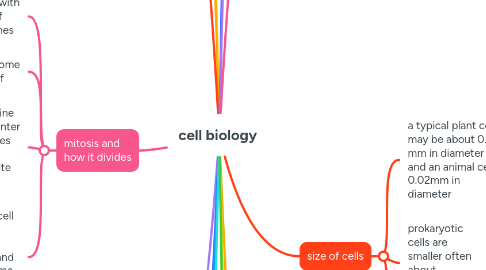
4. mitosis and how it divides
4.1. parent cell with two pairs of chromosomes
4.2. each chromosome replicates itself
4.3. chromosomes line up along the center of the cell,divides and the copies move to opposite poles
4.4. each daughter cell has the same number of chromosomes and contains the same genes as the parent cell
5. stem cells
5.1. some cells are undifferentiated they have not yet become specialised
5.2. this means they can divide to make different types of cells these are called stem cells
5.3. stem cells are found in human embryos and are called human embryonic stem cells. they can make all type of cells
5.4. the stem cells are found in human embryos in the umbilical cord of a new born baby and in some organs and some tissues
5.5. adult stem cells are found in some organs and tissues e.g. bone marrow, they can only make certain types of cells and capacity to divide is limited
6. why people might not be interested in stem cell uses
6.1. there might be risks of viral infections
6.2. there maybe ethical or religious objections
7. transport in and out of cells
7.1. diffusion: particals from a high concentration from a high concentration to low concentration
7.2. osmosis: diffusion of water from a dilute solution to a concentrated solution through a partially permeable membrane
7.3. active transport: area of loe concentration to high concentration
8. the small intestine and the Lungs in mammals and Gills in fish and the roots and leaves in plants are adapted in exchanging materials
8.1. they have a large surface area
8.2. thin surface so that molecules can move in fast
8.3. moist surface so that the substance can disolve and diffuse faster
8.4. in animal a rich blood supply maintains a concerntration gradient
8.5. in animals ventilation occurs to speed up gaseous exchange
9. cell structure: animal cells
9.1. neucleas: controls the activities of the cell and also contains genetic material
9.2. cytoplasm: gel like substance where chemical reaction takes place
9.3. cell membrane: controls what goes in and out of the cell
9.4. mitochondria: where aerobic respiration takes place
9.5. ribosomes: where proteins are synthesised. [made]
10. plant cells are algal cells that contain sub cellular structures which are also found in animal cells. the also contain:
10.1. a cell wall: which is made from cellulose, which strengthens the cell
10.2. vacuole: which is filled with cell sap which gives support to the plant.
10.3. plants need to create there own food, so there cells contain chloroplasts.
10.3.1. chloroplasts: absorb sunlight to make food [glucose] by photosynthesis.
10.3.2. photosynthesis equation : carbon dioxide+ water+ light = glucose+ oxygen
10.3.3. how photosynthesis is made
10.3.3.1. to produce glucose molecules energy is required
10.3.3.2. this is because reactions are endo- thermic { take heat in}
10.3.3.3. it is then trapped by chlorophyll which is found in chloroplasts.
11. there are two main type of cells and they are: prokaryotic and eukaryotic.
11.1. prokaryotic are bacterial cells
11.2. they are much smaler in size
11.3. the genetic material is not enclosed in a nucleus.
11.4. the genetic material is a single loop of DNA called plasmids
11.5. bacterial cells have different shapes such as spherical, spiral, rod, curved rod
11.6. they do not contain mitochondria or chloroplasts
11.6.1. eukaryotic cells are plant , animal, and fungal cells
11.6.2. plasmid DNA: a small commonly circular, section of DNNA that can replicate independently of chromosomal DNA
11.6.3. chromosomal DNA: the DNA of bacteria is not found within a nucleus and is usually found as one long looped chromosome
11.6.4. flagella: tail like structures that rotate to help some bacteria move
11.6.5. cell wall: provides structural support to the bacteria (it is not made of cellulose)
11.6.6. cytoplasm: gell like substance where chemical reaction takes place
12. size of cells
12.1. a typical plant cell may be about 0.1 mm in diameter and an animal cell 0.02mm in diameter
12.2. prokaryotic cells are smaller often about 0.002mm long
12.3. do describe units of cells scientists have units of prefixes
13. using microscopes to look at cells
13.1. to see two or more objects as separate objects is called resolution
13.2. light microscope was developed in the late 16th century and gave Great revolution to the human eye
13.3. this allowed scientists to discover and see plant, animal, and bacterial cells
13.4. some resolution was achieved by light microscope such as the view of the cell
13.5. in 1933 scientists first used and discovered the electron microscope
13.6. An electron microscope passes electrons than light and also gives a much better resolution
13.7. you can't see cells with a naked eye
13.8. cells can be seen in much finer details
13.8.1. e.g one is that the scientists can see really small cell structures in chloroplasts and other small cubcellular structures such as mitochondria
13.8.2. ribosomes can be seen and also there role on how they can be seen making protiens
14. use of stem cells
14.1. they can be used to treat damaged cells which don't work properly such as in diabetes and paralysis
14.2. they can also be used for therapeutic cloning by a cloned embryo of a patient
14.3. stem cells from the cloned embryo will not be rejected by the patients body, so they could be very useful in treating the patient
15. stem cells in plants
15.1. in plants stem cells are found in an area called the meristems
15.2. these meristems allow plants to make new cells for growth
15.3. stem cells can be used to produce clones of plants quickly this could be useful for
15.3.1. rare species can be cloned to protect them from extinction
15.3.2. large numbers of identical crop plants with special features, such as desiease resistance can be made