Walker, A & White, G (2013). Technology enhanced language learning: Connecting theory and practice. Oxford University Press
作者:sa4iiysour k3uKooEEr7
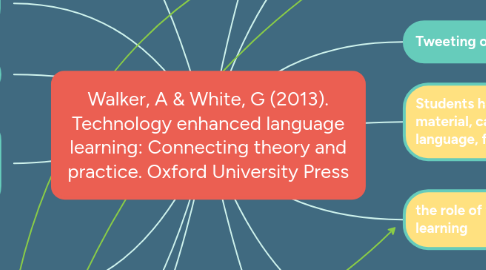
1. Different modes allows for a fuller and deeper understanding of that information. It allows learners and teachers to manupulate the various modes and to break free of the temporal linearity of traditional classrooms instruction. To combine modes such as sound, text, and image; to easily access visual material such as images and videos which may hep clarify infromtation presented in other modes.
2. Students gain skills in both print and digital texts
3. visuals play role in the 'new' literacies:
4. words and images processed stored by different ways in brain. images which give the same message as words could help learning and memorization.
5. Productivity
5.1. Good combinations of images and words and other multimodality forms can be benficial.
5.2. Students feel that the images help them to understand complicated things during the lessons.
5.3. Images and videos give information that only can be provided visually
6. Visual
7. 'new' literacies
7.1. Critical video analyzing
7.2. Visual play roles in the 'new' literacies
8. Students should become aware and think critically about their information they share and the information they read and interact with.
9. The informations is given in small doses with the most important information given in the beginning. It makes it more efficient and productive.
9.1. Finding and being critical of online resources.
9.2. Teachers know that it is their students, not them, who now have the expertise in creating multimodal texts and being able to effortlessly produce and respond to a number of texts simultaneously.
9.3. Teachers in the future will be more focused on helping students to critically analyze these texts and to produce ones which communicate meaning effectively. Students should become critical and analytical regarding digital sources.
10. Tweeting or facebook updates
11. Students have less patientce for text based material, can see the context, body language, facial expressions, and artefacts
12. the role of visuals in language learning
12.1. Images and videos allow learners to see a context,
12.2. Students can better recall a story they have heard if they can link it to a mental/visual image
13. Multimodality
13.1. Images and videos can bring the real world into the classroom and make it more authentic
13.2. Learners not only need to 'do' to be active but also need to articulate their knowledge and make it visible to others. This is called 'constructionism'
14. Examples of activities for the classroom
14.1. Finding and evaluating images
14.2. Creating a digital guidebook
14.3. Comic - strip story
14.4. Animated dialogue
14.5. House racing video

