


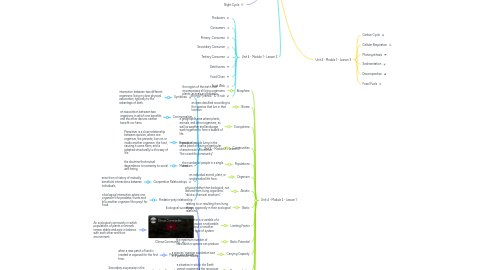
1. Photosynthesis
2. Epidermal leaf cells
3. Cuticle
4. Stomata
5. Mesophyll Cells
6. Chloroplasts
7. Chlorophyll A and B
8. Light Cycle
9. Night Cycle
10. Different sugars
11. Cellular Respiration Glycolysis
12. Mitochondria
13. Lactic Acid Fermentation
14. Ethanol Alcohol Fermentation
15. Unit 4 - Module 1 - Lesson 3
15.1. Carbon Cycle
15.2. Cellular Respiration
15.3. Photosynthesis
15.4. Sedimentation
15.5. Decomposition
15.6. Fossil Fuels
16. Unit 4 - Module 2 - Lesson 1
16.1. Biosphere
16.1.1. the region of the earth that encompasses all living organisms: plants, animals and bacteria.
16.2. Biome
16.2.1. an area classified according to the species that live in that location.
16.3. Ecosystems
16.3.1. a geographic area where plants, animals, and other organisms, as well as weather and landscape, work together to form a bubble of life.
16.4. Communities
16.4.1. a group of people living in the same place or having a particular characteristic in common. "the scientific community"
16.5. Populations
16.5.1. the number of people in a single area.
16.6. Organism
16.6.1. an individual animal, plant, or single-celled life form.
16.7. Abiotic
16.7.1. physical rather than biological; not derived from living organisms. "abiotic chemical reactions"
16.8. Biotic
16.8.1. relating to or resulting from living things, especially in their ecological relations.
16.9. Limiting Factor
16.9.1. A limiting factor is a variable of a system that causes a noticeable change in output or another measure of a type of system.
16.10. Biotic Potential
16.10.1. the maximum number of individuals a species can produce
16.11. Carrying Capacity
16.11.1. a species' average population size in a particular habitat.
16.12. Overpopulation
16.12.1. a situation in which the Earth cannot regenerate the resources used by the world's population each year
16.13. Extinction
16.13.1. A living thing that no longer exist.
16.14. Endangered Species
16.14.1. type of organism that is threatened by extinction.
16.15. Threatened species
16.15.1. a species is likely to become endangered within the foreseeable future.
17. \
18. Unit 4 - Module 2 - Lesson 3
18.1. Ecological succession
18.2. Climax Community
18.2.1. An ecological community in which populations of plants or animals remain stable and exist in balance with each other and their environment
18.3. Primary succession
18.3.1. when a new patch of land is created or exposed for the first time.
18.4. Secondary succession
18.4.1. Secondary succession is the secondary ecological succession of a plant's life.
18.5. Eutrophication
18.5.1. excessive richness of nutrients in a lake or other body of water, frequently due to runoff from the land, which causes a dense growth of plant life and death of animal life from lack of oxygen.
18.6. Dynamic Equilibrium
18.6.1. a state of balance between continuing processes..
18.7. Resource Extraction
18.7.1. the withdrawing of materials from the environment for human use
18.8. Pollution
18.8.1. organisms that do not occur naturally in an area, but are introduced as the result of deliberate or accidental human activities
18.9. Nonnative species
18.9.1. organisms that do not occur naturally in an area.
19. Unit 4 - Module 2 - Lesson 2
19.1. Symbiosis
19.1.1. interaction between two different organisms living in close physical association, typically to the advantage of both.
19.2. Commensalism
19.2.1. an association between two organisms in which one benefits and the other derives neither benefit nor harm.
19.3. Parasitism
19.3.1. Parasitism is a close relationship between species, where one organism, the parasite, lives on or inside another organism, the host, causing it some harm, and is adapted structurally to this way of life.
19.4. Mutualism
19.4.1. the doctrine that mutual dependence is necessary to social well-being.
19.5. Cooperative Relationships
19.5.1. arise from a history of mutually beneficial interactions between individuals.
19.6. Predator-prey relationship
19.6.1. a biological interaction where one organism (the predator) hunts and kills another organism (the prey) for food.