


1. Concept checking questions
1.1. Concept checking is checking the understanding of difficult aspects of the target structure in terms of function and meaning. Concept checking is vital, since learners must fully understand the structure before any intensive practice of form and phonology is carried out.
1.1.1. The questions 'Do you understand? Is it clear?', or the remark 'OK?' do not achieve any of these aims.
1.1.1.1. Yes/no questions, either/or questions and simple 'wh' questions are particularly effective
1.1.2. The rules of making CCQ
1.1.2.1. Don't use the new (target) vocabulary in your questions · Don't use unfamiliar vocabulary · Use as many questions as possible to check various aspects of the language and to cover as many learners as possible.
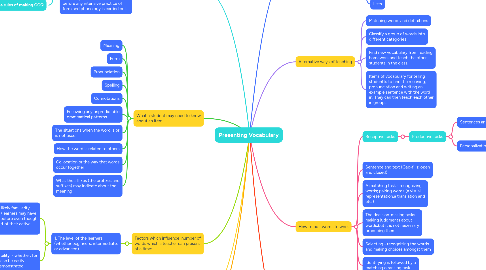
2. What a student may need to know about an item
2.1. Meaning
2.2. Form
2.3. Pronunciation
2.4. Spelling
2.5. Connotations
2.6. Following any unpredictable grammatical patterns
2.7. The situations when the word is or is not used
2.8. How the word is related to others
2.9. Collocation or the way that words occur together
2.10. What the affixes (the prefixes and suffixes) may indicate about the meaning
3. Factors which influence number of words which a teacher can present at a time:
3.1. 1. The level of the learners (whether beginners, intermediate, or advanced)
3.1.1. 2. The learners’ likely familiarity with the words (learners may have met the words before even though they are not part of their active vocabulary)
3.1.1.1. 3.The difficulty of the items - whether, for example, they express abstract rather than concrete meanings, or whether they are difficult to pronounce.
3.1.2. 4.Their ‘teachability’ - whether, for example, they can be easily explained or demonstrated
3.1.2.1. 5. Whether items are being learned for production (in speaking and writing) or for recognition only (as in listening and reading). Since more time will be needed for the former, the number of items is likely to be fewer than if the aim is only recognition
4. Number of words which we should present
4.1. 7+2
5. Ways of presenting vocabulary
5.1. Illustration
5.2. Mime
5.3. Synonyms/Antonyms/Gradable items
5.4. Definition
5.5. Translation
5.6. Context
5.7. Lists
6. Stages of learning vocabulary
6.1. 1.Receiving
6.1.1. 2.Recognizing
6.1.1.1. 3.Retaining
6.1.1.1.1. 4.Retrieving
7. Alternative ways of teaching
7.1. Matching words and definitions
7.2. Classify a group of words into different categories
7.3. Find new vocabulary from reading homework and teach the other students in the class.
7.4. Items of vocabulary for telling studentts to find the meaning, pronunciation and writing an example sentence with the word in. They can then teach each other in groups.
8. How to put words to work
8.1. Receptive tasks
8.1.1. Productive tasks
8.1.1.1. Sentences and text creation
8.1.1.1.1. Students use new words in their own sentences or texts.
8.1.1.2. Personalization
8.1.1.2.1. For example:students can use words to write a true sentence about theirselves or someone they know.
8.2. Sentence and text (Gap-fills: open and closed)
8.3. A matching task - recognizing words; pairing words (a visual representation,a translation and etc.)
8.4. The decision-making tasks - making judgments about words,but it is not necessary producing them
8.5. Selecting - recognizing the words and making choices amongst them
8.6. Identifying is followed by a matching o ranking task
8.7. Sorting the words into different categories
8.8. Ranking and sequencing - putting the words into some kind of order; ranking items according to preference
8.9. Questionnaires (question-and-answer exchanges)
9. Stages of teaching vocabulary
9.1. 1. Conveying meaning
9.1.1. 2. Checking understanding
9.1.1.1. 3.Consolidate learning