
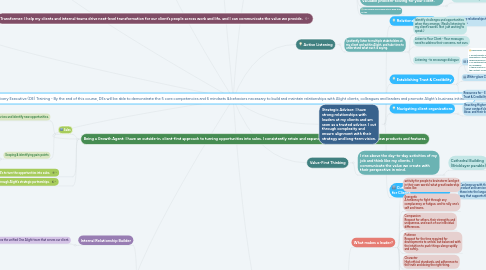
Delivery Executive (DE) Training - By the end of this course, DEs will be able to demonstrate the...


1. Proactive Problem Solving: I make things happen for my client by looking at challenges from their perspective. I diagnose the problem and develop creative solutions.
1.1. Core responsibility is “the ability to make things happen” – the key point of contact for solving problems and making things happen internally. Looks at things from the client's perspective
1.1.1. Root causes/5 whys slides 11-13
1.1.2. SCQA A framework for defining problems and developing a structured approach to the problem.
1.1.3. Resourcefulness
1.1.4. Taking initiative
2. Being a Growth Agent: I have an outside-in, client-first approach to turning opportunities into sales. I consistently retain and expand my client relationships through new products and features.
2.1. Sales
2.1.1. How to sell new services and identify new opportunities.
2.1.1.1. Situation, Opportunity, Wall, Solution - Client service management - logic trees
2.1.1.2. OFF THE TABLE - Operating Efficiency: I prioritize things that are urgent or important, and appropriately delegate across my teams. I am comfortable moving efficiently with speed.
2.1.1.2.1. Governance
2.1.1.2.2. Personal Productivity
2.1.1.2.3. Financial & Business Acumen
2.1.2. Scoping & identifying pain points
2.1.2.1. ties into active listening
2.1.2.2. Consultative Selling (Paul M should have stuff on this)
2.1.2.2.1. Tip from SME: “If you can't explain what this product is to your client, you shouldn't put it in front of your client”
2.1.2.3. focus should be on what to listen for
2.2. Growth Driver: Keeps up with the latest initiatives, and product and service updates, technology and solutions roadmap, and strategic partnerships. Creates an environment where we can bring in our SME’s to turn the opportunities into sales.
2.3. Client-First Perspective: DEs have an outside-in perspective. We think about the client’s issues and problems first. Then we determine how to solve them through our capabilities – whether internal resources or through Alight’s strategic partnerships.
3. Notes/Ideas
3.1. This training is for all the DEs although it's mainly targeted at newer/junior DEs.
3.1.1. Our goal is to develop a learning environment where people are both learning and teaching.
3.2. Idea from DEs: Maybe new DEs should have a mentor when coming into the role
3.2.1. A by-product of this training could be a buddy system. We could build activities or leverage group chats and the live sessions.
3.2.1.1. i.e. In the live session - more senior DEs roles could be assigned to a breakout room with more junior DEs so that they can learn from their experience.
3.2.1.1.1. Keep in mind the importance of change management for live events
4. Kickoff
4.1. Welcome
4.1.1. A video from a leader showing appreciation for the DEs and expressing the value their role brings to the company.
4.1.2. Anonymous comments from DEs
4.1.2.1. What your peers say: When it comes to being successful in the DE role, what would you tell a younger version of yourself?
4.1.2.1.1. "You can only be successful working through others. Be a great team player and delegate."
4.1.2.1.2. "Gaining confidence is important and knowing that even the leaders aren't perfect and learning to trust yourself. There's not just one best optimal way to do something. Take a leap of faith."
4.1.2.1.3. "Don't let your client or your job run you into the ground. Have some work-life balance."
4.1.2.1.4. "Knowing when to shut up and listen and have more patience (is important). Conflict is good sometimes but you need to know how to pick and choose (what to fight for). Know when to defer to your team."
4.1.3. Overview of learning outcomes and course modules.
4.1.3.1. Connect the challenges quoted above from DEs to the content of the program - get the learner prepped for what's to come and manage their expectations for the learning experience.
4.2. Why
4.2.1. This is not an off-the-shelf training program but rather customized for the unique demands of DE role.
4.2.2. The endeavor of this course is to create a collaborative learning environment where DEs can both hone their skills and share their experience and wisdom with others.
4.2.3. The program is also designed to be aspirational, you as the DE decide where you want to build your skills and take your career.
4.2.4. Each DE brings different skills - there is no such thing as the perfect DE in all 11 areas
4.2.4.1. This is a lifelong journey of skill building
4.3. :information_source: "Powering confident decisions, for life"
4.3.1. AI
4.3.2. Experiences
4.3.3. Empathy
4.3.4. New values
4.4. Stress management
4.4.1. Taking PTO
4.4.2. What the experts have to say: tips and tricks
4.4.2.1. DEs need to be able to leave their work at work and have a good work-life balance.
5. Transformer: I help my clients and internal teams drive next-level transformation for our client’s people across work and life, and I can communicate the value we provide.
5.1. :warning: Transformation vs. Vehicle for Transformation
5.2. Stewardship
5.2.1. Help Clients Evolve
5.2.1.1. We help them optimize their processes, accomplish significant business goals … even when it entails significant transformation from existing models.
5.2.1.2. Help clients see the transformation that Alight's solutions will help them make instead of focusing on HOW it does this (Features/functions).
5.2.1.2.1. Slide 6: Google Slides - create and edit presentations online, for free.
5.2.1.3. Execution - Able to turn something upside down - so it works differently - Let's build a new process that is more efficient.
5.2.1.3.1. The ability to take the client's ask and morph it into what Alight's value provides.
5.2.2. Leading with Value
5.2.2.1. :information_source: Demonstrate the value of the solution i.e. by sharing milestones and results.
5.2.3. :white_check_mark: Executive level responsibility and duty of care for the day-to-day affairs of client accounts, including addressing concerns, communicating value and integrating team members.
5.2.3.1. good practical examples here: Google Docs - create and edit documents online, for free.
5.3. Focus more on employees at clients and understanding their needs
5.4. Visioning: The foresight to see a reality that doesn’t yet exist, and then lead a team to achieve it.
6. Integrator: I build internal relationships to integrate our services and colleagues into our client-dedicated One Alight team.
6.1. Internal Relationship Builder
6.1.1. The DE pulls together Alight colleagues from multiple services and businesses, and creates the unified One Alight team that serves our client.
6.1.1.1. Team Builder
6.1.1.1.1. DE holds the team together continuously, describes the mission and reinforces that everyone is part of a larger team. The DE leverages the team’s individual and collective strengths.
6.2. Bringing together all of Alight's different business services
6.2.1. Client Liaison/Mediation
6.2.1.1. Be the client's advocate
6.2.1.1.1. We manage the relationship between our clients and Alight, advocating on behalf of our clients with Alight stakeholders while responsibly managing Alight’s business.
6.2.1.1.2. White-glove Clients
6.2.1.1.3. DEs need to be the internal champion of the client - They have an Alight acquisition playbook but sometimes the client doesn't have time to do it that way so the DE has to be the mediator.
6.2.1.1.4. Represent the client and always have their best interests in mind
6.2.2. Break down the silos and forcefully communicate to the client how the different towers (of solutions) are working together. Don't shy away from the organizational structure.
6.2.2.1. They can do this through team calls and getting everyone on the same page.
6.3. Relationships with Alight Leadership
6.3.1. Maintains relationships with Alight leadership. Can provide tight executive summaries for Alight leaders, and can leverage our leaders appropriately when the needs arise.
6.3.1.1. Executive Updates
6.3.1.1.1. How to talk to leadership and keep them abreast of client status. DEs need to gain/increase comfort level with leadership at Alight.
7. Consulting Confidence - I can carry my client conversations just far enough to tee up the next meeting, and then bring in Alight’s subject matter expert. I know enough about Alight’s offerings to have intelligent conversations with my clients.
7.1. The Solutions
7.1.1. Understanding of internal towers & areas
7.1.1.1. Identifying & finding internal experts - How to navigate and who to go to in different situations.
7.1.2. Glossary of industry specific terms/jargon
7.1.2.1. The idea here is to send out an email asking them to contribute what they think should be in there. If it is a live doc it would be better for all to see what has already been added and get ideas about what should be added.
7.1.3. Technical Aptitude - Developing confidence in your technical knowledge, and in its ability to help your client
7.1.3.1. Not shying away from conversations because we are not the SME (e.g. great at Payroll, but client asks about Health plans)
7.1.3.1.1. Is there scope for having DE's join the Enablement courses we've developed around Payroll, Health and Wealth?
7.1.3.1.2. Going Just Deep Enough (client conversations when you’re not the expert)
7.1.3.1.3. Need to be able to further conversations (even if out of comfort zone) such that DE can bring in SMEs)
7.1.3.2. Survey to assess where their confidence level is now and which areas they want to improve in.
7.1.3.3. Tools, talk tracks, scripts, all-DE Teams channel
7.2. Leadership Presence with clients to show the confidence that you’re grounded in the facts. And that this will translate into valuable problem-solving for your client.
7.2.1. Composure Keeps one’s cool, doesn’t appear rattled. It can come across as a quiet confidence, even if there’s anxiety or fear on the inside.
7.3. Paul Millerd should have lots of good stuff on this
8. Value-First Thinking
8.1. I rise above the day-to-day activities of my job and think like my clients. I communicate the value we create with their perspective in mind.
8.1.1. Cathedral Building (Bricklayer parable)
8.1.1.1. Mindset Challenge - <10 quiz questions to get DEs assessing their approach to the business. The results should be based on various answers they gave to the questions.
8.1.1.1.1. Get them to recognize how their thinking is affecting the way they approach their clients and frame conversations.
8.1.1.1.2. List of 10 questions to ask
9. Strategic Advisor: I have strong relationships with leaders at my clients and am seen as a trusted advisor. I cut through complexity and ensure alignment with their strategy and long-term vision.
9.1. Relationship Building
9.1.1. Develops strong relationships throughout the organization.
9.1.1.1. How to establish yourself as an advisor rather than just a seller
9.1.1.1.1. Think like Your Client: How to view things from the client’s perspective. Help them reach their goals rather than just sell them a solution.
9.1.1.1.2. Don't be more focused on what we need to present than what the client needs. Instead have an outside in instead of inside out perspective
9.1.1.2. Scoping Doc - Asking questions to go deeper
9.1.1.2.1. Focus on the WHY
9.2. Establishing Trust & Credibility
9.2.1. Being transparent
9.2.2. White-glove Clients
9.2.2.1. DE comment: "I've been successful when working with white-glove clients because I have a good relationship and they trust me. They know I wouldn’t come to them with something that isn't good for them."
9.2.3. Resources for - Establishing Trust & Credibility With Clients
9.3. Navigating client organizations
9.3.1. Reaching Higher Client Levels (your contact’s boss; and their boss; and their boss)
9.3.1.1. Resources
9.4. Cutting Through Complexity for Clients
9.4.1. Can keep up with the latest initiatives for product and service updates, and translate these into the language of the client in a way that supports their goals.
9.4.1.1. SME comment: It's not the client's responsibility to know and navigate Alight - it's ours.
9.4.1.2. Strategic Planning
9.4.1.2.1. Navigating the pace of change internally and with clients is challenging - need to pick and choose strategically what I present to clients (filtering information & knowing the client)
9.4.1.2.2. What does success look like - Case studies of other companies like Google and Microsoft (examples of ideas that fell flat)
9.4.1.2.3. Develop a deep understanding of the client’s unique business and strategic challenges
9.4.1.3. Reporting facts and figures: Don’t just report the news. Analyze it, develop a point of view, benchmark it to comparable facts, and then advise clients
9.4.1.3.1. Strategic thinking: Answer the question: So, What?
10. Active Listening
10.1. I patiently listen to multiple stakeholders at my client and within Alight, and take time to understand what each is saying.
10.1.1. Identify challenges and opportunities when they emerge. (Really listening to my client’s words. Not just waiting to speak.)
10.1.2. Listen to Your Client - Your messages need to address their concerns, not ours.
10.1.3. Listening - to encourage dialogue
10.1.3.1. David Bohm conditions for dialogue: 1. all participants must "suspend" their assumptions, literally to hold them "as if suspended before us"; 2. all participants must regard one another as colleagues; 3. there must be a "facilitator" who "holds the context" of dialogue.
11. Clear Communication
11.1. Key Communication Principles
11.1.1. Less is more
11.1.1.1. Use short sentences and simple words instead of long phrases and jargon.
11.1.1.2. Cut out what’s not important. …“I would’ve written less, but I ran out of time.”
11.1.2. Bottom-Lining/Headlining your message (focus on the key issue; strip away the clutter; communicate simply/concisely)
11.1.2.1. What’s your main message? (In one simple sentence.)
11.1.2.1.1. I communicate in a way that bottom-lines my key message and manages the expectations of my internal teams and my clients.
11.1.2.1.2. Figure out what’s most important. Focus on just that.
11.1.2.1.3. Two or Three Key Messages, Max. - If you have more than 2-3 key messages, none will stand out.
11.1.3. Business Writing
11.1.3.1. E-mails
11.1.3.1.1. Managing up content covers different communication styles and email communciation
11.1.4. Presentations
11.1.4.1. PowerPoint slides - Good and bad slide examples
11.1.5. Have a Conversation - Not a Monologue
11.1.5.1. Real consulting is collaborative.
11.1.5.1.1. principles of dialogue
11.1.5.2. Time your pauses so your client can engage.
11.1.6. Slow Down
11.1.6.1. The faster you talk, the less your client hears.
11.1.6.1.1. Nervousness speeds us up. Be aware. Pause, slow down, breathe.
11.1.7. Updating Your Client (busy diner story; socialize this with your team)
11.1.7.1. If the waitress ignores a client who has been waiting at the table for service for 10 minutes - the clients will be very upset. If the waitress on the other hand takes them a cup of coffee and admits she's really busy but will be with them in a few minutes they will feel better about the experience and be more understanding.
11.1.7.2. Clarifying and setting expectations
11.1.7.3. Not leaving clients in dark - efficient answers vs. perfect answers
11.1.8. Your tone: being stern or business-friendly, make sure you are/your communication is balanced professionally.
11.1.8.1. Giving and receiving feedback content
11.1.8.2. Being tactful
11.1.9. Authenticity - the importance of being yourself
11.1.9.1. Candor Video: https://youtu.be/rFgu0nOHCcE
11.1.10. Storytelling
11.1.10.1. Robbie Crabtree content
12. Leader: I navigate the complexity and fluidity in our business environment. I demonstrate clarity of purpose and leadership to my client. I advocate for my clients with Alight stakeholders, while responsibly managing Alight’s business.
12.1. What makes a leader?
12.1.1. activity for people to brainstorm (and get in their own words) what great leadership looks like
12.1.2. Energetic A tendency to fight through any complacency or fatigue, and to rally one’s self and teams.
12.1.3. Compassion Respect for others, their strengths and uniqueness, and each of our individual differences.
12.1.4. Patience Respect for the time required for developments to unfold, but balanced with the intuition to push things along rapidly and safely.
12.1.5. Character High ethical standards, and adherence to the truth and doing the right thing.
12.1.6. Positivity An optimistic and realistic temperament, and a tendency to model it to the clients and teams we lead.
12.1.7. Strength The toughness to remain focused on the goal, despite distractions, obstacles, risks, threats or client’s impatience.
12.2. Influencing within the organization
12.2.1. Managing without being a manager
12.2.1.1. Coaching/mentoring
12.2.1.1.1. Resources - giving feedback - also leveraged under clear communication section
12.2.1.1.2. Resource - managing up - communication - also leveraged under clear communication section
12.2.1.2. Guiding instead of telling people what to do.
12.2.1.3. They manage from a ‘dotted line’ not a direct line as DEs do not have direct reports but many people do report to them as they are in charge of the account.
12.2.2. Persuasion/Negotiation
12.3. Change Management
12.3.1. As Nicole J. pointed out it is the DEs responsibility to keep the client abreast of companywide changes. DEs need to help prepare clients for these changes and ease any tension that these changes may cause.
12.4. Navigating Uncertainty, Complexity & Fluidity: While the HR industry is ever-evolving (i.e. subject to constantly changing laws and regulations) I bring order to my clients. I can express needs and opportunities to my clients in a clear and manageable way. And I can deal with ambiguity, and make judgment decisions that can lead to the best possible outcomes.
12.4.1. Decision making
12.4.1.1. :information_source: Being confident and not shying away from business opportunities.
12.4.1.2. Being prepared and confident to make decisions even when there is no clear solution to a situation/problem.
12.4.1.3. Consistency of Small Positive Actions Over Time
12.4.1.3.1. The Small Steps of Giant Leaps - Farnam Street
12.4.1.4. Being prepared to fail/fail fast (one of their new values?) - similar to the point under operating efficiency.
12.4.2. Internal organization
12.4.2.1. Managing complex teams
12.4.3. I can boldly advocate a point of view and am unafraid to introduce new or conflicting views. I represent the Alight position, while also advocating for my client.
12.4.3.1. Characteristics DEs need to cultivate while navigating uncertainty & complexity
12.4.3.1.1. Fortitude
12.4.3.1.2. Courage
12.4.3.1.3. Persistence
12.4.3.1.4. Grit
12.4.3.1.5. Creativity