Bivariate Statistical Measures
作者:elvis reyes
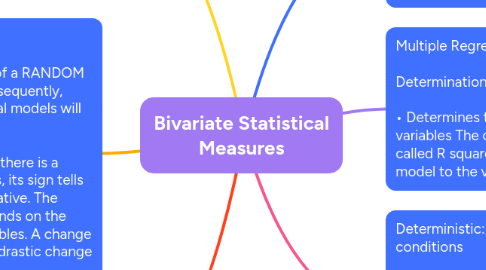
1. Regression Coefficient • Indicates the number of units in which the dependent variable "Y" is modified due to the change in the independent variable "X" or vice versa in a unit of measurement. • The regression coefficient can be: Positive, Negative and Null.
2. Regression analysis model • Statistical: allows the incorporation of a RANDOM COMPONENT in the relationship. Consequently, predictions obtained through statistical models will have an associated prediction error. • Standardized: The slope ẞ1 tells us if there is a relationship between the two variables, its sign tells us if the relationship is positive or negative. The reason is that its numerical value depends on the units of measurement of the two variables. A change of units in one of them can produce a drastic change in the value of the slope.
3. Partial Regression Coefficient • Quantity that results from a multiple regression analysis, indicating the average change in a criterion variable per unit change in a predictive variable, under equal circumstances in all as criction variables.
4. DEFINITION: Regression is about explain the behavior of a variable, called dependent or endogenous explained, based on another variable called dependent or exogenous explanatory variables.
5. Multiple Regression Determination Coefficient R2 • Determines the degree of correlation between the variables The coefficient of determination, also called R square, reflects the goodness of fit of a model to the variable.
6. Deterministic: assumes that under conditions Ideally, the behavior of the dependent variable can be fully described by a mathematical function of the independent variables. That is, under ideal conditions the model allows you to predict the value of the dependent variable WITHOUT ERROR.


