

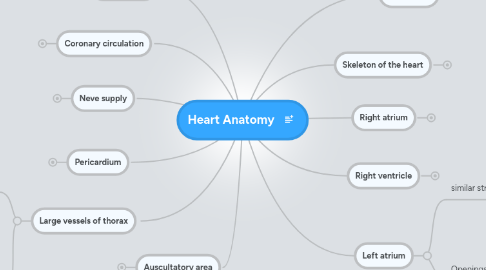
1. Left ventricle
1.1. Openings
1.1.1. Mitral valve
1.1.1.1. Anterior cusp
1.1.1.2. Posterior cusp
1.1.2. Aortic valve
1.1.2.1. Vestibule leads to it (like the infundibulum)
1.1.2.2. right cusp
1.1.2.3. left cusp
1.1.2.4. posterior cusp
1.2. Internal structures
1.2.1. No moderator bands
1.2.2. Two papillary muscles
1.2.3. Thick walls
1.2.4. The lumen is circular in shape
2. Coronary circulation
2.1. Artries
2.1.1. Right coronary artery
2.1.1.1. Sinuatrial nodal branch (60%)
2.1.1.2. Right conus artery
2.1.1.2.1. feeds infundibulum
2.1.1.3. Right marginal branch
2.1.1.3.1. supplies right ventricle
2.1.1.4. Atrioventricular nodal branch (posterior, 65%)
2.1.1.5. Posterior inter ventricular artery (90%, right dominance)
2.1.1.5.1. supplies both ventricles posteriorly
2.1.2. Left coronary artery
2.1.2.1. Anterior inter ventricular artery
2.1.2.1.1. diagonal branch
2.1.2.1.2. left conus artery
2.1.2.1.3. supplies the bundle of HIS
2.1.2.2. Circumflex branch
2.1.2.2.1. Left marginal artery
2.2. Veins
2.2.1. Coronary sinus
2.2.1.1. Small cardiac vein
2.2.1.1.1. with right marginal
2.2.1.2. Middle cardiac vein
2.2.1.2.1. with posterior inter ventricular
2.2.1.3. Great cardiac vein
2.2.1.3.1. with anterior inter ventricular
2.2.2. Right atrium
2.2.2.1. Anterior cardiacl vein
3. Neve supply
3.1. Cardiac plexus
3.1.1. sympathetic
3.1.1.1. preganglionic fibers
3.1.1.1.1. T1-T6
3.1.1.2. Postganglionic fibers
3.1.1.2.1. cervical trunk
3.1.1.2.2. upper thoracic trunk
3.1.1.3. efferent
3.1.1.3.1. increasing rate & contraction force
3.1.1.3.2. vasoconstriction
3.1.1.4. afferent
3.1.1.4.1. referred pain
3.1.2. parasympathetic
3.1.2.1. vagus nerve
3.1.2.2. efferent
3.1.2.2.1. lowering rate & contraction force
3.1.2.2.2. vasoconstriction
3.1.2.3. afferent
3.1.2.3.1. reflexes
4. Pericardium
4.1. surface anatomy
4.1.1. posterior to the sternum, 2-6 costal cartilages
4.1.2. anterior to 5-8 thoracic vertebrae
4.2. Fibrous pericardium
4.2.1. anchors the heart and prevents over stretching
4.2.2. attached to diaphragm, sternum, and major blood vessels
4.2.3. Innervated by the phrenic nerve
4.3. Serous pericardium
4.3.1. parietal layer -> fused to the fibrous pericardium
4.3.1.1. innervated by phrenic nerve
4.3.2. visceral layer (epicardium)
4.3.2.1. innervated by sympathetic trunk & vagus (it's part of the heart)
4.3.3. both are continues around major blood vessles
4.3.4. 50 ml of pericardial fluid in the cavity between them
4.4. Pericardial sinuses
4.4.1. result during development and has NO clinical significance
4.4.2. Transverse sinus
4.4.2.1. between arteries and veins
4.4.3. Oblique sinus
4.4.3.1. within the veins
5. Large vessels of thorax
5.1. Artries
5.1.1. Aorta
5.1.1.1. Ascending aorta
5.1.1.1.1. it's inside the pericardium
5.1.1.1.2. right and left coronary arteries
5.1.1.1.3. begins: at the aortic orifice of left Vent behind the left border of sternum oppsite the 3rd left intercostal space
5.1.1.1.4. run upward, forward to the right ( عكس pulmonary trunk)
5.1.1.1.5. End behind 2nd right sternocostal junction
5.1.1.2. Arch of aorta
5.1.1.2.1. begins at 2nd right sternocostal junction
5.1.1.2.2. end on the left side od disc Between T4-T5
5.1.1.2.3. Brachiocephalic trunk
5.1.1.2.4. left common carotid
5.1.1.2.5. left subclavian
5.1.1.2.6. ligamentum arteriosum binds it with pulmonary trunk biforcation
5.1.1.2.7. Relation p37
5.1.1.3. Descending thoracic aorta
5.1.1.3.1. Begins on the left side od disc Between T4-T5
5.1.1.3.2. Ends at the lower border of T12 by passing through the aoratic opening to continue as abdominal aorta
5.1.1.3.3. Relation p38
5.1.1.3.4. Branches
5.1.1.4. clinical
5.1.1.4.1. Coarctation of aorta
5.1.1.4.2. Aortic aneurysm causing mediastainal syndrome or rupture(fetal)
5.1.1.4.3. Embolism of pulmonary trunk
5.1.2. Pulmonary trunk
5.1.2.1. Right pulmonary artery
5.1.2.1.1. goes behind ascending aorta
5.1.2.2. Left pulmonary artery
5.1.2.2.1. goes in front of descending aorta
5.1.2.3. starts: pulmonary orifice at the summit of infundibulum at the 3rd left costal cartilage
5.1.2.4. end at level of sternal angle (disc Between T4-T5)
5.1.2.5. also inside the fibrous pericardium with the ascending aorta
5.1.2.6. Ligmentum arteriosum:fibrous band between left pulmonary artery and concavity of arch of aorta
5.2. Veins
5.2.1. Superior Vena Cava
5.2.1.1. left brachiocephalic
5.2.1.2. right brachiocephalic
5.2.1.2.1. right subclavian
5.2.1.2.2. internal jaguar
5.2.1.2.3. forms at the root of the neck
5.2.1.3. Union of the 2 brachiocephalic behind lower border of first right costal cartilge
5.2.1.4. End by open in the Rt atrium behind 3rd right costal cartilge
5.2.1.5. Azygos vein as a tributaries, enter before pierces pericardium
5.2.2. inferior Vena Cava
5.2.3. Brachiocephalic
5.2.3.1. begins behind the medial end of clavicle by union of internal jugular and subclavian veins
5.2.3.2. End lower border of first costal cartilage to form S.V.C
5.2.3.3. Drain
5.2.3.3.1. the upper limbs
5.2.3.3.2. head and neck
5.2.3.3.3. anterior wall and upper posterior wall of the thorax
5.2.3.3.4. lymph from the whole body
5.2.3.4. Right brachiocephalic
5.2.3.4.1. Tributaries
5.2.3.5. Left brachiocephalic
5.2.3.5.1. Tributaries
6. Auscultatory area
6.1. Heart
7. Orientation
7.1. Apex
7.1.1. left ventricle
7.2. Base
7.2.1. Mainly left atrium
7.2.2. right atrium
7.3. Anterior surface
7.3.1. Mainly right ventricle
7.3.2. right atrium
7.3.3. left ventricle
7.4. Inferior surface
7.4.1. Mainly left ventricle
7.4.2. Right ventricle
7.5. Right border
7.5.1. Right atrium
7.6. Left border
7.6.1. Left ventricle
7.6.2. Left auricle
7.7. Inferior border
7.7.1. Right ventricle
7.8. Superior border
7.8.1. Vessels
8. Skeleton of the heart
8.1. Fibrous rings surrounding the heart, made of collagen
8.2. Fibrous trigons connect the rings
8.3. Make up the membranous inter ventricular septum
8.4. Function
8.4.1. electrical insulation
8.4.2. support and muscle attachment
9. Left atrium
9.1. similar structure to the right atirum
9.2. Openings
9.2.1. 4 pulmonary viens
9.2.1.1. Left superior pulmonary vien
9.2.1.2. Left inferior pulmonary vien
9.2.1.3. 2 right pulmonary viens
9.2.1.4. NO valves
9.2.2. Mitral valve (left AV)
10. Right atrium
10.1. Posterior wall
10.1.1. Smooth
10.1.2. It is the inter atrial septum
10.1.2.1. Fossa ovalis
10.1.2.2. Anulus ovalis
10.1.2.3. Atrioventricular (AV) node
10.1.2.3.1. most anterior inferior
10.1.2.3.2. septal cusp of tricuspid
10.1.3. 3 openings
10.1.3.1. Superior vena cava
10.1.3.1.1. NO valve
10.1.3.2. Inferior vena cava
10.1.3.2.1. Rudimentary valve
10.1.3.3. coronary sinus orifice
10.1.3.3.1. between the inferior vena cava and the right AV orifice
10.1.3.3.2. Rudimentary valve
10.2. Anterior wall
10.2.1. Rough -> musculi pectinati
10.2.2. Right auricle
10.2.2.1. what separates if from the posterior wall
10.2.2.1.1. Sulcus terminalis (external)
10.2.2.1.2. Crista terminalis (internal)
10.3. Right AV valve (tricuspid)
11. Right ventricle
11.1. Openings
11.1.1. Tricuspid valve
11.1.1.1. anterior cusp
11.1.1.2. septal cusp
11.1.1.3. posterior (inferior) cusp
11.1.2. Pulmonary valve
11.1.2.1. A funnel shaped structure leads to it (the infundibulum)
11.1.2.2. right cusp
11.1.2.3. left cusp
11.1.2.4. anterior cusp
11.2. Internal structures
11.2.1. Trabeculae carneae
11.2.1.1. ridges of cardiac muscles
11.2.1.2. 3 papillary muscles, each gives chordae tendineae to 2 cusps
11.2.1.3. moderator band
11.2.1.3.1. Shortcut to convoy the right branch of the AV bundle
11.2.2. Inter ventricular wall
11.2.2.1. Membranous wall
11.2.2.1.1. very thin, superior
11.2.2.2. Muscular part
11.2.3. Lumen is crescent shape