

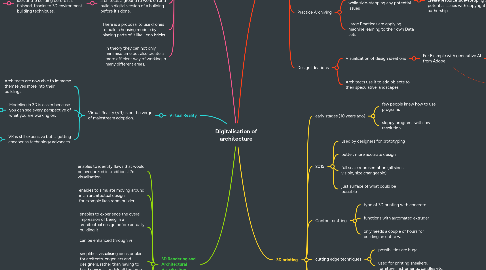
1. Drones
1.1. Drones in general have a bad reputation, because of the misuses so far.
1.1.1. Such as warfare and surveillance
1.2. The history of what we might recognize as drones today began during World War I.
1.2.1. Airplanes guided by radio were used to attack zeppelins.
1.2.1.1. Development of radio-controlled airplanes continued after the war, with better, faster, and, more importantly, smaller drones taking flight.
1.3. Drones can be a useful tool for designers, realtors, architects, and as a delivery service, that provides products in less than an hour.
1.4. They can scan an area, giving the architects a ground to work on and build a digital version of a building before it's done.
1.4.1. Giving the clients an opportunity to look at the building before it's finished, thanks to 3D environment building techniques.
1.4.1.1. Looking inside a room, a building that doesn't exist yet.
1.5. There is a proposal to use drones to build a housing module by placing parts of it like Lego bricks.
1.6. In theory they can not only minimise time but also create a more efficient way of working in many different areas.
2. Virtual Reality
2.1. Virtual Reality (VR) is on the verge of mainstream adoption.
2.1.1. Architects are now able to immerse themselves more into their buildings.
2.1.2. Modeling in 3D is easier because you can see every perspective of what you are working on.
2.1.2.1. VR is making product design more intuitive.
2.1.3. VR is still expensive but is getting cheaper as technology advances.
2.1.3.1. Like Mcdonalds did with their "HappyMeal" cutboard VR Googles, it shows that the industry wants to bring VR more into the public eye.
3. AI
3.1. Concept Designs
3.1.1. Image diffusion apps can produce a stunning concept design images from text prompts alone
3.1.1.1. Architects can take their early stage models and apply stylistic iterations in real time
3.1.1.1.1. -> cycling through different materials types and different iterations of design ideation
3.1.2. Apps like Midjourney and Stable Diffusion
3.2. Text Generation
3.2.1. chat gpt
3.2.1.1. It can be used as a research tool or text generator, although only responding to a series of prompts
3.2.1.2. Writing/rewording reports
3.2.1.3. Summarizing ideas for client presentations
3.2.1.4. Uses general online knowledge with predefined cut-off dates
3.2.1.5. Fee proposals, planning applications, HR tasks
3.3. Practice Archiving
3.3.1. Streamlines their own operations and creates a resource of value while side-stepping any potential issues
3.3.1.1. this should streamline their own operation, the Large practice also create resource side-stepping any potential issues with copyright or authorship
3.3.2. Large Practices are applying machine learning to their own Data sets
3.4. Design Ideations
3.4.1. Visualization of design ideations
3.4.1.1. For Example with generative AI from Adobe
3.4.1.1.1. every user that has photoshop can easily use its Generative Fill system, which means that those people can have viszalizing skills in few seconds
3.4.2. Architects use it to add objects to their speculative landscapes
4. 3D Rendering and Architectural Visualization
4.1. enables to identify flaws that would be overlooked in traditional 2d visualisation
4.2. enables to simulate moving around in an architectual design for example Ikea room builder
4.3. enables to experience the overall impression of being in a architectual design before actually building it can be enhanced through vr
4.4. simplifies visualising ideas or plans for arcitects, engeniers and designers, rather than having to build physical models all the time
4.5. People are able to configure products like cars for example to their liking, to get a better picture of what they'll be expecting.
4.6. 3D design is getting more and more accessable through open source softwares like blender
4.7. The softwhere is getting way better very fast, in aspects of time for renderings, performence and new aproches such as ADF medeling systhem which is an entire new aproch to 3D meding
5. 3D printing
5.1. early stages (10 years ago)
5.1.1. few people knew how to use programs
5.1.2. sloppy programs with low resolution
5.2. 2019
5.2.1. used by designers for prototyping
5.2.2. better, more accurate design
5.2.3. full scale representation (all sides visible, size changeable)
5.2.4. just surface of what could be possible
5.3. Contour crafting
5.3.1. type of 3D printing with concrete
5.3.2. functions with automated extruder
5.3.3. only needs a couple of hours for building an entire wall
5.4. cutting edge techniques
5.4.1. possibilities are huge
5.4.2. used for printing sneakers, furniture, instruments, candles etc.
5.5. future (now)
5.5.1. entire houses being printed
5.5.2. impactful revolution (same level as petroleum products)
5.5.3. will be able to print more than sneakers, furniture, musical instruments & candles
5.6. Connections
5.6.1. Connected to 3D rendering and 3D modelling
5.6.2. helps recreate objects accurately in 3D space (via a software)
5.6.3. compliment each other