


International Management
作者:YenJie Tan
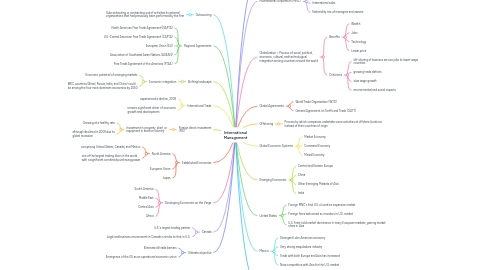
1. Outsourcing
1.1. Subcontracting or contracting out of activities to external organizations that had previously been performed by the firm
2. Regional Agreements
2.1. North American Free Trade Agreement (NAFTA)
2.2. U.S.-Central American Free Trade Agreement (CAFTA)
2.3. European Union (EU)
2.4. Association of Southeast Asian Nations (ASEAN)
2.5. Free Trade Agreement of the Americas (FTAA)
3. Shifting landscape
3.1. Economic integration
3.1.1. Economic potential of emerging markets
3.1.2. BRIC countries (Brazil, Russia, India, and China) could be among the four most dominant economies by 2050
4. International Trade
4.1. experienced a decline, 2009
4.2. remains significant driver of economic growth and development
5. Foreign direct investment (FDI)
5.1. Investment in property, plant, or equipment in another country
5.1.1. Growing at a healthy rate
5.1.2. although declined in 2009 due to global recession
6. Established Economies
6.1. North America
6.1.1. comprising United States, Canada, and Mexico
6.1.2. one of the largest trading blocs in the world with a significant combined purchasing power
6.2. European Union
6.3. Japan
7. Developing Economies on the Verge
7.1. South America
7.2. Middle East
7.3. Central Asia
7.4. Africa
8. Canada
8.1. U.S.'s largest trading partner
8.2. Legal and business environment in Canada is similar to that in U.S.
9. Ultimate objective
9.1. Eliminate all trade barriers
9.2. Emergence of the EU as an operational economic union
10. Apply management concepts and techniques in a multinational environment
10.1. Adapt management practices
11. Multinational corporation (MNC)
11.1. Operations in more than one country
11.2. International sales
11.3. Nationality mix of managers and owners
12. Globalization = Process of social, political, economic, cultural, and technological integration among countries around the world
12.1. Benefits
12.1.1. Wealth
12.1.2. Jobs
12.1.3. Technology
12.1.4. Lower price
12.2. Criticisms
12.2.1. off-shoring of business service jobs to lower-wage countries
12.2.2. growing trade deficits
12.2.3. slow wage growth
12.2.4. environmental and social impacts