


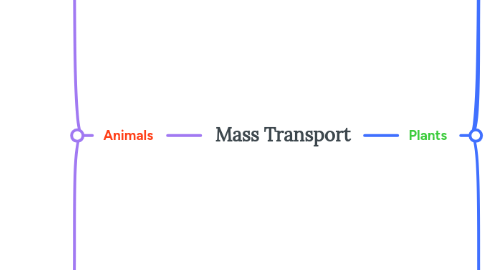
1. Animals
1.1. Haemoglobin
1.1.1. Transports Oxygen
1.1.2. Oxyhaemoglobin Dissociation Curve
1.1.2.1. (+ve) Co-operativity
1.1.2.2. S-Shaped curve
1.1.2.3. Bohr Effect and Carbon Dioxide
1.1.2.3.1. pH has an effect with concentration of carbonic acid changing the amount of carbon dioxide being present
1.1.2.4. Changes in affinity for oxygen
1.1.2.4.1. Unloading at the tissue
1.1.2.4.2. Loading at the lungs
1.1.3. Differnt Types for Different Species and Environments
1.1.4. Quaternary Protein
1.1.4.1. 4 Polypeptide Chains with Haem Groups
1.1.4.2. One Haem Group = One Moleucle of Ocygen
1.2. Circulatory System
1.2.1. Closed System
1.2.1.1. Double Pump System
1.2.2. Heart and Blood Vessels
1.2.2.1. Arteries
1.2.2.1.1. Thick Muscle Layer
1.2.2.1.2. Thick Elastic Layer
1.2.2.1.3. High Pressure of Flowing Blood
1.2.2.1.4. Usualy Carry Oxygenated Blood
1.2.2.1.5. Small Lumen
1.2.2.2. Veins
1.2.2.2.1. Thin Muscle Layer
1.2.2.2.2. Thin Elastic Layer
1.2.2.2.3. Low Pressure of Flowing Blood
1.2.2.2.4. Usually Carry Deoxygenated Blood
1.2.2.2.5. Valves
1.2.2.2.6. Large Lumen
1.2.2.3. Capillaries
1.2.2.3.1. One-cell-thick wall
1.2.2.3.2. Tissue Fluid Action Pathway
1.2.2.4. Atria and Ventricles
1.2.2.4.1. Cardiac Cycle
1.2.2.5. Pulmonary Vein and Artery
1.2.2.5.1. Take blood from and to the lungs
1.2.2.6. Renal Vein and Artery
1.2.2.6.1. Take blood from and to the kidneys
1.2.2.7. Hepatic Portal Vein and Artery
1.2.2.7.1. Take blood from and to the liver
1.2.2.8. Coronary Arteries
1.2.2.8.1. Supply the heart with blood
2. Plants
2.1. Xylem
2.1.1. Transports water in stems and leaves
2.1.2. Transpirational Pull
2.1.2.1. Stomata open for water loss
2.1.3. Cohesion-Tension Theory
2.1.3.1. Continous columns of water
2.1.3.2. H-bonds attachment and ticking and forces of pull btw them
2.1.3.3. Changes in diameter and trunk
2.2. Phloem
2.2.1. Transports organic substances an ions
2.2.2. Mass Flow theory for translocation
2.2.2.1. sieve tube elements
2.2.2.2. sieve plates
2.2.2.3. companion cells
2.2.2.4. Active transport of sugars
2.3. Investigation for the Evidence of Translocation
2.3.1. Ringer Experiment
2.3.2. Tracer Experiment
2.4. Investigatoin for Uptake of Water
2.4.1. This is the experiment which is used to measure the rate of water uptake as a way of measuring transpiration even though mesuring transpiration is not possible or clear just yet.
2.4.2. Method
2.4.2.1. The potometer is filled completely with water, no air bubbles.
2.4.2.2. A leafy shoot is cut underwater to stop air entering the xylem and breaking the water column (interrupting transpiration pull).
2.4.2.3. Using a rubber tube, the shoot is fitted to the potometer under water.
2.4.2.4. The potometer is removed from under the water and joints are sealed with vaseline to prevent the formation of air bubbles which can alter the results.
2.4.2.5. An air bubble is introduced into the capillary tube.
2.4.2.6. Introduce the environmental condition and allow the shoot to adapt for a few minutes.
2.4.2.7. The distance moved by the air bubble in a given time is measured a number of times and the mean is calculated.
2.4.2.8. Using this mean, the volume of water lost is calculated.
2.4.2.9. Volume of water lost against the time in minutes can be plotted on a graph.
2.4.2.10. Once the bubble nears the junction of the reservoir tube, open the reservoir to reset the bubble.
2.4.2.11. The experiment can be continued, changing the strength of the environmental condition.