


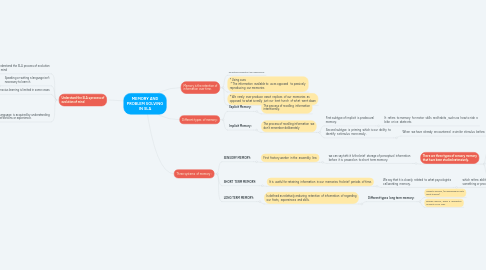
1. Understand the SLA a process of evolution of mind
1.1. Understand the SLA process of evolution of mind
1.1.1. Skill innastist, mentalist and influence
1.2. Speaking or writing a language isn't necessary to learn it.
1.2.1. Knowledge that get a student is based on in organized system
1.3. Conscius learning is limited in some cases
1.3.1. Dynamic system in constant evolution
1.4. Language is acquired by understanding reflections or experience.
1.4.1. Emotional filter hypothesis
1.4.1.1. Student motivated with: * Confident *Low level of anxiety *Positivism
1.4.1.1.1. It will get optimal results
1.4.1.2. Student unmotivated with-distrust *Anxiety *Problems social media (bulling) *Imsomnia
2. Three systems of memory :
2.1. SENSORY MEMORY:
2.1.1. First factory worker in the assembly line.
2.1.1.1. we can say taht it Is the brief storage of perceptual information before it is passed on to short term memory.
2.1.1.1.1. There are three types of sensory memory that have been studied extensively.
2.2. SHORT TERM MEMORY:
2.2.1. It is useful for retaining information in our memories fro brief periods of time.
2.2.1.1. We say that it is closely related to what psycologists call working memory.
2.2.1.1.1. which refers: ability, to hold on to information we have currently thinking about something or processing.
2.3. LONG TERM MEMORY:
2.3.1. Is defined as relatively enduring retention of information of regarding our facts, expereinces and skills.
2.3.1.1. Different types long term memory:
2.3.1.1.1. Semantic memory, (our knowledge of facts about te world)
2.3.1.1.2. Episodic memory, which is recollection of events in our lives.
3. Memory is the retention of information over time.
3.1. We actively reconstruct our memories as:
3.2. * Using cues * The information available to us as opposed to passively reproducing our memories
3.3. * We rarely ever produce exact replicas of our memories as opposed to what is really just our best hunch of what went down
4. Different types of memory:
4.1. Explicit Memory:
4.1.1. The process of recalling information intentionally.
4.2. Implicit Memory:
4.2.1. The process of recalling information we don't remember deliberately
4.2.1.1. First subtype of implicit is prodecural memory.
4.2.1.1.1. It refers to memory for motor skills and habits , suchs as how to ride a bike or ice skate etc.
4.2.1.2. Second subtype is priming which is our ability to identify a stimulus more easily .
4.2.1.2.1. When we have already encountered a similar stimulus before.