


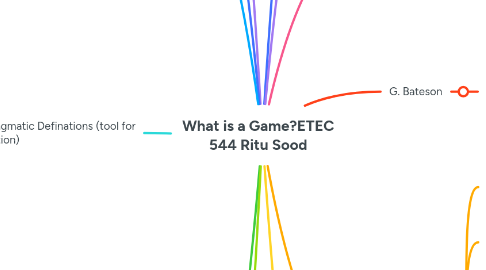
1. Formal Definations
1.1. Parlett
1.1.1. Means
1.1.1.1. Game Equipment and Rules
1.1.2. Ends
1.1.2.1. One player/team is an achiever
1.2. Suits
1.2.1. Permitted by rules
1.2.2. Monoploy-Game based on rules
1.2.2.1. Game of skill and strategy
1.2.2.2. gathering wealth+properties
1.3. Crawford(1982)
1.3.1. Fundamental aspects that will
1.4. K Salen & E. ZImmerman
1.4.1. Rules of play
1.4.2. Quantifiable Outcome
1.4.3. artificial conflict
1.4.4. J. Juul's Magic Circle
2. G. Herbert Mead
2.1. Precursor to communication
2.2. Make believe
2.3. Higher Level Organization
2.4. Games are excellent mirrors
3. H Jenkins
3.1. New form of popular art
3.2. Game designers are artists of the century
3.3. Aesthetic conservatism
4. Pragmatic Definations (tool for action)
4.1. Meir Stretegy games(less rigorous and more casual CIVILIZATION V)
4.1.1. a game is a series of interesting choices
4.2. Action Games
4.3. MDA-Three Dimensions
4.3.1. Mechanics
4.3.1.1. Rules and basic codes
4.3.2. Dynamics
4.3.2.1. Algorithm patterns
4.3.3. Aesthetics
4.3.3.1. Sensation
4.3.3.1.1. Pleasure
4.3.3.2. Fantasy
4.3.3.2.1. Make-Believe
4.3.3.3. Narrative
4.3.3.3.1. Drama
4.3.3.4. Challenge
4.3.3.4.1. Obstacle
4.3.3.5. Fellowship
4.3.3.5.1. Social Framework
4.3.3.6. Discovery
4.3.3.6.1. Uncharted Territory
4.3.3.7. Expression
4.3.3.7.1. Self-Discovery
4.3.3.8. Submission
4.3.3.8.1. PAst-time
4.3.4. MDA-ignores the expressive side of the game
4.4. Hunicke, Leblanc and Zubek
5. Issue of Genre
5.1. Wolf
5.1.1. Interactivity and games goals are linked
5.2. E. Aarseth
5.2.1. Based on series of variable
5.2.2. No objective way of differentiating
5.2.3. Arbitrary-genre create expectations
5.3. Four Genre Games
5.3.1. Action Games
5.3.2. Adventure Games
5.3.2.1. Plot of mystery or exploration
5.3.3. Strategy Games
5.3.3.1. Real- Time Mystery
5.3.3.1.1. Resembles action games-fast reactions and skillfull manipulation of mouse
5.3.3.2. Turn-Based Mystery
5.3.3.2.1. Action stops while player make their choices
5.3.4. Process-Oriented Games
5.3.4.1. Provides a system to play with
5.3.4.2. Entertainment Purposes
5.3.4.3. Character explores and manipulates an ever changing world
5.3.4.4. Incharge of fundamental variables
6. SteinKuehler and Malaby
6.1. Life Rules apply
6.2. Underlying Tensions
6.3. Legal Stitautions
7. R Caillois
7.1. Four Dominant Features of play
7.1.1. Competition
7.1.1.1. Find the better player
7.1.2. Chance
7.1.2.1. Probability to make it exciting and fair
7.1.3. Imitation
7.1.3.1. Experience new ways
7.1.4. Vertigo
7.1.4.1. New experiences are pleasurable
7.2. Classification of Games (Explicitly)
7.2.1. Ludus
7.2.1.1. Restrictive rules(Chess)
7.2.2. Paidia
7.3. Ambigous Rules of Video Games
7.3.1. Real Time strategy and Rules
7.4. Sandbox Activity
7.4.1. Social Rules
8. M. McLuhan
8.1. Games are
8.1.1. actions of culture, art and social reactions
8.1.2. Oracle of the electronic age
8.1.3. Dramatic models of psychological lives.
8.2. Games can
8.2.1. release tension.
8.2.2. also provoke anger and frustration.
9. G. Bateson
9.1. Metacommunication
9.1.1. Helps to understand fictions as meaningful
9.1.2. Alternate Reality Games+reality(using real websitesand email address)
10. Wittgenstein (German Philosopher 1889-1957)
10.1. Elements-Luck & Skill
10.2. Family Resemblences
10.3. Formal game analysis rests on language (German context)
11. J. Huizinga
11.1. Sanskrit drama "Homo Ludens" translated inferior to serious activities.
11.2. Magic circle- cut off from outside world
11.3. Virtual World- Castronova echoed his point
11.4. Real World activities
11.4.1. Require time
11.4.2. Affect moods
11.4.3. Communication media
11.4.4. Affect our behaviour
11.4.5. Affect outside world
11.5. Juul
11.5.1. Confusing metaphor
11.5.2. 3 Frames
11.5.2.1. Goal Orientation
11.5.2.2. Experience
11.5.2.3. Social Context
12. B Sutoton
12.1. Exercise of voluntary control
12.2. Game is Fixed, Finite and goal Oriented
12.3. Different forms
12.3.1. Social games
12.3.2. Solitary Games
12.3.3. Physical Games
12.3.4. Theoretical Games