


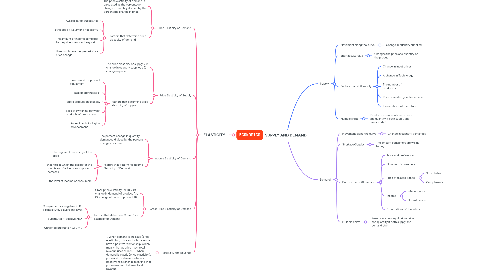
1. ECONOMICS
1.1. ELASTICITY
1.1.1. Price Elasticity of Demand
1.1.1.1. The price elasticity of demand is calculated as the percentage change in quantity divided by the percentage change in price.
1.1.1.2. Factors that determine price elasticity of demand
1.1.1.2.1. Availability of Substitutes
1.1.1.2.2. Is the good a luxury or a necessity?
1.1.1.2.3. The amount of income compared to the price spent on the good
1.1.1.2.4. How much time has passed since price change
1.1.2. Price Elasticity of Supply
1.1.2.1. The price elasticity of supply = % change in quantity supplied / % change in price.
1.1.2.2. Factors that determine price elasticity of supply
1.1.2.2.1. Time period for product adjustment
1.1.2.2.2. Ease of storing stock
1.1.2.2.3. Spare production capacity
1.1.2.2.4. Ease of switching between products of production
1.1.2.2.5. Pace of technicological advancement
1.1.3. Income Elasticity of Demand
1.1.3.1. The percent change in quantity demanded divided by the percent change in income
1.1.3.2. Factors that determine Income Elasticity of Demand
1.1.3.2.1. The degree of necessitiy of the good
1.1.3.2.2. that rate at which the desire for the good is satisfied as consumption increases.
1.1.3.2.3. the level of income of consumers.
1.1.4. Cross Price Elasticity of Demand
1.1.4.1. Cross price elasticity (XED) = (% change in demand of product A) / (% change of price of product B),
1.1.4.2. Factors that determine Cross Price Elasticity of Demand
1.1.4.2.1. Complements > negative XED. Example DVD players and DVD.
1.1.4.2.2. Substitutes > positive XED.
1.1.4.2.3. Unrelated products > XED = 0
1.1.5. Elasticity and Revenue
1.1.5.1. 1. When demand is inelastic (price elasticity ), price and total revenue have a positive relationship, which means that as price rises, total revenue rises as well. 2. When demand is elastic (price elasticity ), price and total revenue have a negative relationship, meaning that price rises lead to lower total revenue.
2. Supply
2.1. Movement along the curve
2.1.1. Change in quantity supplied
2.2. Shortage/Surplus
2.2.1. Changes the price and quantity of the product
2.3. Factors that shift supply
2.3.1. Change in input prices
2.3.2. A change in Technology
2.3.3. The number of producers
2.3.4. Price of related good or service
2.3.5. Expectations of the future
2.4. Multiple shifts
2.4.1. Results in a new equilibrium price and quantity if both supply and demand shift
3. Demand
3.1. Movement along the curve
3.1.1. Change in quantity demanded
3.2. Shortage/Surplus
3.2.1. The amount consumers are willing to buy
3.3. Factors that shift demand
3.3.1. Taste and preference
3.3.2. Number of consumers
3.3.3. Price of related goods
3.3.3.1. Substitutes
3.3.3.2. Compliments
3.3.4. Income
3.3.4.1. Inferior goods
3.3.4.2. Normal goods
3.3.5. Expectations of the future
3.4. Multiple shifts
3.4.1. Results in a new equilibrium price and quantity if both supply and demand shift