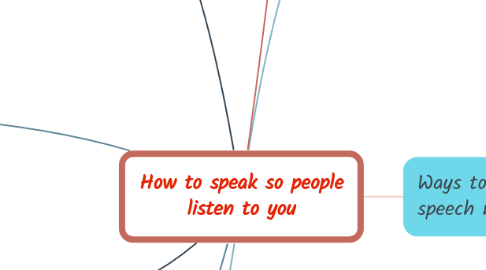
How to speak so people listen to you

马上开始. 它是免费的哦
注册 使用您的电邮地址
How to speak so people listen to you 作者: Mind Map: How to speak so people listen to you

1. be clear and straight

2. be your word

3. wish people well

4. be yourself

5. the relative highness or lowness of a tone as perceived by the ear

6. Like all aspects of vocal variety, it is best when it is varied (swift and slow)

7. reading with good expression, intonation, including pitch, tone, volume, and emphasis on certain words.

8. focus on speaking slowly, with regular pauses and deep breaths

9. Modes of persuasion

9.1. ETHOS

9.2. PATHOS

9.3. LOGOS

10. Aristotle defined three distinct rhetorical appeals as they pertained to the art of persuasion

11. Ways to make our speech more powerful

11.1. HAIL

11.1.1. HONESTY

11.1.2. AUTHENCITY

11.1.3. INTEGRITY

11.1.4. LOVE

12. we tend to believe whom we respect (CREDIBILITY)

13. get emotional response from the audience (using hidden triggers, hints, personal stories and vivid language)

14. use of reasoning (statistics, arguments, facts)

15. Improve your voice

15.1. Instruments

15.1.1. Register

15.1.2. Timbre

15.1.3. Prosody

15.1.4. Pace

15.1.5. Pitch

15.2. Warm-up exercises

15.2.1. Long breaths

15.2.2. Diaphragm exercises

15.2.3. Letting your lips go loose

15.2.4. Lip Rolls and Lip Trills

15.2.5. Tongue Twisters

16. Structuring a Speech

16.1. INTRO

16.1.1. MAIN BODY

16.1.1.1. CONCLUSION

17. HONOUR CODE

17.1. Be truthful (stick to the facts)

17.2. Give your audience accurate info

17.3. Demonstrate tolerance to cultural diversity

17.4. Avoid plagiarism

17.5. Build goodwill, show your concern to the needs of your audience

18. while speaking from your chest gives a lower, more authoritative tone

19. General guidelines

19.1. Keep it short

19.2. Be careful if using humour

19.3. Be positive

20. Some habits we should move away

20.1. Gossips

20.2. Judjing

20.3. Negativity (Complaining)

20.4. Dogmatism

20.5. Exaggeration

20.6. Accussing

21. obtain the attention

22. a flavourable impression

23. logic and structural speech

24. proper mood

25. a sense of closure

26. summary phase, concluding

26.1. Quotation

26.2. A challenge

26.3. Visualize the future

26.4. An appeal

27. use various types of supports effectively

27.1. Definitions

27.2. Generalizations

27.3. Citations

27.4. Examples

27.5. Formal reasoning

28. orient the audience to the parts

29. arouse interest

30. Nonverbal Communication

30.1. Come on strong

30.2. Make contact (one thought- one look)

30.3. Shake things up (monitor audience's reaction)

30.4. Posture & Gesture ( standing with their shoulders back and chin raised, open posture)

30.5. Pause & Nod after key ideas