


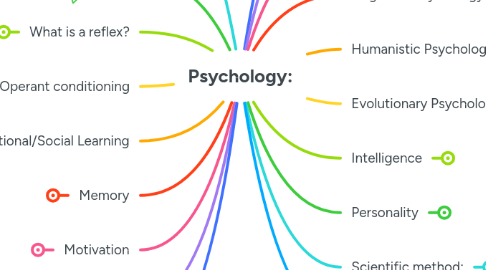
1. What is it?
1.1. "Scientific investigation of mental processes (thinking, remembering and feeling) and behaviour"
1.2. Goals of psychology is to describe, explain, predict and change behaviour and mental processes.
2. What is Learning?
2.1. Learning is adapting to the past, within your lifetime
2.2. Our nervous system is changed by our experiences in such a way as to change how you'll react to similar experiences in the future
3. What is a reflex?
3.1. Automatic behaviour in response to a stimulus
3.2. Unconditioned stimulu and unconditioned responses e.g. puff of air to eye = eyeblink reflex, or food= salivate
3.3. Classical conditioning (aka Pavlov conditoning): innate reaction can come to be paired with neutral stmuli, to produce 'learned' (conditioned) responses
4. Operant conditioning
4.1. also known as 'goal-orientated learning'
4.2. help explain voluntary actions: why we might engage in a particular behaviour
4.3. more likely to repeat actions with good consequenes, and less likely to repeat actions with bad consequences
4.4. reinforcement: any consequence that makes the precedng behaviour more likely to reoccur in the future
4.4.1. positive reinforcement: to give something nice E.g. giving chocolaes, praise
4.4.2. negative reinforcement: to take away something bad E.g. giving painkillers, turning off annoying noises
4.5. punishment: any consequence that makes the preceding behaviour less likely to reoccur in the future
4.5.1. positive punishment: to add something bad E.g. scolding, imprisonment
4.5.2. negative punishment: to take away something nice e.g. grounding, confiscatiion of games
4.5.3. Problems with Punishment: can generate undesirable effects e.g. anger, aggression, apathy. It also demands continous monitoring of behaviour
5. Observational/Social Learning
5.1. Modelling: acquiring a new set of behaviours by copying the movements of another
5.2. vicarious conditioning: acquiring a conditioned response (either classical or operant) based on seeing the pairings + consequences play out for someone else
5.3. Tutelage: teaching concepts or procedures primarily through direct instruction or explanation
5.4. Principles of Behaviour Analysis:
5.4.1. Bheavioural intentions can reduce and/or increase taregt behaviours
5.4.2. decision to change behaviour depends on many factors
5.4.2.1. First step: functional assessment of behaviour. ABC MODEL:
5.4.2.1.1. Antecdents- specific trigger/stimuli
5.4.2.1.2. Behaviour: response of the individual
5.4.2.1.3. Consequence: positive/negative reinforcement
5.4.2.2. Shaping: Occurs when the likelihood of spontaneously performing target behaviour is low.
5.4.2.3. Chaining: for more complex behaviours. They break the activity down, through taska analysis
5.4.2.3.1. Backwards chaining: teaching the steps of the activity backwards
5.4.2.3.2. Forward training: start as step 1, then follow others
5.4.2.3.3. Total/whole task chaining: whole task in 1 go
5.4.2.4. Reinforcers: effectiv reinforcers need to be identified on an individual basis
5.4.2.4.1. Primary reinforcers: meet biological needs
5.4.2.4.2. Secnday: associated with primary, used to help gain primary such as money to buy food.
6. Memory
6.1. The faculty by which the mind stores and remembers information
6.2. Importance: fundamental to daily function, creates meaningful life narratives, allow us to learn from our mistakes and successes
6.3. Basic Memory Processes
6.3.1. Encoding: How does information get into memory. Attention is critical to make sure info is encoded
6.3.1.1. Strategies for encoding:
6.3.1.2. Elaboration: linking the stimulus to other ideas/events
6.3.1.3. Visual imagery: holding a relevant image in the "mind eye'
6.3.1.4. Self-relevance- framing information as relevant to oneself
6.3.1.5. Motivation to Remember: explicitly thinking about possible future contexts when it may be useful
6.3.2. Storage: How is the information maintained once encoded
6.3.3. Retrieval: How is the information brought back out
6.3.3.1. Relies on retrieval cues
6.4. Sensory + Working Memory:
6.4.1. Sensory Memory: Raw sensory data stored for approx. 1 second,
6.4.1.1. echoic and iconic memory
6.4.2. Working Memory: Primary system to share, integrate and reallocate info for multiple parts of the brain
6.4.2.1. Information stored here is only held for a short duration (10-20s), without rehearsal
6.4.2.2. Can increase via Chunking
6.5. Long-term Memory:
6.5.1. our daily lives encounter extensive transferring of information back and forth between Working Memory and Long term
6.5.1.1. any time we remember old piece of info, that involves LTM feeding a content trace back to WM, where missing details are reconstructed
6.5.2. Divisions of Long-term Memory:
6.5.2.1. Declarative (explicit) information that is consciously summoned as verbally describable facts, events or beliefs
6.5.2.1.1. episodic: considered events that occurred somewhere within narrative of one's life-history
6.5.2.1.2. semantic: general knowledge e.g. remembering PM of Aus
6.5.2.2. procedural (implicit) All of the other, more subtle and unconscious ways we learn and adapt to the world
6.5.2.2.1. skill-learning
6.5.2.2.2. priming
6.5.2.2.3. conditioning
6.6. Errors and Memory Failures:
6.6.1. can lose info at any stage of the process, memory can be rendered inaccurate or incomplete by
6.6.1.1. Intrustion errors: the mixing of related, but more recent, memory information into an existing episodic memory
6.6.2. False Memories:
6.6.2.1. Misinformation Effects: the retrieval environment provides details that contaminate the memory (assumption of guilt)
6.6.2.2. Schematic Fitting: commonly associated ideas from habitual thinking add details that fit your worldview (E.g. stereotypes)
6.6.2.3. Implication for: eyewitness testimony, 'repressed memories' of childhood abuse
6.6.3. Disordered Memories
6.6.3.1. Anterograde/Retrogade Amnesia
6.6.3.1.1. Aside from dementia, sudden, retrograde amensia is rare and usually only caused by emotional dissociation
7. Motivation
7.1. Definition: a 'motive' is an internal state that compels goal-directed behaviour and thought. Defined in terms of object of motivation (i.e. the goal) and the intensity of the want/need (e.g. urgency, excitement, discomfort)
7.1.1. Drive theories: Both the PSYCHODYNAMIC + BEHAVIOURIST perspective contributed to drive theories to motivational psychology
7.1.1.1. A 'Drive' is a basic internal process that REGISTERS a NEED + creates an internal STATE OF TENSION in proportion to the intensity of that need
7.1.1.2. All drive operates on the mechanism of NEGATIVE FEEDBACK
7.1.1.3. PSYCHODNYMAIC: Freud's inital drive theories focused on the Unconscious Drives that are complex and partially amviguous when emerging into conciousness. Freud CLASSIFIED DRIVE SENSATIONS in 2 categories
7.1.1.3.1. Eros: desire to gratify a bodily need for sustenance, pleasure or relief
7.1.1.3.2. Thanatos: Desire control or destory unwanted parts of self or environment
7.1.1.4. Behaviourist: soughts to create more physiologically literal and measurable than FREUD
7.1.1.4.1. Make Key distinction betwen: Primary Drives: innate physiology e.g. hunger, thirst, fatige
7.1.1.4.2. Secondary Drive: learned from association e.g. money, fancy luxury items, online clout
7.1.1.4.3. Incentive Theory: outlines the social learning of secondary drives
7.1.1.5. Overall contribution of drives: basic building block of motivational theories, with later theories adding additional factors on top of drive-reduction
7.1.2. Cognitive theories:
7.1.2.1. developed theories about how we organise our knowlesge when our desires require MULTIPLE PLANNED STEPS:
7.1.2.1.1. Goal-Setting Theory: Imagining future situation to PLAN STEPS to get from 'here' to 'there'
7.1.2.1.2. Expectancy-Value Theory: Goal desirability is caused by both the PROSPECT and PLAUSIBILITY. How meaningful would it be for me to get this goal? How realistic is it for me to achieve this goal?
7.1.2.1.3. Self- Determination Theory: Can be extrinsic (goal-orientated) or intrinsic ( activity-orientated), where actions we are performing are compelling and provide motivation in themselves
7.1.3. Humanistic + Evolutionary theories:
7.1.3.1. Humanistic perspective: primarily concerned with human FLOURISHING and the therapeutic prospect of POSITIVE GROWTH, so their contributions to motivational theory address how different spheres of NEEDS RELATE TO EACH OTHER, and the effects of DEPRIVATION
7.1.3.1.1. Main theory is MASLOW'S HIERARCHY OF NEEDS, which arrange common needs by their order of physiological and social priority
7.1.3.1.2. Core insight is that: unmet 'lower' needs impair out ability to fully engage with and pursue 'higher' needs
7.1.3.2. Evolutionary perspective: Adds context to the otherwise arbitrary nature of our BIOPHYSIOLOGICAL DRIVES (i.e. why do we have the specific drives and capacities we do, like loneliness)
7.1.3.2.1. Also need to consider the particular survival and reproductive context of the HUMAN species, that is exempt in the HIERARCHY OF NEEDS
7.1.3.2.2. Proves that we RISK SAFETY for status, and obsess over fairness
8. Emotion
8.1. Definition: spontaneous, involuntary, evaluative responses to specific environmental conditions -> direct action in real time
8.1.1. Three components of Emotion:
8.1.2. Subjective experience: individuals differ in intensity of emotional states/feelings
8.1.2.1. Affect: most fundamental characteristics of a 'feeling' -> positive or negative. Your tendency to experience positive or negative emotions is HERITABLE
8.1.2.2. Controlled by neurotransmitter systems
8.1.2.3. Emotion vs Mood: Mood is a longer duration, lower intensity, diffuse feelings of positivity or negativity, corresponding to a 'general state'. Emotion is already defined
8.1.3. Reflexive behaviour
8.1.4. Physiological arousal
8.2. Emotional Expressions:
8.2.1. Displaying Emotions: emotons also trigger a range of overt physical behaviours (changes in posture, body language and facial expressions)
8.2.1.1. Darwin's predictions
8.2.1.1.1. 5 basic UNIVERSAL expressions (anger, fear, disgust, joy and sadness)
8.2.1.1.2. Basic emotions are similar across closely related species including humans, apes
8.2.1.1.3. Indivudals who are born blind will still make the same facial expressions, as sighted individuals especially basic expressions
8.2.1.2. Expression norms
8.2.1.2.1. Women vs Men: women tend to feel more intense emotions and a wider variety
8.2.1.2.2. Even most basic emotions can be modified based on cultural values e.g. In 17th century, Japanese wives of the Samurai were told to smile when their husbands had died in battle
8.3. Physiological reactions:
8.3.1. when describing our emotions, we often reference how they affect our bodies e.g. my heart is racing
8.3.2. emotional responses involve activation of the autonomic nervous system (ANS).
8.3.2.1. Sympathetic subsystem: mobilises for action (fight or flight response), the physiological activation is also known as autonomic arousal (or just 'arousal. Heartbeat, digestive activity increases, dilates pupil, glucose is released and it stimulates the secretion of epinephrine or neorepinephrine.
8.3.2.2. Parasympathetic nervous system: contracts pupil. slows hearbeat and stimulates digestive activity
8.3.3. theories of emotion:
8.3.3.1. James-Lange theory: emotional stimulus leads to physiological arousal which gives way to subjective feeling. However, this process is too slow.
8.3.3.2. Cannon-Bard theory: emotional stimulus, experienes physiological arousal and subjective feeling at the same time
8.3.3.3. Two-Factor theory of emotion: according to this theory, we experience simultaneous conscious sensation + arousal, but attribute the label of the emotion from the context of the situation
8.3.3.3.1. Two factors: autonomic arousal and cognitive appraisal
8.3.3.3.2. arousal is necessary to experience emotion, but it is cognitive interpretation that determines the emotion (YOU provide a label for the arousal which determines the emotion)
8.3.4. misattribution of arousal: confusion between actual location of physiological arousal
8.3.5. cognition + emotion regulation
8.3.5.1. emotional regulation: emotions are reactive and reflexive, but do not make sense on a conscious level without cognitive interpretation and attribution (2 factor theory).
8.3.5.1.1. cognitive evaluation: emotions are triggered by, and thus our cognition focus on, a particular stimulus/event e.g. stress on exams, just got married. HOWEVER, every emotion is a reaction to our COGNITIVE EVALUATIONS of the stimulus/situation
8.3.5.2. Emotiions are both reactive and communicative, but also may be disruptive. Being able to regulate our emotions is socially adaptive.
8.3.5.2.1. This is possible through control of attention: distracting oneself from emotional triggers, forcing attention onto useful elements of a scene
8.3.5.2.2. cognitive reappraisal: mentally reframing the situation to side-step the emotion triggers, as in mindfulness or absurd/sarcastic humour (thinking about how absurd a situation is)
8.3.5.2.3. Expressive Suppression: voluuntarily over-express certain postures, gestures or expressions to mask emerging emotions (e.g. forcing a fake smile to mask anger)
8.3.6. neuropsychology of emotion
8.3.6.1. 'fast pathway': the limbic system is primarily involved, acts quickly. Very rapid, 'automatic', emotional reaction. REACT BEFORE THINK
8.3.6.2. 'slow pathway': the cerebral cortex becomes involved, information is processed in thalamus, then transported to the frontal cortex (which is iportnat in planning, or reasoning- adds a layer of thoughful evaluations + mental reframing). THINK BEFORE REACT
9. Attitudues + Social Cognition
9.1. What is Social cognition? umbrella term for the range of physiological processes, typically automatic and unconscious, which allow us to perceive, categorise and respond to the SOCIAL dimensons around us
9.2. What is Attribution? Our innate tendency to attach MEANING to BEHAVIOUR. It is about what will SEEM to be the cause of the behaviour to us, now about the actual cause
9.2.1. When we see the actions of others, we make RAPID, INTUITIVE JUDGMENTS about what we think CAUSED the behaviour in question
9.2.2. attribution judgements/categories tend to be dichotomous
9.2.2.1. Internal (Dispositional) vs External (Situational), Stable vs Unstable, Controllable vs Uncontrollable
9.2.2.2. Internal= something within the person we observe i.e. their personality. We then make a dispositional attribution/ External= caused by something outside the person we observe i.e. their situation. We then make a situational attribution
9.2.3. Attribution biases: snap judgements of attribution are prone to some well-known systematic biases/ diproportionately uses internal attributions when judging others/ uses external attributions for us, internal for others on same behaviour/ switch attributions for own behaviours to enhance self-image (internal for good things, external for bad things)
9.3. Attitudes + Persusasion
9.3.1. Definition: attitudes are evaluative disposition that a person has towards a person, place, idea or thing, and defined by 3 elements:
9.3.1.1. Attitude Object: the thing the attitude is about
9.3.1.2. Functions of attitude: Organises our affect: positive or negative feelings, behaviour: tendency to approach or avoid, cognition: relevant thoughts, beliefs and judgments
9.3.1.2.1. Acquiring new attitudes through 1 of 3 ways:
9.3.1.3. Attitude Valence: an evaluation/sense of positivity or negativity
9.3.1.4. Attitude Intensity: how strongly felt the valence judgement is
9.3.1.5. For example: I really (high intensity) hate (negative valence) onions (object)
9.3.2. Persuasion
9.3.2.1. persuasion can be difficult, and usually involves targeting a specific functional domain (rather than the whole associated attitude)
9.3.2.1.1. Inegration: performs a small favour to make them feel positive about you and your offer (AFFECT)
9.3.2.1.2. The Foot-In-The-Door Effect is getting someone to make a small, initial act of commitment, then haggling them up (BEHAVIOUR)
9.3.2.1.3. Presenting Selective Information can be useful way to give someone new, though potentially false, beliefs (COGNITION)
9.3.2.1.4. 1 effective method to actually change someone's attitude on a matter, which is to invoke a state of COGNITIVE DISSONANCE
9.4. Biases + Stereotypes
9.4.1. Confirmation Bias: our general tendency to SEARCH FOR, INTERPRET and RECALL INFO in ways that CONFIRM our EXISTING beliefs while overlooking or minimising contradictory information/ CONFIRMATION BIAS contributes to how difficult it is to change attitudes
9.4.2. most basic categories in the social cognition of groups is the INGROUP-OUTGROUP distinction:
9.4.2.1. Outgroup: all other identifiable groups, especially rival groups
9.4.2.2. Ingroup: any group a person belongs to and identifies with
9.4.3. Social Identity Theory: Outlines the three main processes involved in this
9.4.3.1. Social Categorisation: which groups exist?
9.4.3.2. Social Identification: which groups are my groups?
9.4.3.3. Social Comparison: are my groups better than the other groups?
9.4.4. Social Identity interacts with Self-Serving Bias to produce Ingroup Favouritism.
9.4.4.1. Also, interacts with the Actor-Observer Bias, contributing to Outgroup Homogeneity (perceive outgroups as containing less variation than ingroups) and Outgroup Derogation (outgroup members are seen as threatening, inferior and unpleasant)
9.4.4.2. Together, these biases influence the character of stereotypes, such that it is common to hold disproportionately negative stereotypes about OUTGROUPS, which are Maintained by the CONFIRMATION BIAS
9.4.5. Stereotypes as Schema:
9.4.5.1. definition: generalised beliefs about social groups, which share expectations + assumptions about members of those groups
9.4.5.1.1. prejudice + discrimination involves judging or reducing an individual to stereotyped assumptions (can be harmful even when positive)
9.4.5.2. psychologists call these kinds of knowledge-structures 'schema': we process information more quickly when it is consistent with our schema
10. Group Dynamics + Processes:
10.1. Group Decision making:
10.1.1. wheen groups need to make decision by consenus, the need to maintain Harmony and Cohesion give rise to 2 phenomena.
10.1.1.1. Groupthink: group of people trying to make a decision to reluctantly express disagreement and critical scrutiny to avoid risking group COHESION
10.1.1.2. Group Polarisation: groups tend to 'magnify' the average consense to increasingly extreme cautious/conservative or risky decision. "ALL about what the initial starting position is"
10.1.1.2.1. Normalisation: exposure to shared/similar perspectives that allow groups to lose awareness of alternatives
10.1.2. False consensus: the belief that other group members silently agree with the plan
10.1.2.1. In extreme cases, can result in PLURALISTIC IGNORANCE, where a group COLLECTIVELY pretends to not notice a problem everyone has noticed
10.2. Group sometimes share explicit goal, but every group has implicit goal of maintaing Harmony and Cohesion between members
10.3. Performance in groups:
10.3.1. As social creatures, human performances at demanding tasks tend to chane in the immediate presence of others in 3 main ways
10.3.1.1. social facilitation: performing better than you would alone when around others (perform bettter around each other)
10.3.1.1.1. reinforcing factors: co-action effects and audience effects
10.3.1.1.2. This idea contradicts social interference, with examples such as stage fright
10.3.1.2. social interference: performance is worse when around others (better alone
10.3.1.2.1. reinforcing factors: co-action effects and audience effects
10.3.1.3. social loafing: when individual puts in less effort into group taks than individual taks, knowing they are going to be assessed as a group
10.3.1.3.1. "free-riding on the efforts of the others
10.3.1.3.2. gives rise to the tragedy of the commons, where suspected lack of effort from group members justifies further withdrawal of effort, ("encourages free ride from individual as well')
10.3.1.3.3. Caused by a DIFFUSION OF RESPONSIBILITY. To undermine social loafing, you have to increase individual responsibility in the task
10.4. Conformity, Obedience, and Social Norms
10.4.1. social norms- unspoken, expected standards of behaviour
10.4.1.1. in every situation, there is a behaviour that is considered normal and correct
10.4.1.2. Do not need explicit instruction
10.4.1.3. Suggests that someone is doing the "wrong thing", if they don't follow it
10.4.2. conformity= tendency to align behaviour to the norms of others
10.4.2.1. tendency to bring our behaviour in line with social norms. Happens through 2 mechanisms
10.4.2.2. Informational Influence: Assumption that an apparent norm must exist fot a good reason and follows along with desire to do the correct thing
10.4.2.3. Normative Influence: we suspect that others would disapprove of us if we violate the norm they're following, so follow along to avoid SOCIAL SCRUTINY
10.4.3. obedience: deferring judgement to follow instructions from authority
10.4.3.1. when given instructions by someone with authority, we tend to suspend our won judgement and comply with the the instruction
10.4.3.2. obedience is stronger the more LEGITIMATE and TRUSTWORTHY we view the authority figure as being
10.4.3.3. EXTREME exmaple cause people to act against their own conscience or best interests
11. Psychodynamic
11.1. Created by Sigmund Freud
11.2. root of mental disorders is due to the internal conflict with the dynamic mind
11.3. unconscious mind guides behaviour
11.4. Behaviour is largely the result of unconscious processes, motivation and early experiences
11.5. Most of psychological activity occurs outside of conscious awareness, but still influences what we think and feel
12. Behaviourism
12.1. Observable behaviours, not interested in thoughts or cognitions
12.2. "experimental approach"
12.3. Breaking down behaviour into the simplest elements, and building theories from that point
12.4. Classical conditioning, operant conditioning, stimulus generalisation
13. Cognitive Psychology
13.1. Jerry Fodor and Noam Chomsky
13.2. "computer analogy"
13.3. How does the brain actually processes information?
13.4. cognition, thought processe as an information processing device
14. Humanistic Psychology
14.1. Carl Rogers and Abraham Maslow
14.2. approach clients with unconditional positive regard
14.3. the concept of self-actualisation is one highest goal
14.4. while people have needs, these needs are largely tiered in importance, and many people cannot achieve greater fulfilment in life due to the limitations of poverty
15. Evolutionary Psychology
15.1. Charles Darwin, John Tooby, Leda Cosmides
15.2. Natural selection -> 'mental adaptations'
15.3. all feautres of human psychology are heritable adaptive response s to the recurring survival + reproductiv challanges of ancestors
15.4. "survival of the fittest", or the mismatch to the modern world
16. Intelligence
16.1. Intelligence is adpative and context-specific
16.2. Definition: Set of mental abilities + talents that an organism can employ to achieve its goals by overcoming challenges + obstacles
16.3. What comprises inteliigence? Intelligence differs in their capacity to perform a range of mental tasks: solve problems, recall info, use + comprehend language, react quickly to stimuli.Despite differences, these abilties STRONGLY CORRELATE in most people
16.4. ALLIED HEALTH context: application of theories and measurements of intelligence is understanding and assisting people with intellectual impairments
16.4.1. Clients with impaired cognitive faulties, either general or specific hardships in negotiating demands of everyday life
16.4.2. Intellectual Impairments can also affect a client's capacity to SEEK, ENGAGE with or BENEFIT from ALLIED HEALTH INTERVENTIONS
16.5. Quantifying Intelligence: IQ tests, IQ= Mental age/ Chronological Age X 100
16.5.1. Use of intelligence Tests: main application is in education
16.5.2. Low ability in students: lets us help students with REMEDIAL HELP
16.5.3. High ability in students: lets us help students to escalate difficulty to ACHIEVE MORE
16.5.4. People are more likely to thrive when offered an appropriate level of challenge and assistance with their specific needs
16.5.5. Limitations of intelligence: They make a lot of assumptions, and broken down into social harm
16.6. General + specific intelligence:
16.6.1. Genetics of intelligence: general intelligence shows heritability ( correlates more highly the closer the genetic relationship between people)- Intelligence does run in families
16.6.2. Environmental effects of intelligence: access to education, better childhood nutrition, stressful/dangerous circumstances (IMPAIRS IQ), early intervention on developmental delays, higher parental age ( IMPAIRS IQ), exposure to toxic chemcials, stimulating conditions (media + challenge-rich)= improves IQ
17. Personality
17.1. definition: their suite of unique patterns in cognitive (thought), emotional, and behavioural responding
17.1.1. Psychodynamic Approach: personality is shaped by dilemmas of childhood. 'Fixations' at particular psychosexual stages cause distinctive neurotic behaviours in adulthood
17.1.1.1. Stages: oral, nal, phallic, latent, genital. If we dont move through challenge successfully in childhood, will leave neurotic behaviours in adulthood.
17.1.1.1.1. Oral: 0-18 months, conflict: children become aware of their dependence on their mothers, and the vulnerability associated with this, managing separation anxiety. Fixation: clingy, needy personality profile, with a strong need for approval (neurotic habits involve the mouth e.g. biting nails, cigarettes)
17.1.1.1.2. Anal Stage: around 2 years, Conflict: children become aware of the value judgements associated with the waste their bodies produce, priming concern of cleanliness, order, control + compliance. Fixation: either extreme neatness + fussiness (retentive), or extreme messiness + laziness (epulsive)
17.1.1.1.3. Phallic Stage: 4-6 years, CONFLICT: Children begin to parse identity, identify with same-sex parent, covet attention of other parent, FIXATION: Differs with gender role, males who cannot move past Oedipal conflict assert their brash, destructive masculinity, whereas women grow emotional or histrionic
17.1.1.1.4. Latency Stage: 7-11 years, CONFLICT: Children begin to learn to sublimate and suppress their Eros (sexual) desires, focusing on maintaining a dispassionate Ego as a safety mechanism, FIXATION: Excessive comfort found in neutrality of proportional self-denial can become a crutch, stunting later psychosexual development, leading to asexuality + dullness
17.1.1.1.5. Genital Stage: 12years+, CONFLICT: Children begin the slow process of sexual maturity, parsing the new intense desires, as well as sources of anxiety, possible failures/rejection, FIXATION: Various sexual obsessions or resurgence of earlier partial fixations
17.1.2. Social-cognitive and humanistic approaches:
17.1.2.1. Social-cognitive: bases in behavioural and cognitive psychology. PERSONALITY DEVELOPMENT mostly explained by: learning mechanisms e.g. classical and operant conditioning, and social/observational learning
17.1.2.1.1. According to Social- Cogntive, personality depends on:
17.1.2.1.2. Behaviour-Outcome Expectancies- beliefs about what is possible
17.1.2.1.3. Self-Efficacy Expectancies- confidence accrued from past successes
17.1.2.1.4. Competencies- acquired skills useful in probelm-solving (procedural)
17.1.2.1.5. Self-Regulation- managing new gaps in expectancies + competencies
17.1.2.1.6. our everyday behaviours (which form our behavioural tendencies) are all managed by COGNITIVE EVALUATIONS + BELIEFS
17.1.2.2. Humanistic Approach: personality development focused primarily on growth by choice
17.1.2.2.1. Human nature + individual character is fundamentally good
17.1.2.2.2. there is a desire + capability to survive, grow and improve
17.1.2.2.3. intentional choices + 'free will' shape our self-perceptions
17.1.3. Trait Approaches:
17.1.3.1. Definition: words people use to describe themselves, emotional, cognitive and behavioural tendencies
17.1.3.2. Central traits: traits which characterise interactions (E.g. reliable)
17.1.3.3. secondary traits: characteristics in response to particular situations (e.g. dislikes crowds)
17.1.3.4. Measuring traits: questionnaire completed by a close individual and/or self-report questionnaire
17.1.3.5. Trait theories: Began at 18,000 word in 1936, reduced to 16 via Cattell in 1990 including warm, emotionally stbale, tense, suspicious etc.
17.1.3.5.1. FIVE factor Model OCEAN: Openness (fantasy, flexbile, emotionally open), Conscientiousness (order, self-discpline, dutifulness), Extroversion (warmth, excitement seeking, assertiveness), Agreeableness (trust, altruism, tenderness), Neuroticism (anxiety, depression, self-consciousness)
17.2. Defence Mechanisms: protects conscious mind from unconsious urges. Methods such as repression (block demands from unconscious mind), displacement (redirect desire to another object), regression (hide patterns from an earlier age), rationalisation (provides an alternate story to tell ourselves that our behaviour is justified), Denial (refusing to acknowledge a behaviour at all), projection (putting my own desires and behaviours onto other people)
17.2.1. Defence Mechanisms -> shape personality
18. Scientific method:
18.1. Evidence-Based Practice: best tool to produce reliable and valid knowledge. Duty of Care demands your treatments be evidence-based
18.1.1. Based on theory, hypotheses are tested empirically. Results will either falsify or support the predictions. We may then REJECT or TENTATIVELY ACCEPT the theory
18.1.1.1. Two main taks of Science: Description= Descriptive and Correlational research. Explanation= experimental research
18.1.1.2. descritpive research: needs to be detailed, systematic (all info is there, no bias), and it needs to be ethical
18.1.1.2.1. Research methods: naturalistic observation, case studies and surveys
18.1.1.2.2. Make sense of data: dichotomous (yes or no data), using counts, rating counts against TIME, correlations
19. Health Psychology:
19.1. Definition: field of psychology concerned with the thoughts, beliefs and habitual behaviours that influence the maintenance (or undermining) of our bodily health. MAIN FOCUS of the field: health-comprising behaviours, whch are self-managed behaviours that can have cumulative impact on any person's longevity and quality of life
19.1.1. Two major models to design potential interventions: protection-motivation theory and theory of planned behaviour
19.1.1.1. Protection-Motivation Theory: Perceived susceptibility: does the health condition posed affect people like me? Perceived Severity: How bad would it be if I got it? Benefits and Barriers: What do I stand to gain or lose? What barriers do I have to pass? Cues to Action: What tells me I should or shouln't? Self-Efficacy: Will I succeed if I try to change?
19.1.1.2. Theory of Planned Behaviour: what is my attitude to the behaviour in question? Then weigh agains the subjective norms. What do people of the world think about this action? What would they think of me if I did it?
19.1.2. Barriers to Health Promotion: Individual: personality, gender roles/ Family: parental modelling, care needs, genetic vulnerability/ Health Systems: cost, availability, public outreach and awareness, Community, Cultural and Ethic: vulnerable minorities and isolation.
19.2. biggest challenge is understanding why people engage in behaviours they know have negative health consequences and design meaningful ways to intervene (e.g.g ways to quit smoking
19.2.1. Why do we engage in health comprimising behaviours: temporal discounting (benefits now, consequences later), and drive mis match: ancestrally rare things are now common (e.g. sugar)
19.2.2. Also, individual differences that influence some tissues: satiety= how long it takes to fell cesssation of hunger when eating/attention= differential ability to ignore unwanted messaging (advertising)/emotion-regulation= differential tendencies to indulge as self-soothing
19.3. Physiology of stress
19.3.1. Definition of stress: sensation we experience when our nervous system is responding to a perceived challenge
19.3.2. Have to understand you are being challenged, so it can be exciting or stressful to complete
19.3.3. Stress involves physiological activation of the Sympathetic Autonomic Nervous System
19.3.3.1. Physiological costs of stress: longer in stress state, the more time the body is not at rest and digesting, healing and not reparing yourself. Crucial bodily maintence of healing, digesting nutrients, maintaining immunity to pathogens and preparing for future responses are all SUPPRESSED while stressed. The longer stress response lasts, more body breaks down
19.4. Support and coping strategies to deal with stres
19.4.1. Coping with stress: umbrella term for psychological and social processes used to REDUCE, REDIRECT, MANAGE, or AVOID stress
19.4.1.1. Coping Mechanisms= specific actions that can mitigate stress
19.4.1.1.1. Emotion- focused coping: strategies aimed at reducing or avoiding the immediate discomfort and emotional sensations caused by stress, such as
19.4.1.1.2. Problem-focused Coping: these strategies are aimed at addressing the underlying challenges that are causing the stress response such as
19.4.1.1.3. Offering Support: people most commonly seek support from friends + family, or immediate community, but sometime reach out to institutions and specialists such as allied health workers
19.4.1.1.4. Individual Differences in coping: need to consider individuals, before deciding whether it is more approp. to attempt emotion-focused or problem-focused coping
19.4.1.2. Coping strategies: planned combinations of multiple mechanism
19.4.2. The main distinction in the value of a method of coping: Adaptive= strategies that are effective, sustainable and harmless or Maladaptive= strategies with poor trade-offs or diminishing returns (creating a worse problem for yourself in the future, with the coping mechanism used)