


Language in Space
作者:SHEY SAMANIEGO
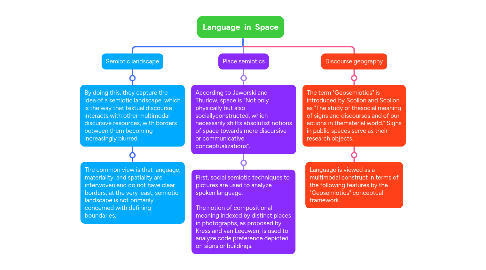
1. Semiotic landscape
1.1. By doing this, they capture the idea of a semiotic landscape, which is the way that textual discourse interacts with other multimodal discursive resources, with borders between them becoming increasingly blurred.
1.1.1. The common view is that language, materiality, and spatiality are interwoven and do not have clear borders; at the very least, semiotic landscape is not primarily concerned with defining boundaries.
2. Place semiotics
2.1. According to Jaworski and Thurlow, space is "Not only physically but also sociallyconstructed, which necessarily shifts absolutist notions of space towards more discursive or communicative conceptualizations".
2.1.1. First, social semiotic techniques to pictures are used to analyze spoken language. The notion of compositional meaning indexed by distinct places in photographs, as proposed by Kress and van Leeuwen, is used to analyze code preference depicted on signs or buildings.
3. Discourse geography
3.1. The term "Geosemiotics" is introduced by Scollon and Scollon as "The study of thesocial meaning of signs and discourses and of our actions in thematerial world." Signs in public spaces serve as their research objects.
3.1.1. Language is viewed as a multimodal construct in terms of the following features by the "Geosemiotics" conceptual framework.