


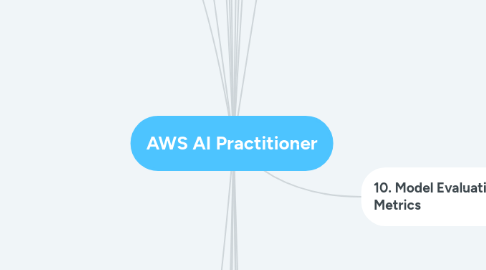
1. 1. **Introduction to Artificial Intelligence (AI)**
1.1. - **Definition:**
1.1.1. - AI refers to the simulation of human intelligence in machines designed to think and act like humans.
1.1.2. - Capabilities include understanding natural language, recognizing patterns, solving problems, and making decisions.
1.2. - **Examples of AI Applications:**
1.2.1. - **Personal Assistants:**
1.2.1.1. - Virtual assistants like Alexa and Siri that perform tasks such as setting reminders, answering questions, and controlling smart home devices.
1.2.2. - **Fraud Detection:**
1.2.2.1. - Systems designed to identify and prevent fraudulent activities by analyzing transaction data in real-time to detect anomalies.
1.2.3. - **Medical Imaging:**
1.2.3.1. - AI applications that analyze medical images like X-rays, MRIs, and CT scans to assist in diagnosis and treatment planning.
1.2.4. - **Manufacturing:**
1.2.4.1. - Uses AI for quality control by identifying defects in products and for predictive maintenance to anticipate equipment failures.
1.2.5. - **Customer Support:**
1.2.5.1. - Automated chatbots that handle customer queries and provide product recommendations.
1.2.6. - **Predictive Analytics:**
1.2.6.1. - Utilizing historical data to forecast future trends and demands, aiding in strategic planning and decision-making.
1.3. - **Key Concepts:**
1.3.1. - **Machine Learning (ML):** A subset of AI that involves algorithms learning from data to make decisions without explicit programming.
1.3.2. - **Deep Learning:** A further subset of ML that uses neural networks with many layers (deep networks) to analyze complex data patterns.
1.3.3. - **Generative AI:** A branch of AI that focuses on creating new content, such as text, images, or code, by learning from existing data, often using models like neural networks.
2. 3. **Deep Learning**
2.1. - **Definition:**
2.1.1. - A subset of machine learning that utilizes neural networks with multiple layers (hence "deep") to model complex patterns in large datasets.
2.2. - **Neural Network Structure:**
2.2.1. - **Input Layer:**
2.2.1.1. - Receives the initial data (e.g., pixels in an image, words in a sentence).
2.2.2. - **Hidden Layers:**
2.2.2.1. - Multiple layers where the data is processed. Each layer extracts features and passes them to the next layer.
2.2.2.2. - **Types of Layers:**
2.2.2.2.1. - **Dense (Fully Connected) Layers:** Every neuron is connected to every neuron in the next layer.
2.2.2.2.2. - **Convolutional Layers:** Used primarily in image processing to detect spatial hierarchies.
2.2.2.2.3. - **Recurrent Layers:** Used in sequence data to remember previous inputs (e.g., LSTMs for text).
2.2.3. - **Output Layer:**
2.2.3.1. - Produces the final prediction or classification (e.g., classifying an image as a dog or cat).
2.3. - **Applications:**
2.3.1. - **Image Classification:**
2.3.1.1. - Identifying objects within images, such as recognizing different species of animals in photos.
2.3.2. - **Natural Language Processing (NLP):**
2.3.2.1. - Understanding and generating human language, such as translating languages or summarizing text.
2.4. - **Deep Learning vs. Traditional ML:**
2.4.1. - **Data Type:**
2.4.1.1. - **Traditional ML:** Structured and labeled data.
2.4.1.2. - **Deep Learning:** Unstructured data like images, text, and audio.
2.4.2. - **Feature Extraction:**
2.4.2.1. - **Traditional ML:** Requires manual feature selection and extraction.
2.4.2.2. - **Deep Learning:** Automatically extracts features from raw data.
2.4.3. - **Computation Cost:**
2.4.3.1. - **Traditional ML:** Generally lower computational cost.
2.4.3.2. - **Deep Learning:** Higher computational cost due to large datasets and complex models.
2.4.4. - **Use Cases:**
2.4.4.1. - **Traditional ML:** Predictive analytics, classification, recommendation.
2.4.4.2. - **Deep Learning:** Image recognition, speech recognition, language translation.
3. 5. **Guidelines for Responsible AI**
3.1. - **Development of Responsible AI Systems:**
3.1.1. - Ensuring AI systems are ethical, transparent, and fair.
3.1.2. - **Principles:**
3.1.2.1. - **Fairness:** AI should be unbiased and treat all individuals equally.
3.1.2.2. - **Transparency:** The workings of AI models should be understandable.
3.1.2.3. - **Robustness:** AI systems should be resilient and handle unexpected situations gracefully.
3.1.2.4. - **Privacy and Security:** Protecting user data and ensuring compliance with privacy regulations.
3.2. - **Transparent and Explainable Models:**
3.2.1. - Importance of creating AI models that are interpretable and explainable.
3.2.2. - **Techniques for Explainability:**
3.2.2.1. - **LIME (Local Interpretable Model-agnostic Explanations):** Provides local explanations for individual predictions.
3.2.2.2. - **SHAP (SHapley Additive exPlanations):** Calculates the contribution of each feature to the model's prediction.
3.2.2.3. - **Integrated Gradients:** Attributes the prediction of a model to its input features by computing gradients.
4. 7. **Types of Machine Learning Problems**
4.1. - **Supervised Learning:**
4.1.1. - **Definition:** The model is trained on a labeled dataset, where each training example is paired with an output label.
4.1.2. - **Types of Supervised Learning:**
4.1.2.1. - **Classification:**
4.1.2.1.1. - **Binary Classification:** Categorizes data into two classes (e.g., spam vs. not spam emails).
4.1.2.1.2. - **Multiclass Classification:** Categorizes data into more than two classes (e.g., categorizing news articles into sports, finance).
4.1.2.2. - **Regression:**
4.1.2.2.1. - **Linear Regression:** Predicts a continuous output with a linear relationship between input and output.
4.1.2.2.2. - **Multiple Linear Regression:** Uses multiple input variables to predict the output.
4.1.2.2.3. - **Logistic Regression:** Used for binary classification tasks, predicting the probability of an event occurring.
4.2. - **Unsupervised Learning:**
4.2.1. - **Definition:** The model is given data without explicit instructions on what to do with it, identifying underlying patterns or structures.
4.2.2. - **Clustering:**
4.2.2.1. - **K-Means Clustering:** Divides data into a predefined number of clusters based on similarity.
4.2.2.2. - **Hierarchical Clustering:** Builds a tree of clusters based on data similarity.
4.2.3. - **Anomaly Detection:** Identifies rare items or events that do not conform to expected patterns (e.g., fraud detection).
4.3. - **Semi-Supervised Learning:**
4.3.1. - **Definition:** A blend of supervised and unsupervised learning, where the model is trained on a small amount of labeled data and a larger amount of unlabeled data.
4.4. - **Reinforcement Learning:**
4.4.1. - **Definition:** An agent learns to make decisions by performing actions in an environment to maximize cumulative rewards.
4.4.2. - **Examples:** Game playing, robotics.
5. 9. **Model Monitoring**
5.1. - **Performance Degradation:**
5.1.1. - Over time, model performance may degrade due to factors like data quality, model quality, and bias.
5.1.2. - **Mitigation Strategies:**
5.1.2.1. - Retraining models with new data, adjusting algorithms, or updating features.
5.2. - **Monitoring Systems:**
5.2.1. - **Data & Concept Drift:**
5.2.1.1. - Detects significant changes in data distribution (data drift) and changes in target variable properties (concept drift).
5.2.2. - **Amazon SageMaker Model Monitor:**
5.2.2.1. - Monitors models in production, detects errors, and compares data against a baseline.
5.2.2.2. - Sends alerts via CloudWatch, potentially triggering re-training cycles.
5.3. - **Automation & MLOps:**
5.3.1. - **MLOps:**
5.3.1.1. - Incorporates DevOps practices into ML model development, focusing on automating tasks, ensuring version control, and monitoring deployments.
5.3.1.2. - Improves productivity, repeatability, reliability, compliance, and data quality.
5.3.2. - **Amazon SageMaker Pipelines:**
5.3.2.1. - Facilitates the orchestration of ML pipelines, enabling the deployment of models and tracking lineage.
6. 11. **AWS AI Services**
6.1. - **Computer Vision Services:**
6.1.1. - **Amazon Rekognition:**
6.1.1.1. - Deep learning service for computer vision tasks.
6.1.1.2. - **Use Cases:** Face recognition, object detection, content moderation, real-time video analysis.
6.1.2. - **Amazon Textract:**
6.1.2.1. - Extracts text, handwriting, forms, and tables from scanned documents.
6.1.2.2. - **Use Cases:** Automating document processing (e.g., invoices, forms).
6.2. - **Natural Language Processing (NLP) Services:**
6.2.1. - **Amazon Comprehend:**
6.2.1.1. - NLP service that discovers insights and relationships in text.
6.2.1.2. - **Use Cases:** Sentiment analysis, PII detection, entity recognition.
6.2.2. - **Amazon Lex:**
6.2.2.1. - Builds voice and text interfaces using Amazon Alexa technology.
6.2.2.2. - **Use Cases:** Chatbots, interactive voice response systems for customer service.
6.2.3. - **Amazon Polly:**
6.2.3.1. - Converts text into natural-sounding speech in multiple languages.
6.2.3.2. - **Use Cases:** Text-to-speech conversion for audio content, enhancing accessibility and engagement.
6.2.4. - **Amazon Kendra:**
6.2.4.1. - ML-powered search service for enterprise systems.
6.2.4.2. - **Use Cases:** Intelligent search with natural language queries.
6.2.5. - **Amazon Transcribe:**
6.2.5.1. - Converts spoken language into text (speech-to-text).
6.2.5.2. - **Use Cases:** Real-time transcription, captioning for live or recorded audio/video.
6.3. - **Personalization & Recommendation Services:**
6.3.1. - **Amazon Personalize:**
6.3.1.1. - Provides personalized recommendations for customers.
6.3.1.2. - **Use Cases:** Product/content recommendations, targeted marketing campaigns.
6.4. - **Translation Services:**
6.4.1. - **Amazon Translate:**
6.4.1.1. - Neural machine translation for text across 75 languages.
6.4.1.2. - **Use Cases:** Real-time translation in chat applications, multilingual content creation.
6.5. - **Forecasting & Planning Services:**
6.5.1. - **Amazon Forecast:**
6.5.1.1. - AI service for time series forecasting.
6.5.1.2. - **Use Cases:** Demand forecasting, inventory management, financial planning.
6.6. - **Fraud Detection Services:**
6.6.1. - **Amazon Fraud Detector:**
6.6.1.1. - Detects potentially fraudulent online activities using pre-trained models.
6.6.1.2. - **Use Cases:** Preventing online payment fraud, detecting fake accounts, account takeover prevention.
6.7. - **Generative AI Services:**
6.7.1. - **Amazon Bedrock:**
6.7.1.1. - Service to build generative AI applications using foundation models from top AI providers.
6.7.1.2. - **Use Cases:** Content creation, image generation, retrieval augmented generation (RAG) for enhanced model accuracy.
6.8. - **Custom ML Development:**
6.8.1. - **Amazon SageMaker:**
6.8.1.1. - Comprehensive service for building, training, and deploying custom ML models.
6.8.1.2. - **Use Cases:** Custom model development for predictive analytics, large-scale data processing, real-time inference.
7. 13. **Foundational Models**
7.1. - **Selection Criteria for Pre-trained Models:**
7.1.1. - **Cost:** Consider the expense of training the model, including hardware, storage, and computational resources.
7.1.2. - **Latency Constraints:** For real-time applications, the model must provide rapid responses.
7.1.3. - **Modalities Supported:** Models may handle different types of data (text, image, etc.) and may require ensemble methods to improve performance.
7.1.4. - **Architecture and Complexity:** More complex models may offer higher accuracy but require more computational resources.
7.1.5. - **Performance Metrics:** Evaluate models using metrics like accuracy, precision, recall, F1 score, RMSE, MAP, MAE.
7.2. - **Biases in Training Data:**
7.2.1. - **Bias Mitigation:** Address biases present in training data to ensure ethical and fair outcomes.
7.2.2. - **Ethical Considerations:** Make informed decisions about model selection and fine-tuning with a focus on minimizing biases.
7.3. - **Availability and Compatibility:**
7.3.1. - **Model Repositories:** Check if the model is available on platforms like TensorFlow Hub, PyTorch Hub, Hugging Face.
7.3.2. - **Compatibility:** Ensure the model aligns with your framework, language, and environment.
7.4. - **Customization and Explainability:**
7.4.1. - **Customization Techniques:**
7.4.1.1. - **Model Fine-Tuning:** Adjusting a pre-trained model on new data to improve task-specific performance.
7.4.1.2. - **Transfer Learning:** Adapting a pre-trained model to a new but related task.
7.4.1.3. - **Meta Learning:** Models learn to adapt to new tasks quickly.
7.4.1.4. - **Self-Supervised Learning:** Models learn to predict parts of their input data, creating labeled data from raw data.
7.4.2. - **Explainability Tools:**
7.4.2.1. - **LIME, SHAP, Integrated Gradients:** Techniques for interpreting model predictions.
7.5. - **Inference Parameters:**
7.5.1. - **Temperature:** Controls the randomness of responses. Higher values increase diversity, lower values make the output more focused and deterministic.
7.5.2. - **Top K:** Limits the number of top predictions considered during generation, reducing randomness.
7.5.3. - **Top P (Nucleus Sampling):** Uses cumulative probability to determine the response space, dynamically choosing the set of likely next words.
7.5.4. - **Response Length:** Sets limits on the length of model outputs to prevent overly long or short responses.
7.5.5. - **Penalties:** Adjusts the model's tendency to repeat the same output (repetition penalty) or to continue a thought (presence penalty).
7.6. - **Evaluation Metrics for Generative AI:**
7.6.1. - **ROUGE:** Evaluates the quality of text summarization.
7.6.2. - **BLEU:** Measures the accuracy of machine translation.
7.6.3. - **GLUE:** Benchmarks for general language understanding.
7.6.4. - **SuperGlue:** Extends GLUE with more challenging language understanding tasks.
7.6.5. - **MMLU:** Tests broad knowledge and problem-solving skills.
7.6.6. - **BIG-bench:** Evaluates models on tasks that are beyond current capabilities.
7.6.7. - **HELM:** Focuses on transparency and bias detection in AI outputs.
8. 15. **Vector Databases and Retrieval Augmented Generation (RAG)**
8.1. - **Vector Databases:**
8.1.1. - **Function:** Store data as numerical vectors for efficient lookups and enhance model capabilities by providing relevant data.
8.1.2. - **AWS Services for Vector Search:**
8.1.2.1. - **Amazon OpenSearch Service, Amazon Aurora, Redis, Amazon Neptune, Amazon DocumentDB, Amazon RDS with PostgreSQL.**
8.2. - **Retrieval Augmented Generation (RAG):**
8.2.1. - **Components:**
8.2.1.1. - **Retriever:** Searches knowledge base for relevant data.
8.2.1.2. - **Generator:** Produces outputs based on the retrieved data.
8.2.2. - **Applications:**
8.2.2.1. - **Question Answering:** Enhances model responses by integrating external knowledge.
8.2.2.2. - **Content Generation:** Uses external data to improve content accuracy.
9. 17. **Methods to Secure AI Systems**
9.1. - **Shared Responsibility Model:**
9.1.1. - **AWS Responsibilities:** Security of the cloud infrastructure.
9.1.2. - **Customer Responsibilities:** Security within the cloud.
9.2. - **IAM (Identity and Access Management):**
9.2.1. - **Purpose:** Manages access to AWS resources, including user creation, permissions, and MFA.
9.2.2. - **Root User:** Initial account with unrestricted access; best practices include minimizing usage and enabling MFA.
9.2.3. - **IAM Users and Groups:** Best practices for managing user access.
9.2.4. - **IAM Roles:** Reducing risk by providing temporary access.
9.3. - **Data Encryption:**
9.3.1. - **Types:** Data at Rest and Data in Transit.
9.3.2. - **AWS KMS (Key Management Service):** Manage and control encryption keys.
9.4. - **S3 Block Public Access:** Prevents public access to S3 buckets and objects.
9.5. - **SageMaker Role Manager:** Simplifies role creation for SageMaker tasks.
10. 2. **Machine Learning (ML)**
10.1. - **Definition:**
10.1.1. - ML is a method of data analysis that automates the building of analytical models based on the idea that systems can learn from data, identify patterns, and make decisions with minimal human intervention.
10.2. - **Types of Data:**
10.2.1. - **Structured Data:**
10.2.1.1. - Data that is organized in a defined manner (e.g., databases, spreadsheets).
10.2.1.2. - Examples: Sales data, customer information.
10.2.2. - **Semi-Structured Data:**
10.2.2.1. - Partially organized data that doesn't fit into a relational database but has some organizational properties.
10.2.2.2. - Examples: JSON files, XML documents.
10.2.3. - **Unstructured Data:**
10.2.3.1. - Data that does not have a predefined structure.
10.2.3.2. - Examples: Text data (emails, social media posts), images, videos.
10.3. - **Training Process:**
10.3.1. - Involves feeding large amounts of data to an algorithm so that it can learn to make predictions or decisions.
10.3.2. - **Algorithms:**
10.3.2.1. - Mathematical models that process the data to find patterns or relationships.
10.3.3. - **Features:**
10.3.3.1. - Measurable properties or characteristics of the data used as input for algorithms.
10.3.4. - **Inference:**
10.3.4.1. - The process of using the trained model to make predictions on new, unseen data.
10.4. - **Machine Learning Styles:**
10.4.1. - **Supervised Learning:**
10.4.1.1. - Trains on labeled data where the output is known.
10.4.1.2. - **Examples:**
10.4.1.2.1. - **Image Classification:** Identifying objects within images.
10.4.1.2.2. - **Spam Detection:** Classifying emails as spam or not spam.
10.4.2. - **Unsupervised Learning:**
10.4.2.1. - Trains on unlabeled data to find hidden patterns.
10.4.2.2. - **Examples:**
10.4.2.2.1. - **Clustering Analysis:** Grouping data points based on similarity (e.g., customer segmentation).
10.4.2.2.2. - **Anomaly Detection:** Identifying unusual data points (e.g., fraud detection).
10.4.3. - **Reinforcement Learning:**
10.4.3.1. - Trains an agent to make decisions through trial and error by receiving rewards or penalties.
10.4.3.2. - **Examples:**
10.4.3.2.1. - **Game Playing:** Training AI to play games like chess or Go.
10.4.3.2.2. - **Robotics:** Teaching robots to navigate environments.
11. 4. **Generative AI**
11.1. - **Definition:**
11.1.1. - Refers to models that generate new content based on training data.
11.2. - **Techniques:**
11.2.1. - **Transformers:**
11.2.1.1. - A type of model architecture that processes sequences of data (e.g., sentences) in parallel, making them efficient for training on large datasets.
11.2.1.2. - **Components of Transformers:**
11.2.1.2.1. - **Self-Attention Mechanism:** Weighs the importance of different parts of the input when generating output.
11.2.1.2.2. - **Encoder-Decoder Architecture:** Consists of encoder layers to process input and decoder layers to generate output.
11.2.1.2.3. - **Positional Encoding:** Encodes the relative position of each token in a sequence to preserve order.
11.3. - **Applications:**
11.3.1. - **Content Creation:**
11.3.1.1. - Writing articles, generating images, composing music.
11.3.2. - **Language Models:**
11.3.2.1. - Understanding and generating human language, such as in chatbots and translation services.
11.4. - **Core Components:**
11.4.1. - **Models:**
11.4.1.1. - Built using neural networks, trained to generate output resembling the input data.
11.4.2. - **Tokenization:**
11.4.2.1. - Converts human text into vectors called token IDs, which represent words or units in the model's vocabulary.
11.4.3. - **Embeddings:**
11.4.3.1. - Numerical vector representations of tokens, capturing semantic meaning and context.
11.4.4. - **Self-Attention Mechanism:**
11.4.4.1. - Computes query, key, and value vectors for each token to determine attention weights.
11.4.5. - **Positional Encoding:**
11.4.5.1. - Encodes the relative position of each token to maintain the structure and order of sentences.
11.5. - **In-Context Learning:**
11.5.1. - **Few-Shot Learning:**
11.5.1.1. - Provides a few examples within a prompt to guide the model in generating better outputs.
11.5.1.2. - **Example:** Showing the model a few translated sentences to improve its translation capability.
11.5.2. - **Zero-Shot Learning:**
11.5.2.1. - The model performs a task it hasn't been explicitly trained for, without examples.
11.5.2.2. - **Example:** Asking a model to generate a summary without providing any prior examples.
11.5.3. - **One-Shot Learning:**
11.5.3.1. - Provides only one example to learn from.
11.5.3.2. - **Example:** Teaching the model to classify a rare object with a single labeled example.
12. 6. **Security, Compliance, and Governance for AI Solutions**
12.1. - **Methods to Secure AI Systems:**
12.1.1. - **Shared Responsibility Model:**
12.1.1.1. - **AWS Responsibilities:** Infrastructure security, service management.
12.1.1.2. - **Customer Responsibilities:** Service configuration, application security.
12.1.2. - **Identity and Access Management (IAM):**
12.1.2.1. - **IAM Users:** Represent individuals needing access to AWS services.
12.1.2.2. - **IAM Groups:** Collections of users with similar permissions.
12.1.2.3. - **IAM Roles:** Temporary access permissions for AWS resources.
12.1.2.4. - **Principle of Least Privilege:** Grant minimal permissions necessary.
12.1.3. - **Data Encryption:**
12.1.3.1. - **Data at Rest:** Encryption of stored data.
12.1.3.2. - **Data in Transit:** Encryption during data transfer.
12.1.3.3. - **AWS Key Management Service (KMS):** Management of encryption keys.
12.1.4. - **Logging and Monitoring:**
12.1.4.1. - **AWS CloudTrail:** Captures and logs API calls.
12.1.4.2. - **Amazon SageMaker Role Manager:** Simplifies the creation of IAM roles for ML tasks.
12.2. - **Governance and Compliance Regulations for AI Systems**
12.2.1. - **AWS Compliance Tools:**
12.2.1.1. - **AWS Audit Manager:** Automates compliance audits and evidence collection.
12.2.1.2. - **AWS Config:** Monitors resource configurations and evaluates compliance.
12.2.1.3. - **Amazon Inspector:** Provides automated security assessments.
12.2.1.4. - **AWS Trusted Advisor:** Offers guidance on security best practices.
13. 8. **Model Deployment**
13.1. - **Batch vs. Real-Time Inference:**
13.1.1. - **Batch Inference:**
13.1.1.1. - Ideal for large numbers of inferences where results can be delayed (e.g., overnight processing).
13.1.1.2. - Cost-effective as resources are used intermittently.
13.1.2. - **Real-Time Inference:**
13.1.2.1. - Suitable for immediate responses to client requests, often via a REST API.
13.1.2.2. - Deployed models respond immediately, ideal for applications like chatbots.
13.2. - **Deployment Options:**
13.2.1. - **AWS API Gateway & Lambda:**
13.2.1.1. - **API Gateway:** Handles client interactions and passes requests to Lambda running the model.
13.2.2. - **Docker Containers:**
13.2.2.1. - Used for deploying models, offering versatility across AWS services (ECS, EKS, Lambda, EC2).
13.2.3. - **Amazon SageMaker:**
13.2.3.1. - Provides managed endpoints for various inference types (batch, asynchronous, serverless, real-time).
13.2.3.2. - Simplifies deployment by managing infrastructure, scalability, and updates.
14. 10. **Model Evaluation Metrics**
14.1. - **Classification Metrics:**
14.1.1. - **Confusion Matrix:**
14.1.1.1. - **True Positive (TP):** Correctly predicted positive cases.
14.1.1.2. - **True Negative (TN):** Correctly predicted negative cases.
14.1.1.3. - **False Positive (FP):** Incorrectly predicted positive cases.
14.1.1.4. - **False Negative (FN):** Incorrectly predicted negative cases.
14.1.2. - **Accuracy:** Measures the percentage of correct predictions. Suitable for balanced datasets.
14.1.3. - **Precision:** Focuses on the accuracy of positive predictions. Important when minimizing false positives.
14.1.4. - **Recall:** Measures the ability to detect all actual positives. Used when minimizing false negatives is critical.
14.1.5. - **F1 Score:** Balances precision and recall. Ideal when both metrics are important.
14.1.6. - **AUC-ROC:** Evaluates binary classification models by plotting true positive rate against false positive rate across thresholds.
14.2. - **Regression Metrics:**
14.2.1. - **Mean Squared Error (MSE):** Average of squared differences between predictions and actual values. Sensitive to outliers.
14.2.2. - **Root Mean Squared Error (RMSE):** Square root of MSE, easier to interpret as it's in the same units as the dependent variable.
14.2.3. - **Mean Absolute Error (MAE):** Average of absolute errors, less sensitive to outliers than MSE.
14.3. - **Business Metrics:**
14.3.1. - **Return on Investment (ROI):** Measures the profitability of an investment.
14.3.2. - **Cost Reduction:** Quantifies the savings achieved through AI solutions.
14.3.3. - **Increased Sales:** Evaluates the impact of AI solutions on revenue growth.
14.3.4. - **AWS Cost Explorer with Cost Allocation Tags:** Monitors project expenses.
14.4. - **Generative AI Metrics:**
14.4.1. - **ROUGE (Recall-Oriented Understudy for Gisting Evaluation):** Measures the quality of summarization and translation by comparing generated text to reference text.
14.4.2. - **BLEU (Bilingual Evaluation Understudy):** Evaluates machine translation by comparing the model's translations to human translations.
14.4.3. - **GLUE (General Language Understanding Evaluation):** A benchmark that tests various language understanding tasks like sentiment analysis.
14.4.4. - **SuperGlue:** Extends GLUE by adding tasks that require complex reasoning and understanding, like reading comprehension.
14.4.5. - **MMLU (Massive Multitask Language Understanding):** Tests a model's knowledge and problem-solving skills across diverse topics, from history to mathematics.
14.4.6. - **BIG-bench:** Challenges models with tasks beyond current capabilities, such as advanced reasoning and specialized knowledge.
14.4.7. - **HELM (Holistic Evaluation of Language Models):** Focuses on improving model transparency and evaluates performance on tasks like summarization and sentiment analysis.
15. 12. **Amazon SageMaker Services**
15.1. - **SageMaker Ground Truth:**
15.1.1. - A data labeling service to build highly accurate training datasets for machine learning quickly.
15.1.2. - **Features:** Human-in-the-loop labeling, integration with other AWS services, automated data labeling using machine learning models.
15.2. - **SageMaker Canvas:**
15.2.1. - Enables business analysts to build machine learning models and generate accurate predictions without writing code.
15.2.2. - **Features:** No-code interface, automated model generation, supports structured data.
15.3. - **SageMaker Experiments:**
15.3.1. - A tool to organize, track, compare, and evaluate machine learning experiments.
15.3.2. - **Features:** Experiment tracking, lineage tracking, comparison of experiment results, integration with SageMaker Studio.
15.4. - **SageMaker Model Monitor:**
15.4.1. - Monitors deployed models in production for data and model quality issues and automatically detects and alerts on potential problems.
15.4.2. - **Features:** Real-time monitoring, alerting via CloudWatch, integration with SageMaker Studio for visualization, supports custom rules and built-in monitors.
15.5. - **SageMaker Pipelines:**
15.5.1. - A service to build, automate, and manage end-to-end machine learning workflows.
15.5.2. - **Features:** Workflow orchestration, model deployment, lineage tracking, integration with SageMaker Studio, Python SDK, JSON-based pipeline definition, supports conditional logic.
15.6. - **SageMaker Model Registry:**
15.6.1. - A centralized repository to store, version, and manage machine learning models.
15.6.2. - **Features:** Model versioning, model lineage tracking, integration with deployment pipelines, support for multiple model versions.
15.7. - **SageMaker Feature Store:**
15.7.1. - A purpose-built repository for storing, retrieving, and sharing machine learning features.
15.7.2. - **Features:** Feature definition storage, real-time and offline retrieval, integration with SageMaker Pipelines and SageMaker Studio, versioning of feature definitions.
15.8. - **SageMaker Inference Recommender:**
15.8.1. - Helps select the best compute instance and configuration for inference workloads by running benchmark tests on different configurations.
15.8.2. - **Features:** Instance type recommendation, configuration testing, support for different inference options, integration with SageMaker deployment.
15.9. - **SageMaker Serverless Inference:**
15.9.1. - Allows serving machine learning models without managing infrastructure, automatically scaling based on traffic patterns.
15.9.2. - **Features:** No need for provisioning instances, automatic scaling, cost-effective for intermittent workloads, leverages AWS Lambda.
15.10. - **SageMaker Real-Time Inference:**
15.10.1. - Provides persistent endpoints for real-time inference that are fully managed and can automatically scale.
15.10.2. - **Features:** Low-latency real-time responses, persistent endpoints, support for auto-scaling, integration with other AWS services like API Gateway.
15.11. - **SageMaker Batch Transform:**
15.11.1. - A service for offline inference that processes large datasets in batches.
15.11.2. - **Features:** Suitable for large datasets, supports gigabyte-scale data, no need for persistent endpoints, integration with S3 for input/output data.
15.12. - **SageMaker Asynchronous Inference:**
15.12.1. - Supports workloads that involve large payloads or have long inference processing times, decoupling request and response so clients don't have to wait for the inference response.
15.12.2. - **Features:** Asynchronous response handling, decoupling request and response, support for large payloads, storage of results in S3, cost-effective for long-running or large-payload inferences.
16. 14. **Prompt Engineering Techniques**
16.1. - **Introduction to Prompts:**
16.1.1. - Definition and components of a prompt.
16.2. - **Prompting Techniques:**
16.2.1. - **Few-Shot Prompting:** Providing a few examples to guide the model.
16.2.1.1. - **Example:** Translate the following sentences into French.
16.2.2. - **Zero-Shot Prompting:** Asking the model to perform a task without examples.
16.2.2.1. - **Example:** Translate "good morning" to Spanish.
16.2.3. - **One-Shot Prompting:** Providing a single example.
16.2.3.1. - **Example:** Show how to solve a single math problem to guide the model.
16.2.4. - **Chain-of-Thought Prompting:** Breaking down complex tasks into intermediate steps to improve coherence.
16.2.4.1. - **Example:** Provide step-by-step reasoning for a scientific explanation.
16.2.5. - **Prompt Tuning:** Using continuous embeddings optimized during training to improve model outputs.
16.3. - **Best Practices:**
16.3.1. - **Be Specific:** Define clear instructions and examples.
16.3.2. - **Include Examples:** Guide the model with sample inputs and outputs.
16.3.3. - **Experiment and Iterate:** Test and refine prompts to enhance model performance.
16.3.4. - **Use Multiple Comments:** Provide context without cluttering the prompt.
16.3.5. - **Add Guardrails:** Implement safety measures to manage AI interactions.
16.4. - **Risks and Limitations:**
16.4.1. - **Prompt Injection:** Manipulating prompts to produce unintended outputs.
16.4.2. - **Jailbreaking:** Bypassing safety mechanisms set by prompt engineers.
16.4.3. - **Hijacking:** Changing the original prompt with new instructions.
16.4.4. - **Poisoning:** Embedding harmful instructions in various inputs.
17. 16. **Overview of Responsible AI**
17.1. - **Core Dimensions:**
17.1.1. - **Fairness:** Ensures equitable treatment across diverse groups.
17.1.2. - **Explainability:** Provides clear reasons for AI decisions.
17.1.3. - **Robustness:** Ensures tolerance to failures and minimizes errors.
17.1.4. - **Privacy:** Protects user data and ensures PII is not exposed.
17.1.5. - **Governance:** Meets compliance and risk management standards.
17.1.6. - **Transparency:** Clearly communicates model capabilities and risks.