


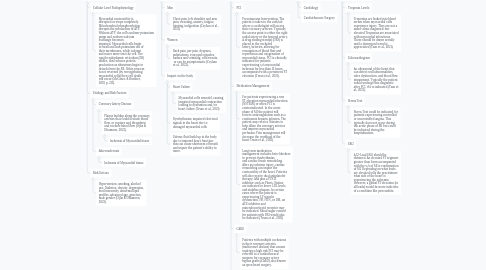
1. Etiology and Pathophysiology
1.1. Cellular Level Pathophysiology
1.1.1. Myocardial contractility is disrupted or stops completely. Mitochondrial phosphorylation disrupts the production of ATP. Without ATP, the cell's sodium-potassium pump and sodium-calcium exchange becomes impaired. Myocardial cells begin to swell and leak potassium out of their membranes, while calcium and water move into the cell. The rough endoplasmic reticulum (ER) dilates, this reduces protein production as ribosomes begin to detach from the ER. If this process is not reversed (by reoxygenating myocardial cells) then cell death will occur (McCance & Huether, 2019, p. 213).
1.2. Etiology and Risk Factors
1.2.1. Coronary Artery Disease
1.2.1.1. Plaque buildup along the coronary arteries that could occlude blood flow, or rupture and thrombose and occlude blood flow (Ojha & Dhamoon, 2023).
1.2.1.1.1. Ischemia of Myocardial tissue
1.2.2. Atherosclerosis
1.2.2.1. Ischemia of Myocardial tissue
1.3. Risk Factors
1.3.1. Hypertension, smoking, alcohol use, Diabetes, obesity, depression, food insecurity, abnormal lipid profiles, advanced age, genetics, male gender (Ojha & Dhamoon, 2023).
2. Signs and Symptoms
2.1. Men
2.1.1. Chest pain, left shoulder and arm pain, sweating, anxiety, fatigue, fainting, indigestion (Ceyhan et al., 2023)
2.2. Women
2.2.1. Back pain, jaw pain, dyspnea, palpitations, syncopal episodes, nausea and vomiting, cold sweats, or can be asymptomatic (Ceyhan et al., 2023).
2.3. Impact on the body
2.3.1. Heart Failure
2.3.1.1. Myocardial cells remodel, causing impaired myocardial contraction leading to dysfuntion and/or heart failure (Trsan et al., 2021)
2.3.2. Dysrhythmias; impaired electrical signals in the heart due to damaged myocardial cells
2.3.3. Edema: fluid build up in the body due to impared heart function: this can cause shortness of breath and impair the patient's ability to move.
3. Treatment Options
3.1. PCI
3.1.1. Percutaneous Intervention. The patient is taken to the cath lab where a cardiologist will access their coronary arteries. Typically the access point is either the right radial artery or the femoral artery. A drug eluding stent(s) (DES) is placed in the occluded artery/arteries, allowing for resumption of blood flow and reperfusion and oxygenation of myocardial tissue. PCI is clinically indicated for patients experiencing s/s myocardial ischemia for less than 12 hours, accompanied with a persistent ST elevation (Trsan et al., 2021).
3.2. Medication Management
3.2.1. For patients experiencing a non ST elevation myocardial infarction (NSTEMI) or when PCI is contraindicated. In the acute phase of MI the patient will recieve anticoagulation such as a continuous heparin infusion. The patient may receive Nitrates to help dilate the coronary arteries and improve myocardial perfusion. Pain management will decrease the workload of the heart Trsan et al., 2021).
3.2.2. Long term medication management includes beta-blockers to prevent dysrhythmias and cardiac tissue remodeling. After an ischemic injury, cardiac remodeling can impair the contractility of the heart. Patients will also receive dual antiplatelet therapy; ASA plus a P2Y12 inhibitor such as Plavix. Statins are indicated to lower LDL levels and stabilize plaques. In certain cases where the patient is experiencing LV systolic dysfunction, HF, HTN, or DM, an ACE inhibitor and mineralocorticoid receptor may be indicated. Blood sugar control for patients with DM would also be indicated (Trsan et al., 2021)
3.3. CABG
3.3.1. Patients with multiple occlusions in their coronary arteries (multivessel disease) that cannot undergo a high risk PCI may be referred to a cardiothoracic surgeon for coronary artery bypass grafts (CABG), also known as open heart surgery.
3.4. Fibrinolytic Therapy
3.4.1. Administration of altepase or another fibrin-specific agent is indicated for patients with an elevated ST segment when PCI within two hours is not an option, or when transfer to a PCI center will occur within 60-90 minutes Trsan et al., 2021).
4. Referrals, Specialists
4.1. Cardiology
4.2. Cardiothoracic Surgery
5. Diagnostic Tests
5.1. Troponin Levels
5.1.1. Troponins are leaked into blood serum when myocardial cells experience injury. They are not a stand-alone diagnostic but elevated Troponins are associated with myocardial infarctions. These should be drawn serially until a downward trend is appreciated (Tsan et al., 2021).
5.2. Echocardiogram
5.2.1. An ultrasound of the heart that can detect wall abnormalities, valve dysfunction, and blood flow impairment. Typically the patient would undergo this diagnostic after PCI, if it is indicated (Tsan et al., 2021).
5.3. Stress Test
5.3.1. Stress Test could be indicated for patients experiencing controlled or uncontrolled angina. This typically does not occur during the acute phase of MI but could be indicated during the hospitalization.
5.4. EKG
5.4.1. A 12-Lead EKG should be obtained. An elevated ST segment greater than 5mm accompanied with the s/s of MI is confirmation of MI. Depending on what leads are elevated tells the practitioner what side of the heart is experiencing the ischemia. However, a global ST elevation (in all leads) would be more indicitive of a condition like pericarditis.