


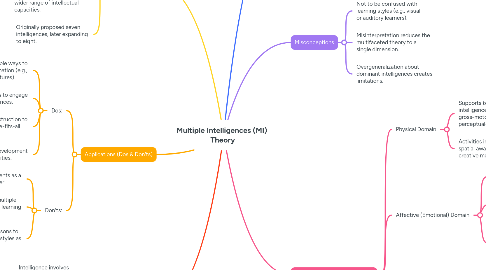
1. Howard Gardner
1.1. Introduced MI Theory in his book 'Frames of Mind'.
1.2. Criticized the traditional IQ test for focusing too narrowly on linguistic and logical intelligences.
1.3. Drew inspiration from the arts and psychology to include a wider range of intellectual capacities.
1.4. Originally proposed seven intelligences, later expanding to eight.
2. Applications (Dos & Don'ts)
2.1. Dos:
2.1.1. Provide multiple ways to access information (e.g., diagrams, lectures).
2.1.2. Incorporate arts to engage various intelligences.
2.1.3. Individualize instruction to avoid a one-size-fits-all approach.
2.1.4. Encourage holistic development through diverse activities.
2.2. Don'ts:
2.2.1. Avoid labeling students as a single type of learner.
2.2.2. Do not confuse multiple intelligences with learning styles.
2.2.3. Avoid matching lessons to perceived learning styles as it lacks evidence.
3. Brain Research Support
3.1. Intelligence involves interconnected brain functions.
3.2. Cognitive growth and intellectual development continue into adulthood.
3.3. Reading requires the coordination of all brain regions.
4. The 8 Intelligences
4.1. Linguistic
4.1.1. Language use and communication
4.2. Logical-Mathematical
4.2.1. Reasoning and problem-solving
4.3. Musical
4.3.1. Rhythm, tone, and musical composition
4.4. Bodily-Kinesthetic
4.4.1. Movement and coordination
4.5. Spatial
4.5.1. Visualization and manipulation of space
4.6. Interpersonal
4.6.1. Understanding and interacting with others
4.7. Intrapersonal
4.7.1. Self-awareness and introspection
4.8. Naturalistic
4.8.1. Understanding and working with nature
5. Misconceptions
5.1. Not to be confused with learning styles (e.g., visual or auditory learners).
5.2. Misinterpretation reduces the multifaceted theory to a single dimension.
5.3. Overgeneralization about dominant intelligences creates limitations.
6. Domains and Their Connections
6.1. Physical Domain
6.1.1. Supports bodily-kinesthetic intelligence through gross-motor, fine-motor, and perceptual-motor skills.
6.1.2. Activities include balance, spatial awareness, and creative movement.
6.2. Affective (Emotional) Domain
6.2.1. Aligns with interpersonal and intrapersonal intelligences.
6.2.2. Focuses on self-awareness, empathy, and emotional resilience.
6.2.3. Teachers foster emotional development through supportive strategies (e.g., discussing emotions, promoting self-discipline).
6.3. Aesthetic Domain
6.3.1. Encourages creativity and artistic expression.
6.3.2. Fosters musical, spatial, and bodily-kinesthetic intelligences.
6.3.3. Teachers integrate arts into the curriculum and promote multicultural understanding.
6.4. Social Domain
6.4.1. Strengthens interpersonal intelligence through collaboration and conflict resolution.
6.4.2. Focuses on social skills, socialization, and responsibility.
6.4.3. Teachers scaffold social interactions through modeling, coaching, and mediating.