


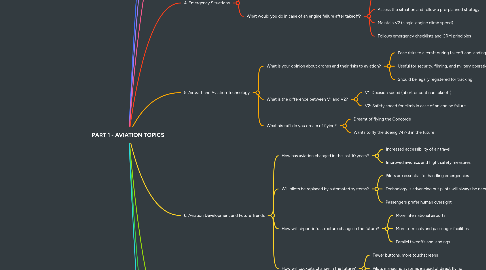
1. 1. Flight Safety
1.1. What can airline companies do to promote flight safety?
1.1.1. Investment in R&D and CRM
1.1.2. Air safety reports
1.1.3. Mitigating crew and corporate fatigue
1.1.4. Risk mitigation for internal and external threats
1.2. What is the importance of CRM?
1.2.1. Reduces power distance
1.2.2. Prevents incidents and air disasters
1.2.3. Covers leadership, teamwork, situational awareness
1.2.4. Promotes a safety culture1.
2. 2. Pilot Health and Medical Checks
2.1. Why should pilots perform regular health checks? (CMA)
2.1.1. Prevents spine problems, blood circulation issues, skin cancer
2.1.2. Identifies physical and mental health issues early
2.1.3. Ensures pilots are fit for duty
3. 3. Pilot's Career and Background
3.1. Tell me about your aviation background.
3.1.1. First flight in 2012
3.1.2. Started in 2008, joined Air Force
3.1.3. Graduated in 2014
3.1.4. Have been flying EMB KC-390 at Anapolis Airbase since 2022
3.2. Why did you decide to become a pilot?
3.2.1. See it as a vocation, not just a job
3.2.2. Passion for aviation since childhood
3.2.3. Inspired by my father
3.3. What are the biggest challenges of being a pilot?
3.3.1. Time away from family
3.3.2. High stress and fatigue
4. 4. Emergency Situations
4.1. When should a pilot perform an emergency landing?
4.1.1. Pilot incapacitation
4.1.2. Fire on board, engine failure, depressurization
4.2. What would you do in case of an engine failure after takeoff?
4.2.1. Use flight simulators for regular training
4.2.2. Assess the situation and follow a pre-planned strategy
4.2.3. Maintain V2 (single-engine climb speed)
4.2.4. Follows emergency checklists and CRM principles
5. 5. Aircraft and Aviation Technology
5.1. What is your opinion about drones and their risks to aviation?
5.1.1. Pose risks to aircraft during takeoff and landing
5.1.2. Useful for security, filming, and military operations
5.1.3. Should be legally registered for tracking
5.2. What is the difference between V1 and V2?
5.2.1. V1: Decision speed (abort or continue takeoff)
5.2.2. V2: Safety speed for climb in case of an engine failure
5.3. What aircraft do you dream of flying?
5.3.1. Dreamt of flying the Concorde
5.3.2. Wants to fly the Boeing 747-8 in the future
6. 6. Aviation Development and Future Trends
6.1. How has aviation changed in the last 10 years?
6.1.1. Increased accessibility of air travel
6.1.2. Improved avionics and flight safety measures
6.2. Will pilots be replaced by automated systems?
6.2.1. Pilots are essential for handling emergencies
6.2.2. Technology is advancing but pilots will always be needed
6.2.3. Passengers prefer human oversight
6.3. How will airport infrastructure change in the future?
6.3.1. More international airports
6.3.2. More terminals and passenger facilities
6.3.3. Parallel takeoffs and landings
6.4. How will cockpits change in the future?
6.4.1. Fewer buttons, more touchscreens
6.4.2. Pilots managing systems instead of direct flying
6.4.3. More reliable backup systems
7. 7. Airport Operations
7.1. What’s the most technological airport you’ve operated in?
7.1.1. Guarulhos Airport:
7.1.2. Two long runways, ILS system at all thresholds, taxiing lights system
7.1.3. Large number of gates and passenger facilities
7.2. What is the best and worst airport you have operated in?
7.2.1. Worst: Querari
7.2.2. Best: Ushuaia
7.2.3. Landscape, efficient infrastructure
7.3. How does the Airbus A380 affect airport operations?
7.3.1. Requires specific infrastructure
7.3.2. Generates significant wake turbulence
8. 8. Pilot Procedures
8.1. What do pilots do after takeoff?
8.1.1. Gear up, retract flaps
8.1.2. Maintain heading, perform checklists
8.1.3. Prepare for descent and landing
8.2. What do pilots do after landing?
8.2.1. Perform a thorough pre-flight check
8.2.2. Communicate aircraft status to maintenance
8.3. How do you prepare for a flight?
8.3.1. Stay fit and well-rested
8.3.2. Review all flight documents and weather
8.3.3. Perform parking checklist
9. 9. Industry Comparisons
9.1. Will the Airbus A380 replace the Boeing 737?
9.1.1. The 737 is more suited for short/medium-haul flights
9.1.2. No, due to infrastructure and operational constraints
9.2. What was the first aircraft you flew?
9.2.1. T-25
9.2.2. Lightweight and acrobatic
9.2.3. Small single-engine military trainer