ADHD
作者:Alexis Reinert
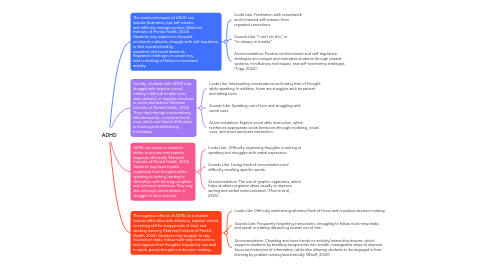
1. The emotional impact of ADHD can include frustration, low self-esteem, and difficulty managing stress (National Institute of Mental Health, 2024). Students may experience frequent emotional outbursts, struggle with self-regulation, or feel overwhelmed by academic and social demands. Repeated challenges in school may lead to feelings of failure or increased anxiety.
1.1. Looks Like: Frustration with schoolwork and a lowered self-esteem from repeated corrections.
1.2. Sounds Like: “I can’t do this,” or “I’m always in trouble.”
1.3. Accommodation: Positive reinforcement and self-regulation strategies encourages and motivates students through reward systems, mindfulness techniques, and self-monitoring strategies (Tripp, 2024).
2. Socially, students with ADHD may struggle with impulse control, making it difficult to take turns, wait patiently, or regulate emotions in social interactions (National Institute of Mental Health, 2024). They may interrupt conversations, talk excessively, or misread social cues, which can lead to difficulties in forming and maintaining friendships.
2.1. Looks Like: Interrupting conversations and losing train of thought while speaking. In addition, there are struggles with be patient and taking turns.
2.2. Sounds Like: Speaking out of turn and struggling with social cues.
2.3. Accommodation: Explicit social skills instruction, which reinforces appropriate social behaviors through modeling, visual cues, and structured peer interaction.
3. ADHD can impact a student’s ability to process and express language efficiently (National Institute of Mental Health, 2024). Students may have trouble organizing their thoughts when speaking or writing, leading to difficulties with forming complete and coherent sentences. They may also interrupt conversations or struggle to listen actively.
3.1. Looks Like: Difficulty organizing thoughts in writing or speaking and struggles with verbal expression.
3.2. Sounds Like: Losing track of conversations and difficulty recalling specific words.
3.3. Accommodation: The use of graphic organizers, which helps students organize ideas visually to improve writing and verbal communication (Thorne et al., 2025).
4. The cognitive effects of ADHD on a student include difficulties with attention, impulse control, remaining still for long periods of time, and working memory (National Institute of Mental Health, 2024). Students may struggle to stay focused on tasks, follow multi-step instructions, and organize their thoughts. Impulsivity can lead to quick, poorly thought out decision-making.
4.1. Looks Like: Difficulty maintaining attention/lack of focus and impulsive decision-making.
4.2. Sounds Like: Frequently forgetting instructions, struggling to follow multi-step tasks, and speak or making distracting sounds out of turn.
4.3. Accommodation: Chunking and more hands-on activity/interactive lessons, which supports students by breaking assignments into smaller, manageable steps to improve focus and retention of information, while also allowing students to be engaged in their learning by problem solving kinestetically (Woolf, 2020).


