


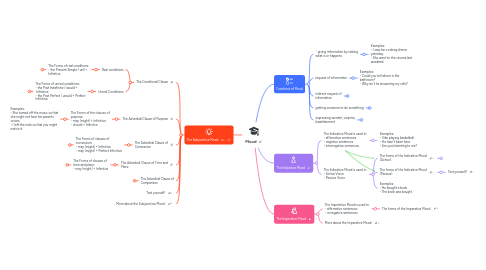
1. The Subjunctive Mood
1.1. The Condtional Clause
1.1.1. Real conditions
1.1.1.1. The Forms of real conditions: - the Present Simple / will + Infinitive
1.1.1.1.1. Examples: - If it snows, we will stay at home - If you're late, we will go without you
1.1.2. Unreal Conditions
1.1.2.1. The Forms of unreal conditions: - the Past Indefinite / would + Infinitive - the Past Perfect / would + Perfect Infinitive
1.1.2.1.1. Examples: - If she were you, she wouldn't let him betray you - If you hadn't helped us then
1.2. The Adverbial Clause of Purpose
1.2.1. The Forms of the clauses of purpose: - may (might) + Infinitive - should + Infinitve
1.2.1.1. Examples: - She turned off the music so that she might not hear her parents' voices. - I left the note so that you might notice it.
1.3. The Adverbial Clause of Consession
1.3.1. The Forms of clauses of consession: - may (might) + Infinitive - may (might) + Perfect Infinitive
1.3.1.1. Examples: - Although you may not know him, ask for help - Though you might have suffered much, they won't forgive you
1.4. The Adverbial Clause of Time and Place
1.4.1. The Forms of clauses of time and place: - may (might) + Infinitive
1.4.1.1. Examples: - Whenever you may go, I'll find you - Wherever you may happen to be, I'll come
1.5. The Adverbial Clause of Comparison
1.5.1. The Forms of clauses of comparison: - the Past Indefinite - the Past Perfect
1.5.1.1. Examples: - We ignored him as if he weren't out friend - She behaved as though she had been in the city before
1.6. Test yourself!
1.7. More about the Subjunctive Mood.
2. Functions of Mood
2.1. - giving information by stating what is or happens
2.1.1. Examples: - I saw her cooking dinner yeterday. - She went to the cinema last weekend.
2.2. request of information
2.2.1. Examples: - Could you tell where is the bathroom? - Why isn't he answering my calls?
2.3. indirect request of information
2.3.1. Examples: - I wonder if you know where I can find Tom. - I'd like to know why you are so rude to me.
2.4. getting someone to do something
2.4.1. Examples: - Do your homework right now! - Drive us home, we can't do it ourselves.
2.5. espressing wonder, surprise, bewilderment
2.5.1. Examples: - What a shame that you should behave like that. - I'm vexed that he should leave us soon.
3. The Indicative Mood
3.1. The Indicative Mood is used in: - affirmative sentences - negative sentences - interrogative sentences
3.1.1. Examples: - I like playing basketball. - He hasn't been here. - Are you listenting to me?
3.2. The Indicative Mood is used in: - Active Voice - Passive Voice
3.2.1. The forms of the Indicative Mood (Active).
3.2.1.1. Test yourself!
3.2.2. The forms of the Indicative Mood (Passive).
3.2.2.1. Test yourself!
3.2.3. Examples: - He bought a book. - The book was bought.
4. The Imperative Mood
4.1. The Imperative Mood is used in: - affirmative sentences - in negative sentences
4.1.1. The forms of the Imperative Mood.