


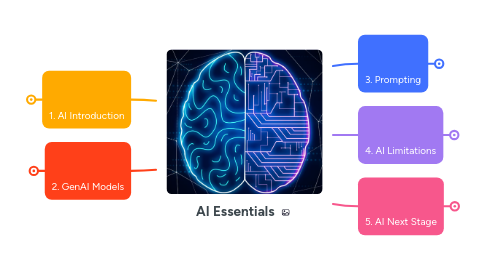
1. 1. AI Introduction
1.1. History of AI
1.1.1. 200BC-1700, Foundation of Maths
1.1.1.1. Image
1.1.1.1.1. 200BC, Chinese mathematicians invent Matrix Calculus
1.1.1.2. Image
1.1.1.2.1. 1700, Newton and Leibniz invent Differentation
1.1.2. 1950's, Turing Test
1.1.2.1. Image
1.1.2.1.1. Video
1.1.3. 1980's, Machine Learning - Neural Network
1.1.3.1. Image
1.1.4. 2012, Deep Learning - CNN architecture, AlexNet
1.1.4.1. Image
1.1.5. 2020s, Generative AI - ChatGPT
1.1.5.1. 2017 Transformer, Google, "Attention is all you need"
1.1.5.1.1. Image
1.1.5.2. 2018, ASLM successfully built EUV machine
1.1.5.2.1. Image
1.1.5.3. 2022-Mar, NVIDIA anounced H100 GPU (1,979 TFLOPS)
1.1.5.4. 2022-Nov: chatGPT moment
1.1.5.4.1. Image
1.2. AI Evolution
1.2.1. Image
1.2.1.1. Perception AI
1.2.1.1.1. Image
1.2.1.2. Generative AI
1.2.1.2.1. Image
1.2.1.3. Agentic AI
1.2.1.3.1. Image
1.2.1.4. Physical AI
1.2.1.4.1. Image
1.3. AI Types
1.3.1. Image
1.3.1.1. Artifical Narrow Intelligence (ANI)
1.3.1.2. Artifical General Intelligence (AGI)
1.3.1.3. Artifical Super Intelligence (ASI)
1.4. AI Training
1.4.1. Image
1.4.1.1. Unsupervised Learning
1.4.1.1.1. Tôi đi làm; Tôi ngủ muộn; Tôi đi chơi một mình; Tôi đi chơi một lần
1.4.1.2. Supervised Fine-tune
1.4.1.2.1. Hãy làm XYZ + context -> Làm XYZ
1.4.1.3. Reinforcement Learning
1.4.1.3.1. Làm XYZ1, Làm XYZ2, Làm XYZ3, Trong đó làm XYX2 là được phần thưởng cao nhất
1.5. AI Solutions
1.5.1. Stand-alone (Use)
1.5.2. Integration
1.5.3. Customization (Build)
2. 2. GenAI Models
2.1. Text-to-Text
2.1.1. Foundation Models (LLM)
2.1.1.1. GPT-4
2.1.1.2. Gemini Pro 2.5
2.1.1.3. Claude Sonet 4
2.1.1.4. Grok 3
2.1.1.5. Reasoning Models
2.1.1.5.1. GPT-3o
2.1.1.5.2. Deepseek R1
2.1.1.6. Multimodal Models
2.1.1.6.1. GPT-4o
2.2. Text-to-Image
2.2.1. Stable Diffusion
2.2.2. MidJourney
2.3. Image-to-Text
2.3.1. Gemini 2.0 Flash
2.4. Text-to-Speech
2.4.1. ElevenLabs
2.5. Text-to-Song
2.5.1. Suno
2.5.1.1. Link
2.5.2. YuE
2.6. Speech-to-Text
2.6.1. ElevenLabs Transcribe
2.7. Text-to-Video
2.7.1. Sora
2.7.2. Video
2.8. Text-to-Mindmap
2.8.1. NotebookLM
2.9. Speech-to-Speech
2.9.1. GPT-4o Advance Voice Mode
2.10. Vision-language-action
2.10.1. OpenVLA
3. 3. Prompting
3.1. Direct Prompting
3.1.1. Zero-shot Prompt
3.1.1.1. CRE Framework
3.1.1.1.1. Image
3.1.1.2. Detailed Instruction
3.1.1.2.1. Image
3.1.1.3. Persona
3.1.1.3.1. Image
3.1.1.4. Delimiters
3.1.1.4.1. Image
3.1.1.5. Output format
3.1.1.5.1. Image
3.1.2. One-shot Prompt
3.1.2.1. Image
3.1.3. Few-shot Prompt
3.1.3.1. Image
3.2. Advance Prompting
3.2.1. Chain-of-Thought / Step-by-Step Instruction
3.2.1.1. Image
3.2.2. Iterations and Consistency
3.2.2.1. Image
3.2.3. Prompt Chaining
3.2.3.1. Image
3.2.4. Clarification Prompting
3.2.4.1. Image
3.2.5. Lazy Prompting
3.2.5.1. Image
3.2.6. Ask chatGPT
3.3. Prompt Evaluation
3.3.1. Image
3.4. LLMs' Parameters
3.4.1. Image
3.5. Customize a chatbot
3.5.1. OpenAI
3.5.1.1. Image
3.5.2. Copilot
3.5.2.1. Image
3.6. Human-in-the-loop
3.6.1. Image
4. 4. AI Limitations
4.1. Bias
4.1.1. Image
4.2. Drift
4.2.1. Knowledge Cutoff
4.2.1.1. Image
4.3. Halluciations
4.4. Privacy / Security
4.4.1. Self-host vs Cloud
4.4.2. Deepfake
4.4.2.1. Link
4.4.3. Voice cloning
4.4.4. Prompt Injection
5. 5. AI Next Stage
5.1. Agentic AI
5.1.1. MCP, A2A
5.1.2. code
5.1.2.1. Python
5.1.2.1.1. LangGraph
5.1.2.1.2. CrewAI
5.1.3. no-code
5.1.3.1. n8n
5.1.3.2. zapier
5.2. Domain-Specific Models
5.2.1. Finance
5.2.1.1. FIN-GPT
5.2.1.2. BloombergGPT
5.2.2. Healthcare
5.2.2.1. Med-PALM2
5.2.2.2. ClinicalBERT
5.2.3. Legal
5.2.3.1. Paxton AI
5.3. Vision-Language-Action Model
5.3.1. Atlas
5.3.1.1. Link
5.3.2. Optimus
5.3.2.1. Link
5.3.3. Unitree
5.3.3.1. Link
5.4. Quantum Computing
5.4.1. Image