L1 acquisition
作者:CATALINA COLIPUE AHUMADA
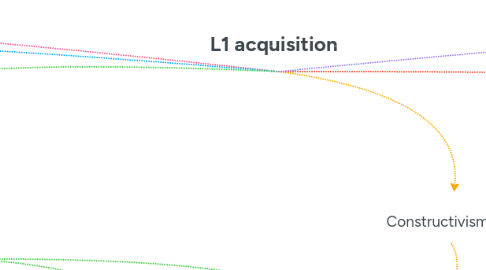
1. Structuralism
2. Behaviourism
3. Innatism
4. Constructivism
5. Emergentism/Connectionism
6. Saussure
7. B.F Skinner
8. Noam Chomsky
9. Jean Piaget
10. Jeffrey Elman
11. Cognitive stages
12. Sensorimotor
13. Pre-operational
14. Concrete operational
15. Formal operational
16. Stimulus-response
17. Classical conditioning
18. Operant conditioning
19. Positive reinforcement
20. Negative reinforcement
21. Positive punishment
22. Negative punishment
23. Punishment
24. Reinforcement
25. System of signs
26. Signifier
27. Signified
28. Social constructivism
29. Vygotsky
30. LAD
31. UG
32. Object permanence
33. Synchrony
34. Diachrony
35. Deductive reasoning
36. Imagination
37. Children
38. Sign
39. Structure
40. Sounds
41. Words
42. Phrases
43. Social development
44. Observable behavior
45. Neural interconnections
46. Social network
47. Input frequency
48. Cognitive mechanisms
49. Pattern recognition
50. Complex networks
51. Social & Interactionist Perspectives
52. Interaction
53. Principles
54. Parameters
55. Cognitive constraints
56. Critical Period Hypothesis
57. Cognitive Science
58. Competence vs Performance
59. Competence
60. Performance
61. Innate structures
62. Input
63. Dichotomies
64. Langue vs Parole
65. Langue
66. Parole
67. Synchrony vs Diachrony
68. Relations between elements
69. Syntagmatic relation
70. Paradigmatic relation
71. Impact on modern linguistics
72. Key principles
73. Types of conditioning
74. Pavlov
75. Imitation
76. Abstract theorizing
77. Arbitrariness
78. Mediation
79. Internalization
80. Cognitive development
81. Speech
82. Interaction & environment
83. ZPD
84. Social interaction
85. Process vs product
86. Input
87. Children
88. LAD
89. Input processing
90. Perception
91. Ongoing exposure
92. Statistical frequencies
93. Key concepts
94. Input and Frequency
95. Key concepts
96. Thought
97. Key processes
98. Memorization


