


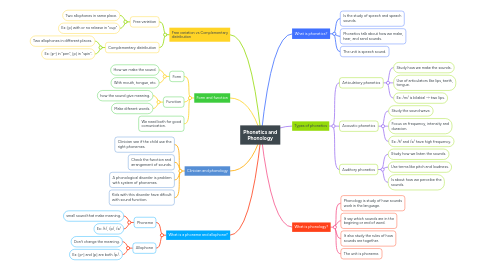
1. Free variation vs Complementary distribution
1.1. Free variation
1.1.1. Two allophones in same place.
1.1.2. Ex: [p] with or no release in "cup"
1.2. Complementary distribution
1.2.1. Two allophones in different places.
1.2.2. Ex: [pʰ] in "pen", [p] in "spin".
2. Form and function
2.1. Form
2.1.1. How we make the sound.
2.1.2. With mouth, tongue, etc.
2.2. Function
2.2.1. how the sound give meaning.
2.2.2. Make diferent words.
2.3. We need both for good comunication.
3. Clinician and phonology
3.1. Clinician see if the child use the right phonemes.
3.2. Check the function and arrangement of sounds.
3.3. A phonological disorder is problem with system of phonemes.
3.4. Kids with this disorder have dificult with sound function.
4. What is a phoneme and allophone?
4.1. Phoneme
4.1.1. small sound that make meaning.
4.1.2. Ex: /t/, /p/, /s/
4.2. Allophone
4.2.1. Don’t change the meaning.
4.2.2. Ex: [pʰ] and [p] are both /p/.
5. What is phonetics?
5.1. Is the study of speech and speach sounds.
5.2. Phonetics talk about how we make, hear, and send sounds.
5.3. The unit is speech sound.
6. Types of phonetics
6.1. Articulatory phonetics
6.1.1. Study how we make the sounds.
6.1.2. Use of articulators like lips, teeth, tongue.
6.1.3. Ex: /m/ is bilabial → two lips.
6.2. Acoustic phonetics
6.2.1. Study the sound wave.
6.2.2. Focus on frequency, intensity and duracion.
6.2.3. Ex: /f/ and /s/ have high frequency.
6.3. Auditory phonetics
6.3.1. Study how we listen the sounds.
6.3.2. Use terms like pitch and loudness.
6.3.3. Is about how we perceibe the sounds.