
What is Containerization?

An explanation of what is containerization for the assignments.

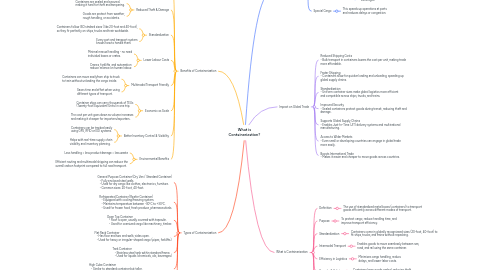
1. Benefits of Containerization
1.1. Faster Handling & Reduced Transit Time
1.1.1. Containers are loaded/unloaded quickly using cranes and other automated equipment.
1.1.2. This speeds up operations at ports and reduces delays or congestion.
1.2. Reduced Theft & Damage
1.2.1. Containers are sealed and secured. making it hard for theft and tampering.
1.2.2. Goods are protect from weather, rough handling, or accidents.
1.3. Standardization
1.3.1. Containers follow ISO stndard sizes ( like 20-foot and 40-foot), so they fir perfectly on ships, trucks and train worldwide.
1.3.2. Every port and transport system knows how to handle them.
1.4. Lower Labour Costs
1.4.1. Minimal manual handling - no need individual boxes or crates.
1.4.2. Cranes, forklifts, and automation reduce reliance on human labour.
1.5. Multimodal Transport Friendly
1.5.1. Containers can move easilyfrom ship to truck to train without unloading the cargo inside.
1.5.2. Saves time and effort when using different types of transport.
1.6. Economic os Scale
1.6.1. Container ships can carry thousands of TEUs (Twenty-foot Equivalent Units) in one trip.
1.6.2. The cost per unit goes down as volume increases and making it cheaper for importers/exporters.
1.7. Better Inventory Control & Visibility
1.7.1. Containers can be tracked easily using GPS, RFID or EDI systems.
1.7.2. Helps with real-time supply chain visibility and inventory planning.
1.8. Environmental Benefits
1.8.1. Less handling = less product damage = less waste
1.8.2. Efficient routing and multimodal shipping can reduce the overall carbon footprint compared to full road transport.
2. Goods Transported via Containerization
2.1. Dry Cargo
2.1.1. Electronics, textiles, furniture, and packaged food.
2.2. Refrigated Cargo (reefer containers)
2.2.1. Fruits, vegetables, dairy, meat, and seafood.
2.3. Liquid Bulk (tank containers)
2.3.1. Cooking oil, chemicals, and beverages.
2.4. Special Cargo
2.4.1. This speeds up operations at ports and reduces delays or congestion.
3. Types of Containerization
3.1. General Purpose Container (Dry Van / Standard Container) - Fully enclosed steel walls. - Used for dry cargo like clothes, electronics, furniture. - Common sizes: 20-foot, 40-foot.
3.2. Refrigerated Container (Reefer Container) - Equipped with cooling/freezing system. - Maintains temperature between -30°C to +30°C. - Used for frozen food, fresh produce, pharmaceuticals.
3.3. Open Top Container - Roof is open, usually covered with tarpaulin. - Used for oversized cargo like machinery, timber.
3.4. Flat Rack Container - Has floor and two end walls; sides open. - Used for heavy or irregular-shaped cargo (pipes, forklifts).
3.5. Tank Container - Stainless steel tank within standard frame. - Used for liquids (chemicals, oils, beverages)
3.6. High Cube Container - Similar to standard container but taller. - Used for large volume but lightweight cargo (cotton, plastics).
3.7. Ventilated Container - Has vent ilation openings for air circulation. - Used for agricultural products like coffee, cocoa.
4. Impact on Global Trade
4.1. Reduced Shipping Costs - Bulk transport in containers lowers the cost per unit, making trade more affordable.
4.2. Faster Shipping - Containers allow for quicker loading and unloading, speeding up global supply chains.
4.3. Standardization - Uniform container sizes make global logistics more efficient and compatible across ships, trucks, and trains.
4.4. Improved Security - Sealed containers protect goods during transit, reducing theft and damage.
4.5. Supports Global Supply Chains - Enables Just-In-Time (JIT) delivery systems and multinational manufacturing.
4.6. Access to Wider Markets - Even small or developing countries can engage in global trade more easily.
4.7. Boosts International Trade - Makes it easier and cheaper to move goods across countries.
5. What is Containerization
5.1. Definition
5.1.1. The use of standardized metal boxes (containers) to transport goods efficiently across different modes of transport.
5.2. Purpose
5.2.1. To protect cargo, reduce handling time, and improve transport efficiency.
5.3. Standardization
5.3.1. Containers come in globally recognizeed sizes (20-foot, 40-foot) to fit ships, trucks, and trains without repacking.
5.4. Intermodal Transport
5.4.1. Enables goods to move seamlessly between sea, road, and rail using the same container.
5.5. Efficiency in Logistics
5.5.1. Minimizes cargo handling, reducs delays, and lowerr labor costs.
5.6. Security & Safety
5.6.1. Containers keep goods sealed, reducing theft and damge during transit.
5.7. Global Trade Backbone
5.7.1. Plays a vital role in international supply chains and trade growth.
5.8. Historical Context
5.8.1. Popularized in the 1950s by Malcolm McLean, revultionizing global shipping.