

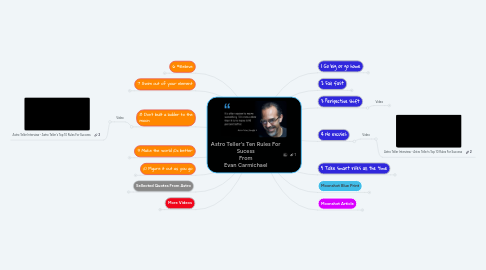
1. 6 #Believe
1.1. Video
1.1.1. Astro Teller Interview - Astro Teller's Top 10 Rules For Success
2. 7 Swim out of your element
2.1. Video
2.1.1. Astro Teller Interview - Astro Teller's Top 10 Rules For Success
3. 8 Don't built a ladder to the moon
3.1. Video
3.1.1. Astro Teller Interview - Astro Teller's Top 10 Rules For Success
4. 9 Make the world 10x better
4.1. Video
4.1.1. Astro Teller Interview - Astro Teller's Top 10 Rules For Success
5. 10 Figure it out as you go
5.1. Video
5.1.1. Astro Teller Interview - Astro Teller's Top 10 Rules For Success
6. Sellected Quotes From Astro
6.1. It is the essence of innovation to fail most of the time.
6.2. Failing doesn't have to mean not succeeding. It can be, 'Hey we tried that. We can go forward, smarter.'
6.3. If you're shooting to make the world 10% better, you're in a smartness contest with everyone else in the world - and you're going to lose. There are too many smart people in the world.
6.4. Here is the surprising truth: It's often easier to make something 10 times better than it is to make it 10 percent better.
6.5. Use creativity and storytelling as your main muscle instead of smartness.
7. More Videos
7.1. The unexpected benefit of celebrating failure | Astro Teller
7.1.1. The unexpected benefit of celebrating failure | Astro Teller
7.2. A Fireside Chat with X’s Captain of Moonshots, Astro Teller (Google I/O'19)
7.2.1. A Fireside Chat with X’s Captain of Moonshots, Astro Teller (Google I/O'19)
7.3. Moonshot Thinking from Astro Teller
7.3.1. Moonshot Thinking from Astro Teller
7.4. Google X’s Astro Teller on the future of delivery drones
7.4.1. Google X’s Astro Teller on the future of delivery drones
7.5. 10 Things You Can Count On Being True In the Future | Astro Teller | TEDxLosAltosHigh
7.5.1. 10 Things You Can Count On Being True In the Future | Astro Teller | TEDxLosAltosHigh
7.6. Failure, innovation, and engineering culture | Astro Teller, X
7.6.1. Failure, innovation, and engineering culture | Astro Teller, X
7.7. Alphabet X's Astro Teller on 'Bloomberg Studio 1.0'
7.8. Alphabet X's Astro Teller on 'Bloomberg Studio 1.0'
7.8.1. Alphabet X's Astro Teller on 'Bloomberg Studio 1.0'
7.9. Astro Teller | Class of 2020 Commencement Speech
7.9.1. Astro Teller | Class of 2020 Commencement Speech
7.10. Astro Teller on how AI can solve global challenges | MIT EmTech 2018
7.10.1. Astro Teller on how AI can solve global challenges | MIT EmTech 2018
7.11. Astro Teller, Google Director of New Projects, on Innovation | Singularity University
7.11.1. Astro Teller, Google Director of New Projects, on Innovation | Singularity University
7.12. Astro Teller: Celebrating Failure Fuels Moonshots [Entire Talk]
7.12.1. Astro Teller: Celebrating Failure Fuels Moonshots [Entire Talk]
7.13. Astro Teller talks playing the 'moonshot game'
7.13.1. Astro Teller talks playing the 'moonshot game'
8. 1 Go big or go home
8.1. Video
8.1.1. Astro Teller Interview - Astro Teller's Top 10 Rules For Success
9. 2 Fail fast
9.1. Video
9.1.1. Astro Teller Interview - Astro Teller's Top 10 Rules For Success
10. 3 Perspective shift
10.1. Video
10.1.1. Astro Teller Interview - Astro Teller's Top 10 Rules For Success
11. 4 No excuses
11.1. Video
11.1.1. Astro Teller Interview - Astro Teller's Top 10 Rules For Success
12. 5 Take smart risks all the time
12.1. Video
12.1.1. Astro Teller Interview - Astro Teller's Top 10 Rules For Success
13. Moonshot Blue Print
13.1. MSBP
14. Moonshot Article
14.1. What is moonshot thinking? It’s all about 10X!
14.1.1. The context matters so much the expectations matter so much the people matter the resources matter but that’s not the biggest issue there have been these times in the world and sadly they’ve been mostly military in nature where you get a huge number of really smart people together you know not 5 or 10 but a hundred or more and you give them the resources but much more importantly the expectation that they will produce miracles.
14.2. Create exigency
14.2.1. One of the things for which humans are wired is survival. The issue is that most cultures and corporate cultures create a feeling of normality, which makes us feel safe. That feeling kills the moonshot thinking. Moonshot thinking starts from a life philosophy of treating each day like it is the last and most important for survival. This is not different from Jeff Bezos’ Day One.
14.2.2. Momento Mori
14.3. Context is king for the moonshot thinking
14.3.1. Making the context that’s the hard part perspective shift is what it’s all about that’s why going ten times bigger is more important and works better than going 10 percent bigger when you shoot for 10 percent better you’re in a smartness contest you’re putting all of your people in a smartness contest with everyone else in the world they’re not gonna win it doesn’t matter how much money you give them but if you push them if you give them the expectation and the freedom to be weird that’s moonshot thinking then they can do the perspective shifts and not only if you shoot for ten times bigger instead of 10% bigger it’s almost never a hundred times harder and the payoff is a hundred times so you already know that you’ve got a better return on your investment but sometimes it’s literally easier and the reason is because that perspective shift is actually cheap relative to being smarter than everyone around you.
14.3.2. Astro Teller also pointed out the importance of creating a context where moonshot thinking becomes the rule. That is according to him the most challenging part. Once you have the context, you’re ready for the rest!
14.4. Give up on incremental changes
14.4.1. An incremental change is as hard if not harder than a massive change. Why? You compete against others to find a solution to a similar problem. What if you switch the perspective and ask a different kind of question. For instance, when it comes to growth, it is a usual pattern to see business owners think in terms of “how do I grow my business 30% this year?”
14.4.2. With that thinking, you’ll look for conventional solutions, in many cases prepackaged by others. You’ll look at old formulas to new problems and stick with it until you end up with a failed enterprise. Instead, if you start asking, “how do I grow my business 10X?” that changes everything!
14.4.3. All of a sudden, you need to look for a new solution; you need to get creative, and obsessed about the original question you have in your mind. There won’t be anyone out there able to give you the answer, but you only. That’s when you start embracing a 10X attitude!
14.5. Embrace the 10X attitude
14.5.1. As Peter Thiel pointed out in his book, Zero to One, you win when you create a monopoly. When Google took over the search market, it was a latecomer, yet it had a 10X attitude, it wanted to dominate the information market. When Facebook took over the social media industry, it was a latecomer too. Yet, Mark Zuckerberg was thinking in terms of world domination!
14.5.2. The 10X attitude requires an audacious vision, yet also a creative way to think about the problem, and it starts from first principles.
14.6. It all starts by reasoning from first principles
14.6.1. In every systematic inquiry (methodos) where there are first principles, or causes, or elements, knowledge and science result from acquiring knowledge of these; for we think we know something just in case we acquire knowledge of the primary causes
14.6.2. As pointed out on Wikipedia, reasoning from first principles means digging into primary causes.
14.6.3. A good part of the modern world has been built on assumptions that primarily took place anywhere between the 1800s and the beginning of the 1900s. Many of those assumptions, if further questioned, can turn into first principles — a set of assumptions that can’t be further examined. Where in the scientific world, going to first principles means getting closer to nature. In the business world, that might mean to ask the right question rather than to stick to a question that anyone else is asking.
14.7. Target the impossible but make it actionable
14.7.1. In most cases, a failure in achieving results is not due to setting up a too ambitious goal. Quite the opposite, as Grant Gardone points out in the 10X Rule in many cases, failure is due to an objective which was not ambitious. Not only that, it was not actionable enough. Indeed, to start making the impossible happen, you need to have a clear direction and be able to take massive actions!
14.8. Fail most of the time
14.8.1. There’s no playbook for taking moonshots — and we like it that way. Building things that are on the edge of the impossible means we have to embrace ambiguity and be prepared to tinker, experiment, and learn our way into the future. Responsibly irresponsible, we live in the sweet spot between audacity and humility, idealistic and pragmatic. Passionately dispassionate, we ask hard questions, seek out diverse perspectives, and find inspiration in weird and unexpected places.
14.8.2. As pointed out on Google X, there is no playbook for moonshot thinking. Yet it starts from embracing ambiguity and finding the sweet spot between audacity and humility, between being idealistic and pragmatic. On the edge of a continuous flow where bold solutions come out regularly.
14.9. Do the hardest thing first
14.9.1. There’s no playbook for taking moonshots — and we like it that way. Building things that are on the edge of the impossible means we have to embrace ambiguity and be prepared to tinker, experiment, and learn our way into the future. Responsibly irresponsible, we live in the sweet spot between audacity and humility, idealistic and pragmatic. Passionately dispassionate, we ask hard questions, seek out diverse perspectives, and find inspiration in weird and unexpected places.
14.9.2. As pointed out on Google X, there is no playbook for moonshot thinking. Yet it starts from embracing ambiguity and finding the sweet spot between audacity and humility, between being idealistic and pragmatic. On the edge of a continuous flow where bold solutions come out regularly.
14.10. Take massive actions
14.10.1. Once you’ve committed to the moonshot thinking, and you apply the 10X rule, it comes the time to take massive action. No longer you can afford to make the same level of efforts that average people take; you need to take a 100X.
14.10.2. You need to breathe the problem you want to solve; you need to identify with it. It is a sort of obsession that gets close to madness, yet only for those looking from the outside. For you, that mindset means taking a level of actions that just a few people in the world can.
14.11. Forget T-shaped; it’s all about X-shaped people
14.11.1. T-shaped people have now become an essential part of the business world. As the story goes, a T-shaped profile is a person that has a deep understanding and expertise in one or two areas and a broad knowledge of several other areas:
14.11.1.1. T-Shaped
14.11.2. The problem with a T-shaped profile is that it won’t get you to reach the ambitious vision you have. I consider myself a T-shaped profile, yet I’m aware of its limitations. In other words, as a T-shaped, I would not be able to have the ability to move a small team toward a 10X goal.
14.11.3. However, if you want to hit it big, you need to start adding authoritativeness and leadership as critical skills. That is when you make the jump from T-shaped to an X-shaped profile!
14.11.3.1. X shaped
14.11.4. The X-shaped is an evolution of the T-shaped. Where T-shaped understands that collaboration is a key for growth; The X-shaped profile understands that leadership and strategic thinking are a crucial ingredient to move a small or large group toward goals that require massive action.
14.11.5. Thus, the X-shaped is together a T-shaped profile and a recognized leader within the organization!
14.12. Why 10X thinking is cheaper than incremental thinking, in the long-run
14.12.1. Many believe that 10X thinking is expensive and requires a lot of resources. Instead, 10X thinking is just the opposite. It is about finding inexpensive, creative solutions to hard questions.
14.12.2. It also involves a lot of failure along the way, yet the world becomes your laboratory, and failure becomes just another step in the growth process! Thus, in the long run, 10X thinking isn’t only inexpensive but will have a massive ROI on your business.