

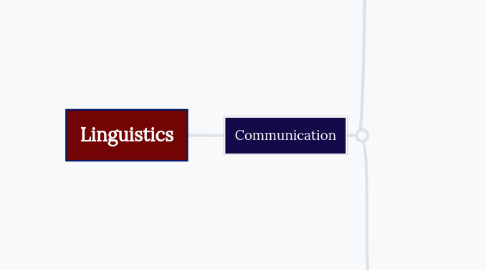
1. Communication
1.1. Verbal: Using lenguaje
1.1.1. Speech:Spoken sounds
1.1.2. Speaking: Act of producing speech
1.1.3. Writing: Symbols that represent speech
1.1.4. Signed Lenguage: Visual-Manual Language
1.2. Non-Verbal: Communication without words
1.2.1. Kinesics: Body movements/gestures
1.2.2. Proxemics: Use of space
1.2.3. Oculesics: Eye contact/gaze
1.3. Language (Type of Communication)
1.3.1. Rule-Governed System: Phonology, Morphology, Syntax, Semantic rules
1.3.2. Meaning: Message conveyed
1.3.3. Relation: Connection among elements
1.3.4. Constituency: Hierarchical word grouping
1.3.5. Characteristics of Language
1.3.5.1. Arbitrariness: No natural link form-meaning
1.3.5.2. Discreteness: Built from distinct units
1.3.5.3. Recursion: Embedding phrases
1.3.5.4. Duality: Sounds-> Meaningful Units
1.3.5.5. Variation: DIfferent ways to say the same
1.3.6. Layers of Language
1.3.6.1. Phonetics: Study of speech sounds
1.3.6.1.1. Sounds: Speech units
1.3.6.1.2. Phones: Concrete sounds units
1.3.6.1.3. Articulatory: How sounds are produced
1.3.6.1.4. Auditory: How sounds are perceived
1.3.6.1.5. Acoustics: Physical properties of sounds
1.3.6.1.6. Suprasegmental features: Features beyond single sounds
1.3.6.1.7. Stress: Emphasis on syllables
1.3.6.1.8. Intonation: Pitch movement
1.3.6.1.9. Syllables: Units of sound centered on vowels.
1.3.6.1.10. Tone: Pitch differences that change meaning
1.3.6.2. Phonology: Abstract sound system
1.3.6.2.1. Phonemes: Minimal meaning-distinguishing units
1.3.6.2.2. Accent: Pronunciation variety
1.3.6.3. Morphology: Study of word structure
1.3.6.3.1. Morphemes: Minimal meaning-bearing units
1.3.6.3.2. Content: Lexical meaning
1.3.6.3.3. Agglutination: Adding separate morphemes
1.3.6.3.4. Compounding: Joining whole words
1.3.6.3.5. Fusion: One form encodes multiple meanings
1.3.6.3.6. Incorporation: Verb absorbs object
1.3.6.3.7. Isolation: Few or no bound morphemes
1.3.6.3.8. Transfixation: Inserting vowels into root
1.3.6.4. Syntax: Rules for sentence structure
1.3.6.4.1. Description: Objective description of use
1.3.6.4.2. Prescription: Norms of "Correct" use
1.3.6.4.3. Agreement: Matching form(number/gender)
1.3.6.4.4. Government: Dependancy of forms
1.3.6.4.5. Speech: Spoken language system
1.3.6.4.6. Prepositions: Relations words (in, on)
1.3.6.4.7. Nouns: Names entities
1.3.6.4.8. Adjectives: Describe nouns
1.3.6.4.9. Adverbs: Modify verbs/adjectives
1.3.6.4.10. Verbs: Actions or states
1.3.6.4.11. Determiners: Specify nouns
1.3.6.4.12. Conjunctions: Connect words/clauses
1.3.6.4.13. Pronouns: Replace nouns
1.3.6.4.14. Structure: Sentence arrangement
1.3.6.4.15. Sentences: Complete thought
1.3.6.4.16. Predicate: Says something about subject
1.3.6.4.17. Argument: Required element of predicate
1.3.6.4.18. Adjunct: Optional modifier
1.3.6.4.19. Simple sentences: One clause
1.3.6.4.20. Complex sentences: Independent+Dependent clause
1.3.6.4.21. Compound sentences
1.3.6.5. Semantics: Study of meaning
1.3.6.5.1. Connotation: Associated meanings
1.3.6.5.2. Denotation: Literal meaning
1.3.6.5.3. Field: Words in same domain
1.3.6.5.4. Homonymy: Same form, different meanings
1.3.6.5.5. Synonymy: Different form, same meaning
1.3.6.5.6. Antonymy: Opposite meaning
1.3.6.5.7. Hyponymy: "X is a type of Y"
1.3.6.5.8. Polysemy: One word, related meanings
1.3.6.5.9. Ambiguity: Multiple interpretations
1.3.6.5.10. Reference: Using language to identify things
1.3.6.5.11. Perspective: View point shaping interpretation
1.3.6.5.12. Semantic shift: Meaning change over time
1.3.6.5.13. Idioms: Fixed expressions with special meaning
1.3.6.6. Pragmatics: Language use in context
1.3.6.6.1. Social context: Situational background
1.3.6.6.2. Functions: Purposes of language
1.3.6.6.3. Principles: Guidelines for cooperative use
1.3.6.6.4. Maxims: Conversational rules
1.3.6.6.5. Quantity: Say enough, not too much
1.3.6.6.6. Quality: Say what's true
1.3.6.6.7. Manner: Be clear and brief
1.3.6.6.8. Violating: Breaking a maxim secretly
1.3.6.6.9. Flouting: Breaking a maxim to imply
1.3.7. Linguistics (studies)
1.3.7.1. Psycholinguistics: How the brain processes and produces language
1.3.7.2. Sociolinguistics: How society and culture affect language use
1.3.7.3. Applied linguistics: Practical study of learning and teaching languages
1.3.7.4. Variation system: Patterns of languages differences across speakers/regions
1.3.8. Words: Smallest separable units