


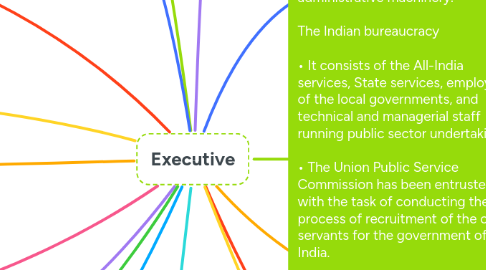
1. function of implementation and administrations called the executive.
1.1. Executive is the branch of government responsible for the implementation of laws and policies adopted by the legislature.
1.2. The executive is often involved in framing of policy.
1.3. Some countries have presidents, while others have chancellors.
1.4. The executive branch is not just about presidents, prime ministers and ministers.
1.4.1. While the heads of government (PM) and their ministers, saddled with the overall responsibility of government policy, are together known as the political executive, those responsible for day to day administration are called the permanent executive.
1.4.1.1. Political Executive
1.4.1.2. Permanant Executive
1.5. It also extends to the administrative machinery (civil servants).
2. Parliamentary Executive In India
2.1. India already had some experience of running the parliamentary system under the Acts of 1919 and 1935. The Government of India Act. This experience had shown that in the parliamentary system, the executive can be effectively controlled by the representatives of the people.
2.2. • Indian Constitution wanted to ensure that the government would be sensitive to public expectations and would be responsible and accountable. • The presidential executive puts much emphasis on the president as the chief executive and as source of all executive power. • There is always the danger of personality cult in presidential executive. • Executive will be answerable to and controlled by the legislature or people's representatives.
2.3. Why Parliamentary Form
3. President
3.1. Power & Position
3.1.1. Article 74 (1): There shall be a Council of Ministers with the Prime Minister at the head to aid and advise the President who shall in the exercise of his functions, act in accordance with such advice. • Provided that the President may require the Council of Ministers to reconsider such advice and the President shall act in accordance with the advice tendered after such reconsideration.
3.1.1.1. Article 74
3.1.1.2. COM with PM
3.1.1.3. Aid & advice President
3.1.1.4. Reconsider Advice
3.2. Discretionary Powers of the President
3.2.1. Three Situations where the President can exercise the power using his or her own discretion: • Can send back the advice given by the Council of Ministers and ask the Council to reconsider the decision. In doing this, the President acts on his (or her) own discretion. • Has veto power by which he can withhold or refuse to give assent to Bills (other than Money Bill) passed by the Parliament. Every bill passed by the Parliament goes to the President for his assent before it becomes a law. The President can send the bill back to the Parliament asking it to reconsider the bill. This veto' power is limited because, if the Parliament passes the same bill again and sends it back to the President, then, the President has to give assent to that bill. However, there is no mention in the Constitution about the time limit within which the President must send the bill back for reconsideration. This means that the President can just keep the bill pending with him without any time limit. This gives the President an informal power to use the veto in a very effective manner. This is sometimes referred to as pocket veto'. • When after an election, no leader has a clear majority in the Lok Sabha, the President has to decide whom to appoint as the Prime Minister. In such a situation, the President has to use his own discretion in judging who really may have the support of the majority or who can actually form and run the government.
3.2.1.1. Reconsideration of decision
3.2.1.2. Veto power- Withhold or refuse to give assent.
3.2.1.3. Pocket veto
3.3. Constitutionally, the President has a right to be informed of all important matters and deliberations of the Council of Ministers.
3.3.1. The President often writes to the Prime Minister and expresses his views on matters confronting the country.
3.3.1.1. The Prime Minister is obliged to furnish all the information that the President may call for.
4. President who is the formal Head of the state of India and the Prime Minister and the Council of Ministers, which run the government at the national level. • At the State level, the executive comprises the Governor and the Chief Minister and Council of Ministers.
5. organ of government
6. Different Types of Executive?
6.1. Presidential system
6.1.1. The president is the Head of state as well as head of government. • In this system the office of president is very powerful, both in theory and practice. • Countries with such a system include the United States, Brazil and most nations in Latin America.
6.2. Semi-Presidential Executive
6.2.1. Under the system of Executive Presidency, people directly elect the President. • It may happen that both the President and the Prime Minister belong to the same political party or to different political parties. • Countries with such a system include the France, Russia, Sri Lanka.
6.3. Parliamentary System
6.3.1. • The prime minister is the head of government. (Real Head of the state) • Most parliamentary systems have a president or a monarch who is the (nominal Head of state). • In such a system, the role of president or monarch is primarily ceremonial and prime minister along with the cabinet wields effective power. • Countries with such system include Germany, Italy, Japan, United Kingdom as well as Portugal.
6.3.1.1. INDIA
7. Vice President of India
7.1. Elected for five years. Election method is similar to that of the President; the only difference is that members of State legislatures are not part of the Electoral College.
7.1.1. President - Electoral College
7.2. May be removed from his office by a resolution of the Rajya Sabha passed by a majority and agreed to by the Lok Sabha.
7.3. Acts as the ex-officio Chairman of the Rajya Sabha and takes over the office of the President when there is a vacancy by reasons of death, resignation, removal by impeachment or otherwise
7.4. Acts as the President only until a new President is elected
8. CONSTITUTION
8.1. Why we need constitution ?
8.1.1. Functions
8.1.1.1. Provide Basic rules
8.1.1.2. Specify authority in power
8.1.1.3. Set limits on authority
8.1.1.4. Fulfill aspirations of society
8.1.1.5. Define our fundamental identity
8.1.2. Implementation
8.1.2.1. Getting authority of people
8.1.2.2. Provision accepted by all
8.1.2.3. Preserving freedom and equality
8.1.2.4. Distribution of power
8.1.2.5. Keeping balance between rigid & flexible
8.1.3. CONSTITUENT ASSEMBLY
8.1.3.1. FORMATION
8.1.3.2. FUNCTION
8.1.3.3. PROCEDURE
9. Prime Minister and Council of Ministers
9.1. • In the same manner, Chief Ministers of the States choose ministers from their own party or coalition. • If someone becomes a minister or Prime Minister without being an MP, such a person has to get elected to the Parliament within six months.
9.1.1. The Prime Minister becomes the most important functionary of the government in our country. • Head of the Council of Ministers.
9.1.1.1. The President exercises his powers only on the advice of the Council of Ministers. **Decides who will be the ministers in the Council of Ministers.
9.1.1.1.1. Depending upon the seniority and political importance, the ministers are given the ranks of cabinet minister, minister of State or deputy minister
9.1.2. Allocates ranks and portfolios to the ministers.
10. The Prime Minister and all the ministers have to be members of the Parliament.
11. Size of the Council of Ministers
11.1. • The principle indicates that the ministry is an executive committee of the Parliament and it collectively governs on behalf of the Parliament.
11.2. • Collectively responsible to the Lok Sabha. This provision means that a Ministry which loses confidence of the Lok Sabha is obliged to resign.
11.3. An amendment was made that the Council of Ministers shall not exceed 15 percent of total number of members of the House of People (or Assembly, in the case of the States).
12. Permanent Executive
12.1. Bureaucracy
12.1.1. • The Executive organ of the government includes the Prime Minister, the ministers and a large organization called the bureaucracy or the administrative machinery.